


Page 433 - Hall et al (2015) Principles of Critical Care-McGraw-Hill
P. 433
CHAPTER 37: Myocardial Ischemia  303


                                                                    STEMI              Evidence of cardiogenic
                                                                                    shock or conduction disturbance


                                                               Aspirin 325 mg chewed,
                                             O , NTG
                                              2
                                                                UFH or enoxaparin
                                          MSO  IV for pain   LD of clopidogrel or prasugrel   No
                                             4
                                                          Determine strategy for reperfusion in   -blocker
                                                               shortest time possible


                                                           Suspect mechanical complication
                                              No                                              Yes
                                                           (ie, papillary muscle rupture, VSD)
                                          Cardiogenic shock, symptom onset > 3 h  Diagnostic cardiac cath and
                                           contraindication to fibrinolytics, failed
                                         fibrinolytics, or door to balloon time < 90 min  emergent operative repair as indicated


                                         Yes           No                   Fibrinolytic therapy   No

                                            Cardiac cath and          C P  free, ST segment   by 50%,
                                         PCI as clinically indicated  hemodynamically/electrically stable  Cardiac cath

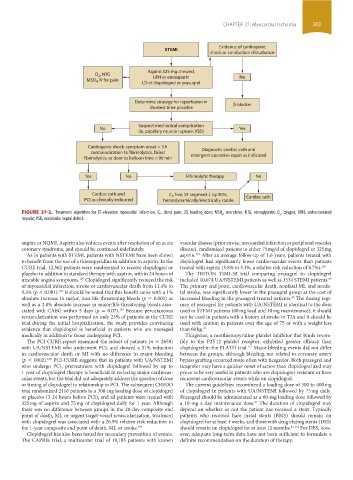
                    FIGURE 37-2.  Treatment algorithm  for ST-elevation myocardial infarction. C P, chest pain; LD, loading dose; MSO , morphine; NTG, nitroglycerin; O , oxygen; UFH, unfractionated
                                                                                        4
                                                                                                           2
                    heparin; VSD, ventricular septal defect.


                    angina or NQMI. Aspirin also reduces events after resolution of an acute   vascular disease (prior stroke, myocardial infarction or peripheral vascular
                    coronary syndrome, and should be continued indefinitely.  disease), randomized patients to either 75 mg/d of clopidogrel or 325 mg
                     As in patients with STEMI, patients with NSTEMI have been shown   aspirin.  After an average follow-up of 1.6 years, patients treated with
                                                                               110
                    to benefit from the use of a thienopyridine in addition to aspirin. In the   clopidogrel had significantly fewer cardiovascular events than patients
                    CURE trial, 12,562 patients were randomized to receive clopidogrel or   treated with aspirin (5.8% vs 5.3%, a relative risk reduction of 8.7%). 110
                    placebo in addition to standard therapy with aspirin, within 24 hours of   The  TRITON  TIMI-38  trial  comparing  prasugrel  to  clopidogrel
                    unstable angina symptoms.  Clopidogrel significantly reduced the risk   included 10,074 UA/NSTEMI patients as well as 3534 STEMI patients.
                                       107
                                                                                                                            69
                    of myocardial infarction, stroke or cardiovascular death from 11.4% to   The primary end point, cardiovascular death, nonfatal MI, and nonfa-
                    9.3% (p < 0.001).  It should be noted that this benefit came with a 1%   tal stroke, was significantly lower in the prasugrel group at the cost of
                                107
                    absolute increase in major, non-life-threatening bleeds (p = 0.001) as   increased bleeding in the prasugrel-treated patients.  The dosing regi-
                                                                                                                69
                    well as a 2.8% absolute increase in major/life-threatening bleeds asso-  men of prasugrel for patients with UA/NSTEMI is identical to the dose
                    ciated with CABG within 5 days (p = 0.07).  Because percutaneous   used in STEMI patients (60 mg load and 10 mg maintenance); it should
                                                     107
                    revascularization was performed on only 23% of patients in the CURE   not be used in patients with a history of stroke or TIA and it should be
                    trial during the initial hospitalization, the study provides convincing   used with caution in patients over the age of 75 or with a weight less
                    evidence that clopidogrel is beneficial in patients who are managed   than 60 kg. 41
                    medically in addition to those undergoing PCI.         Ticagrelor, a nonthienopyridine platelet inhibitor that binds revers-
                     The PCI-CURE report examined the subset of patients (n = 2658)   ibly to the P2Y12 platelet receptor, exhibited greater efficacy than
                    with UA/NSTEMI who underwent PCI, and showed a 31% reduction   clopidogrel in the PLATO trial.  Major bleeding events did not differ
                                                                                                 111
                    in cardiovascular death or MI with no difference in major bleeding     between the groups, although bleeding not related to coronary-artery
                    (p < 0002).  PCI-CURE suggests that in patients with UA/NSTEMI   bypass grafting occurred more often with ticagrelor. Both prasugrel and
                            108
                    who undergo PCI, pretreatment with clopidogrel followed by up to     ticagrelor may have a quicker onset of action than clopidogrel and may
                    1 year of clopidogrel therapy is beneficial in reducing major cardiovas-  prove to be very useful in patients who are clopidogrel-resistant or have
                    cular events, but the trial did not adequately address the question of dose   recurrent cardiovascular events while on clopidogrel.
                    or timing of clopidogrel in relationship to PCI. The subsequent CREDO   The current guidelines recommend a loading dose of 300 to 600 mg
                    trial randomized 2116 patients to a 300-mg loading dose of clopidogrel   of clopidogrel in patients with UA/NSTEMI followed by 75 mg daily.
                    or placebo (3-24 hours before PCI), and all patients were treated with   Prasugrel should be administered as a 60-mg loading dose followed by
                    325 mg of aspirin and 75 mg of clopidogrel daily for 1 year. Although   a 10-mg a day maintenance dose.  The duration of clopidogrel may
                                                                                                   41
                    there was no difference between groups in the 28-day composite end   depend on whether or not the patient has received a stent. Typically
                    point of death, MI, or urgent target-vessel revascularization, treatment   patients who received bare metal stents (BMS) should remain on
                    with clopidogrel was associated with a 26.9% relative risk reduction in   clopidogrel for at least 4 weeks, and those with drug eluting stents (DES)
                    the 1-year composite end point of death, MI, or stroke. 109  should remain on clopidogrel for at least 12 months. 41,112  For DES, how-
                     Clopidogrel has also been tested for secondary prevention of events.   ever, adequate long-term data have not been sufficient to formulate a
                    The CAPRIE trial, a multicenter trial of 19,185 patients with known    definite recommendation on the duration of therapy.


            section03.indd   303                                                                                       1/23/2015   2:07:21 PM

