


Page 424 - Hall et al (2015) Principles of Critical Care-McGraw-Hill
P. 424
294     PART 3: Cardiovascular Disorders


                   Classically, myocardial ischemia has been divided into categories   of oxygen supply, particularly in the setting of hemodynamic instability.
                 including stable angina, unstable angina, and myocardial infarction.   These factors include hypotension, decreasing coronary perfusion pres-
                 Typical angina is exertional, and is relieved promptly by rest or nitro-  sure, and tachycardia, limiting diastolic filling time. In addition, anemia
                 glycerin. Stable angina occurs reproducibly with a similar level of   and hypoxemia can limit the amount of oxygen delivered to the heart.
                 exertion, in a pattern that has not changed over the past 6 months.   Coronary vasospasm may also play a role in some patients. Elevation of
                 Acute coronary syndromes comprise unstable angina and myocardial   left ventricular pressures by heart failure can both increase demand and
                 infarction. Unstable angina consists of ischemic symptoms which are   reduce coronary perfusion pressure.
                 more frequent, severe, or prolonged than the patient’s usual angina,    Thus, critically ill patients, usually those with at least some component
                 are more difficult to control with drugs, or are occurring at rest or with   of obstructive coronary artery disease, may develop myocardial isch-
                 minimal  exertion.  Cardiac  biomarkers  are  not  elevated.  Myocardial   emia on a hemodynamic basis, with variable contributions of increased
                 infarction has been classified as “transmural” and “nontransmural,” but   demand and decreased supply. On the other hand, catecholamine surges,
                 this division has been largely abandoned due to the recognition that   hemodynamic changes, and inflammatory processes may predispose to
                 electrocardiographic criteria are neither sensitive nor specific to make   rupture of preexisting atherosclerotic plaques. Making the distinction is
                 this distinction.                                     vital because the treatment is completely different. In the former case,
                   Acute coronary syndromes were previously classified into Q-wave   treatment is aimed at decreasing the oxygen requirement of the myo-
                 myocardial infarction, non-Q-wave myocardial infarction, and unstable   cardium by eliminating provocative stimuli and controlling heart rate
                 angina. More recently, classification has shifted and has become based   and blood pressure, and on optimizing oxygenation and hemoglobin
                 on the initial electrocardiogram: patients are divided into three groups:   concentration. Relief of myocardial ischemia by these measures usually
                 those with ST elevation (STEMI), without ST elevation but with enzyme   results in prompt restoration of left ventricular function without sig-
                 evidence of myocardial damage (non-ST elevation MI, or non-ST eleva-  nificant cellular damage, since the obstruction to flow is ordinarily fixed
                 tion myocardial infarction [NSTEMI]), and those with unstable angina.   and not total. If plaque rupture is playing a role, then simply removing
                 Classification according to presenting electrocardiogram coincides with   or lessening stimuli that increase myocardial oxygen requirements may
                 current treatment strategies, since patients presenting with ST eleva-  not be sufficient to increase the myocardial oxygen supply:demand ratio,
                 tion benefit from immediate reperfusion and should be treated with   and unless attempts are made to reestablish coronary blood flow, signifi-
                 fibrinolytic therapy or urgent revascularization, whereas fibrinolytic   cant myocardial damage may ensue. Antithrombotic and anticoagulant
                 agents are not effective in other patients with acute coronary syndromes.    strategies should be instituted, and consideration of coronary revascu-
                 The discussion of myocardial infarction in this chapter follows this   larization may be indicated.
                 schematization.
                     ■  PATHOPHYSIOLOGY                                RECOGNITION OF MYOCARDIAL ISCHEMIA
                 and demand. The myocardial requirement for oxygen, and hence for   ■  SIGNS AND SYMPTOMS
                 Myocardial ischemia results from an imbalance between oxygen supply

                 oxygenated blood, is affected by three major variables: heart rate, myo-  Myocardial ischemia is most commonly manifested as constant sub-
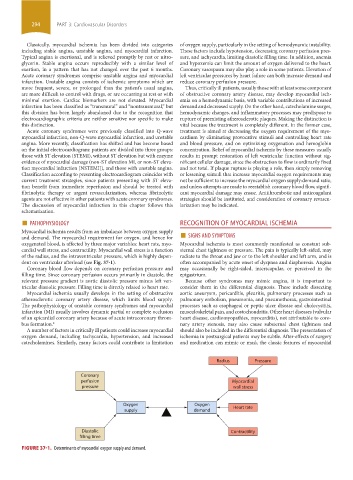
                 cardial wall stress, and contractility. Myocardial wall stress is a function   sternal chest tightness or pressure. The pain is typically left-sided, may
                 of the radius, and the intraventricular pressure, which is highly depen-  radiate to the throat and jaw or to the left shoulder and left arm, and is
                 dent on ventricular afterload (see Fig. 37-1).        often accompanied by acute onset of dyspnea and diaphoresis. Angina
                   Coronary blood flow depends on coronary perfusion pressure and   may occasionally be right-sided, interscapular, or perceived in the
                 filling time. Since coronary perfusion occurs primarily in diastole, the     epigastrium.
                 relevant pressure gradient is aortic diastolic pressure minus left ven-  Because other syndromes may mimic angina, it is important to
                 tricular diastolic pressure. Filling time is directly related to heart rate.  consider them in the differential diagnosis. These include dissecting
                   Myocardial ischemia usually develops in the setting of obstructive   aortic  aneurysm,  pericarditis,  pleuritis,  pulmonary  processes  such  as
                 atherosclerotic coronary artery disease, which limits blood supply.   pulmonary embolism, pneumonia, and pneumothorax, gastrointestinal
                 The pathophysiology of unstable coronary syndromes and myocardial   processes such as esophageal or peptic ulcer disease and cholecystitis,
                 infarction (MI) usually involves dynamic partial or complete occlusion   musculoskeletal pain, and costochondritis. Other heart diseases (valvular
                 of an epicardial coronary artery because of acute intracoronary throm-  heart disease, cardiomyopathies, myocarditis), not attributable to coro-
                 bus formation. 2                                      nary artery stenosis, may also cause substernal chest tightness and
                   A number of factors in critically ill patients could increase myocardial   should also be included in the differential diagnosis. The presentation of
                 oxygen demand, including tachycardia, hypertension, and increased   ischemia in postsurgical patients may be subtle. After-effects of surgery
                 catecholamines. Similarly, many factors could contribute to limitation   and medication can mimic or mask the classic features of myocardial


                                                                                    Radius       Pressure

                                     Coronary
                                     perfusion                                           Myocardial
                                      pressure                                           wall stress


                                                    Oxygen                  Oxygen       Heart rate
                                                    supply                  demand


                                      Diastolic                                          Contractility
                                     filling time
                 FIGURE 37-1.  Determinants of myocardial oxygen supply and demand.


            section03.indd   294                                                                                       1/23/2015   2:07:18 PM

