


Page 431 - Hall et al (2015) Principles of Critical Care-McGraw-Hill
P. 431
CHAPTER 37: Myocardial Ischemia  301


                    Anticoagulants:  Administration of full-dose heparin after thrombolytic     TABLE 37-4     Doses for Antiplatelet/Anticoagulant Therapy in Acute
                    therapy with t-PA is essential to diminish reocclusion after successful   Coronary Syndromes
                    reperfusion. 43,59  Dosing should be adjusted to weight, with a bolus of
                    60 U/kg up to a maximum of 4000 U and an initial infusion rate of   Drug  Initial Medical Treatment
                    12 U/kg/h  up  to  a  maximum  of  1000 U/h,  with  adjustment  to  keep   Antiplatelet Drugs
                    the partial thromboplastin time (PTT) between 50 and 70 seconds.
                                                                      79
                    Heparin should be continued for 24 to 48 hours. For patients undergo-    1.  Aspirin  162-325 mg nonenteric formulation, orally or chewed
                    ing PCI who have already been treated with aspirin and a thienopyri-    2.  Clopidogrel  LD of 300-600 mg orally, MD of 75 mg orally per day
                    dine, both unfractionated heparin or bivalirudin (with or without prior     3.  Prasugrel  LD of 60 mg orally, MD of 10 mg orally per day
                    heparin administration) are acceptable anticoagulant regimens. 41    4.  Ticlopidine  LD of 500 mg orally, MD of 250 mg orally twice daily
                     Bivalirudin is 20-amino acid peptide based on the structure of hiru-
                    din, a natural anticoagulant isolated from the saliva of the medicinal   Anticoagulants
                    leech, Hirudo medicinalis; bivalirudin is a direct thrombin inhibitor that     1.  Unfractionated heparin LD of 60 U/kg (max 4000 U) as IV bolus
                    inhibits both clot-bound and circulating thrombin. It is administered   MD of IV infusion of 12 U/kg/h (max 1000 U/h) to maintain
                    as an initial bolus of 0.75 mg/kg, followed by a continuous infusion at   aPTT at 1.5-2.0 times control (approximately 50-70 seconds)
                    1.75 mg/kg/h for the duration of PCI, with adjustments for patients
                    with renal dysfunction. Bivalirudin is at least as good as heparin plus     2.  Enoxaparin  LD of 30 mg IV bolus may be given. MD = 1 mg/kg SC every
                    a glycoprotein IIb/IIIa inhibitor in reducing ischemic events associ-  12 hours. extend dosing interval to 1 mg/kg every 24 hours
                    ated with unstable angina and/or non-ST elevation myocardial infarc-   if estimated Ccr <30 mL/min
                    tion with the added benefit of a reduction in bleeding.  The potential     3.  Fondaparinux  2.5 mg SC once daily. Avoid for Ccr <30 mL/min
                                                            80
                    role of bivalirudin in STEMI was clarified by HORIZONS-AMI trial,     4.  Eptifibatide  LD of IV bolus of 180 µg/kg. MD of IV infusion of 2.0 µg/kg/
                    which randomized 3602 patients with STEMI undergoing primary PCI       min; reduce infusion by 50% in patients with estimated
                    to unfractionated heparin plus a glycoprotein IIb/IIIa inhibitor or to   Ccr <50 mL/min
                    bivalirudin alone (with provisional glycoprotein IIb/IIIa in the cardiac
                                  81
                    catheterization lab).  Major adverse cardiac event (MACE) rates were     5.  Tirofiban  LD of IV infusion of 0.4 µg/g/min for 30 minutes
                    equivalent, but use of bivalirudin alone was associated with a 40% reduc-  MD of IV infusion of 0.1 µg/kg/min; reduce rate of infusion
                    tion in bleeding,  and there was a suggestion that all-cause mortality at   by 50% in patients with estimated Ccr <30 mL/min
                               81
                    one year might be reduced (3.4% vs 4.8%, p = 0.03).  Bivalirudin is also     6.  Bivalirudin  0.1 mg/kg bolus, 0.25 mg/kg/h infusion
                                                         82
                    an excellent alternative to unfractionated or low-molecular weight hepa-
                    rin in patients with a history of heparin induced thrombocytopenia.  Ccr, creatinine clearance; LD, loading dose; MD, maintenance dose.
                     Enoxaparin is a low molecular weight heparin with established effi-  Adapted with permission from Anderson JL, Adams CD, Antman EM, et al. ACC/AHA 2007 Guidelines for the
                    cacy as an anticoagulant in patients with STEMI who have received   Management of Patients With Unstable Angina/Non ST-Elevation Myocardial Infarction: A Report of the
                    fibrinolytics or are undergoing PCI. 83,84  The standard dose of enoxaparin   American College of Cardiology/American Heart Association Task Force on Practice Guidelines. J Am Coll Cardiol.
                    is a 30-mg intravenous bolus, followed 15 minutes later by subcutaneous   August 14, 2007;116(7):e148-e304.
                    injections of 1.0 mg/kg every 12 hours. Patients with decreased creati-  β-Blockers:  β-Blockers are beneficial both in the early management of
                    nine clearance or those older than 75 are at higher risk of bleeding with
                    standard dose enoxaparin and should not receive a bolus but can receive   myocardial infarction and as long-term therapy. In the prethrombolytic
                                                                          era, early intravenous atenolol was shown to significantly reduce rein-
                    a reduced dose of 0.75 mg/kg every 12 hours. Patient undergoing PCI                       89
                    should have an additional bolus if the last dose was given 8 to 12 hours   farction, cardiac arrest, cardiac rupture, and death.  In conjunction with
                                                                          thrombolytic therapy with t-PA, immediate β-blockade with metoprolol
                    prior. Maintenance dosing of enoxaparin should be given during the
                    hospitalization (up to 8 days).                       resulted in a significant reduction in recurrent ischemia and reinfarction,
                                                                          although mortality was not decreased.
                                                                                                     90
                     Fondaparinux, a synthetic pentasaccharide factor Xa inhibitor, can
                                                                           The COMMIT-CCS 2 trial of 45,852 patients with acute MI had a
                    be dosed daily in patients receiving fibrinolytics for STEMI (initial dose   factorial arm (the clopidogrel arm was discussed above) and random-
                    of 2.5 mg intravenously followed by subcutaneous injections of 2.5 mg
                    once daily). The OASIS-6 trial randomized over 12,000 patients with   ized patients, 93% of whom had STEMI and 54% of whom were treated
                                                                          with lytics, to treatment with metoprolol (three intravenous injections
                    STEMI to 2.5 mg of fondaparinux or placebo, and showed a reduction                                      91
                    in the combined end point of death or reinfarction at both 30 days and   of 5 mg each followed by oral 200 mg/d for up to 4 weeks) or placebo.
                                                                          Surprisingly, there was no difference in the primary end point of death,
                    6 months, accompanied by a reduction in severe bleeds.  In patients
                                                              85
                    undergoing PCI for STEMI, however, fondaparinux administration was   reinfarction, or cardiac arrest by treatment group (9.4% for metoprolol
                                                                          vs 9.9% for placebo, p = NS) or in the coprimary end point of all-cause
                    associated with an increased rate of catheter related thrombosis,  and so
                                                                 85
                    when PCI is performed, unfractionated heparin should be administered   mortality by hospital discharge (7.7% vs 7.8%, p = NS). Although rein-
                                                                          farction was lower in the metoprolol group, there was an increase in the
                    with fondaparinux in the catheterization laboratory.  See Table 37-4
                                                          86
                    regarding doses of antiplatelet and anticoagulant therapy.  risk of developing heart failure and cardiogenic shock (5.0% vs 3.9%,
                                                                          p < 0.0001), and death due to shock occurred more frequently in the
                    Nitrates:  Nitrates have a number of beneficial effects in acute myocar-  metoprolol group (2.2% vs 1.7%).  Based on these findings, routine use
                                                                                                  91
                    dial infarction. They reduce myocardial oxygen demand by decreas-  of intravenous β-blockers in the absence of systemic hypertension is no
                    ing preload and afterload, and may also improve myocardial oxygen   longer recommended. 79
                    supply by increasing subendocardial perfusion and collateral blood   In contrast to the use of early, aggressive β-blocker therapy, the
                    flow to the ischemic region.  Occasional patients with ST elevation   long term use of  β-blockers post-MI has favorable outcomes on
                                         25
                    due to occlusive coronary artery spasm may have dramatic resolution   mortality. 92,93  The CArvedilol Post-infaRct survIval COntRolled
                    of ischemia with nitrates. In addition to their hemodynamic effects,   evaluatioN  (CAPRICORN)  trial  randomized  patients  with  systolic
                    nitrates also reduce platelet aggregation. Despite these benefits,   dysfunction already treated with ACE inhibitors after MI to carvedilol
                    the GISSI-3 and ISIS-4 trials failed to show a significant reduction   or placebo, and showed decreased cardiovascular mortality as well as
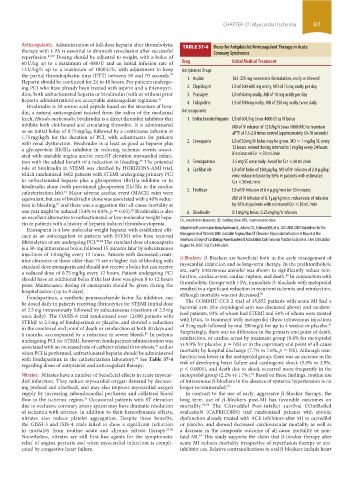
                    in mortality from routine acute and chronic nitrate therapy. 87,88    a decrease in the composite outcome of all-cause mortality or non-
                    Nonetheless, nitrates are still first-line agents for the symptomatic   fatal MI.  This study supports the claim that  β-blocker therapy after
                                                                                94
                    relief of angina pectoris and when myocardial infarction is compli-  acute MI reduces mortality irrespective of reperfusion therapy or ace-
                    cated by congestive heart failure.                    inhibitor use. Relative contraindications to oral β-blockers include heart

            section03.indd   301                                                                                       1/23/2015   2:07:20 PM

