


Page 45 - Hall et al (2015) Principles of Critical Care-McGraw-Hill
P. 45
14      PART 1: An Overview of the Approach to and Organization of Critical Care


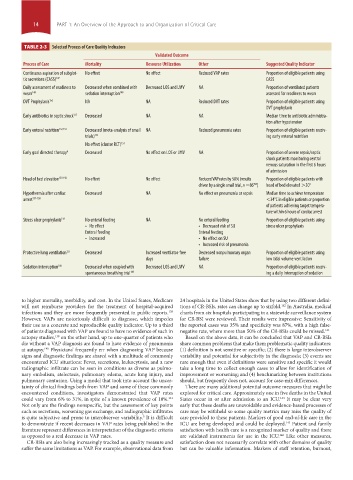
                   TABLE 2-3    Selected Process of Care Quality Indicators
                                                               Validated Outcome
                  Process of Care      Mortality            Resource Utilization  Other              Suggested Quality Indicator
                  Continuous aspiration of subglot-  No effect  No effect     Reduced VAP rates      Proportion of eligible patients using
                  tic secretions (CASS) 147                                                          CASS
                  Daily assessment of readiness to   Decreased when combined with    Decreased LOS and LMV  NA  Proportion of ventilated patients
                  wean 148             sedation interruption 149                                     assessed for readiness to wean
                  DVT Prophylaxis 150  NA                   NA                Reduced DVT rates      Proportion of eligible patients using
                                                                                                     DVT prophylaxis
                  Early antibiotics in septic shock 151  Decreased  NA        NA                     Median time to antibiotic administra-
                                                                                                     tion after hypotension
                  Early enteral nutrition 152,153  Decreased (meta-analysis of small  NA  Reduced pneumonia rates  Proportion of eligible patients receiv-
                                       trials) 152                                                   ing early enteral nutrition
                                       No effect (cluster RCT) 153
                  Early goal directed therapy 6  Decreased  No effect on LOS or LMV  NA              Proportion of severe sepsis/septic
                                                                                                     shock patients monitoring central
                                                                                                     venous saturation in the first 6 hours
                                                                                                     of admission
                  Head of bed elevation 154-156  No effect  No effect         Reduced VAP rates by 50% (results   Proportion of eligible patients with
                                                                              driven by a single small trial, n =86 )  head of bed elevated >30°
                                                                                                156
                  Hypothermia after cardiac   Decreased     NA                No effect on pneumonia or sepsis  Median time to achieve temperature
                  arrest 157-158                                                                     <34°C in eligible patients or proportion
                                                                                                     of patients achieving target tempera-
                                                                                                     ture within 6 hours of cardiac arrest
                  Stress ulcer prophylaxis 159  No enteral feeding  NA        No enteral feeding     Proportion of eligible patients using
                                       •  No effect                           •  Decreased risk of SU  stress ulcer prophylaxis
                                       Enteral feeding                        Enteral feeding
                                       •  Increased                           •  No effect on SU
                                                                              •  Increased risk of pneumonia
                  Protective lung ventilation 127  Decreased  Increased ventilator-free   Decreased nonpulmonary organ   Proportion of eligible patients using
                                                            days              failure                low tidal volume ventilation
                  Sedation interruption 160  Decreased when coupled with    Decreased LOS and LMV  NA  Proportion of eligible patients receiv-
                                       spontaneous breathing trial 149                               ing a daily interruption of sedation


                 to higher mortality, morbidity, and cost. In the United States, Medicare   24 hospitals in the United States show that by using two different defini-
                 will not reimburse providers for the treatment of hospital-acquired   tions of CR-BSIs, rates can change up to sixfold.  In Australia, medical
                                                                                                          142
                 infections and they are more frequently presented in public reports.    charts from six hospitals participating in a statewide surveillance system
                                                                   138
                 However, VAPs are notoriously difficult to diagnose, which impedes   for CR-BSI were reviewed. Their results were impressive: Sensitivity of
                 their use as a concrete and reproducible quality indicator. Up to a third   the reported cases was 35% and specificity was 87%, with a high false-
                 of patients diagnosed with VAP are found to have no evidence of such in   negative rate, where more than 50% of the CR-BSIs could be missed. 143
                 autopsy studies,  on the other hand, up to one-quarter of patients who   Based on the above data, it can be concluded that VAP and CR-BSIs
                             139
                 die without a VAP diagnosis are found to have evidence of pneumonia   share common problems that make them problematic quality indicators:
                 at autopsy.  Physicians’ frequently err when diagnosing VAP because   (1) definition is not sensitive or specific; (2) there is large interobserver
                         140
                 signs and diagnostic findings are shared with a multitude of commonly   variability and potential for subjectivity in the diagnosis; (3) events are
                 encountered ICU situations: Fever, secretions, leukocytosis, and a new   rare enough that even if definitions were sensitive and specific it would
                 radiographic infiltrate can be seen in conditions as diverse as pulmo-  take a long time to collect enough cases to allow for identification of
                 nary embolism, atelectasis, pulmonary edema, acute lung injury, and   improvement or worsening; and (4) benchmarking between institutions
                 pulmonary contusion. Using a model that took into account the uncer-  should, but frequently does not, account for case-mix differences.
                 tainty of clinical findings both from VAP and some of these commonly   There are many additional potential outcome measures that might be
                 encountered conditions, investigators demonstrated that VAP rates   explored for critical care. Approximately one in five deaths in the United
                 could vary from 6% to 31%, in spite of a known prevalence of 10%.    States occur in or after admission to an ICU.  It may be clear very
                                                                                                         144
                                                                   141
                 Not only are the findings nonspecific, but the assessment of key points   early that these deaths are unavoidable and evidence-based processes of
                 such as secretions, worsening gas exchange, and radiographic infiltrates   care may be withheld so some quality metrics may miss the quality of
                 is quite subjective and prone to interobserver variability.  It is difficult   care provided to these patients. Markers of good end-of-life care in the
                                                           5
                 to demonstrate if recent decreases in VAP rates being published in the   ICU are being developed and could be deployed.  Patient and family
                                                                                                           145
                 literature represent differences in interpretation of the diagnostic criteria   satisfaction with health care is a recognized marker of quality and there
                 as opposed to a real decrease in VAP rates.           are validated instruments for use in the ICU.  Like other measures,
                                                                                                         146
                   CR-BSIs are also being increasingly tracked as a quality measure and   satisfaction does not necessarily correlate with other domains of quality
                 suffer the same limitations as VAP. For example, observational data from   but can be valuable information. Markers of staff retention, burnout,


            Section01.indd   14                                                                                        1/22/2015   9:36:44 AM

