


Page 49 - Hall et al (2015) Principles of Critical Care-McGraw-Hill
P. 49
18      PART 1: An Overview of the Approach to and Organization of Critical Care


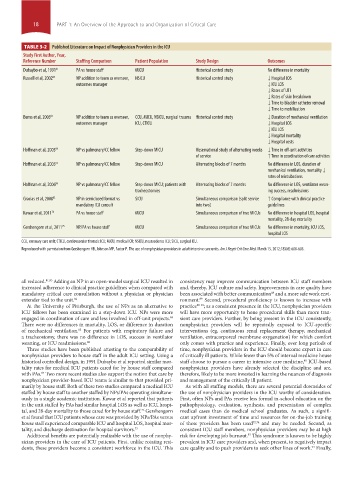
                   TABLE 3-2    Published Literature on Impact of Nonphysician Providers in the ICU
                  Study First Author, Year,
                  Reference Number  Staffing Comparison  Patient Population  Study Design            Outcomes
                  Dubaybo et al, 1991 87  PA vs house staff  MICU            Historical control study  No difference in mortality
                  Russell et al, 2002 83  NP addition to team as overseer,   NSICU  Historical control study  ↓ Hospital LOS
                                      outcomes manager                                               ↓ ICU LOS
                                                                                                     ↓ Rates of UTI
                                                                                                     ↓ Rates of skin breakdown
                                                                                                     ↓ Time to bladder catheter removal
                                                                                                     ↓ Time to mobilization
                  Burns et al, 2003 81  NP addition to team as overseer,   CCU, MICU, NSICU, surgical trauma  Historical control study  ↓ Duration of mechanical ventilation
                                      outcomes manager  ICU, CTICU                                   ↓ Hospital LOS
                                                                                                     ↓ ICU LOS
                                                                                                     ↓ Hospital mortality
                                                                                                     ↓ Hospital costs
                  Hoffman et al, 2003 84  NP vs pulmonary/CC fellow  Step-down MICU  Observational study of alternating weeks   ↓ Time in off-unit activities
                                                                             of service              ↑ Time in coordination of care activities
                  Hoffman et al, 2005 85  NP vs pulmonary/CC fellow  Step-down MICU  Alternating blocks of 7 months  No difference in LOS, duration of
                                                                                                     mechanical ventilation, mortality ↓
                                                                                                     rates of reintubations
                  Hoffman et al, 2006 86  NP vs pulmonary/CC fellow  Step-down MICU; patients with   Alternating blocks of 7 months  No difference in LOS, ventilator wean-
                                                        tracheostomies                               ing success, readmissions
                  Gracias et al, 2008 82  NP in semiclosed format vs    SICU  Simultaneous comparison (split service    ↑ Compliance with clinical practice
                                    mandatory ICU consult                    into two)               guidelines
                  Kawar et al, 2011 76  PA vs house staff  MICU              Simultaneous comparison of two MICUs  No difference in hospital LOS, hospital
                                                                                                     mortality, 28-day mortality
                  Gershengorn et al, 2011 75  NP/PA vs house staff  MICU     Simultaneous comparison of two MICUs  No difference in mortality, ICU LOS,
                                                                                                     hospital LOS
                 CCU, coronary care unit; CTICU, cardiovascular thoracic ICU; MICU, medical ICU; NSICU, neuroscience ICU; SICU, surgical ICU.
                 Reproduced with permission from Gershengorn HB, Johnson MP, Factor P. The use of nonphysician providers in adult intensive care units. Am J Respir Crit Care Med. March 15, 2012;185(6):600-605.


                 all reduced. 81,83  Adding an NP in an open-model surgical ICU resulted in   consistency may improve communication between ICU staff members
                 increased adherence to clinical practice guidelines when compared with   and, thereby, ICU culture and safety. Improvements in care quality have
                 mandatory critical care consultation without a physician or physician   been associated with better communication  and a more safe work envi-
                                                                                                      88
                                                                              89
                 extender tied to the unit. 82                         ronment.  Second, procedural proficiency is known to increase with
                   At the University of Pittsburgh, the use of NPs as an alternative to   practice 90-92 ; as a consistent presence in the ICU, nonphysician providers
                 ICU fellows has been examined in a step-down ICU. NPs were more   will have more opportunity to hone procedural skills than more tran-
                 engaged in coordination of care and less involved in off-unit projects.    sient care providers. Further, by being present in the ICU consistently,
                                                                    84
                 There were no differences in mortality, LOS, or difference in duration   nonphysician providers will be repeatedly exposed to ICU-specific
                 of mechanical ventilation.  For patients with respiratory failure and   interventions  (eg,  continuous  renal  replacement  therapy,  mechanical
                                     85
                 a tracheostomy, there was no difference in LOS, success in ventilator   ventilation, extracorporeal membrane oxygenation) for which comfort
                 weaning, or ICU readmissions. 86                      only comes with practice and experience. Finally, over long periods of
                   Three studies have been published attesting to the comparability of   time, nonphysician providers in the ICU should become expert in care
                 nonphysician providers to house staff in the adult ICU setting. Using a   of critically ill patients. While fewer than 5% of internal medicine house
                 historical controlled design, in 1991 Dubaybo et al reported similar mor-  staff choose to pursue a career in intensive care medicine,  ICU-based
                                                                                                                 45
                 tality rates for medical ICU patients cared for by house staff compared   nonphysician providers  have  already  selected  the  discipline  and  are,
                 with PAs.  Two more recent studies also support the notion that care by   therefore, likely to be more invested in learning the nuances of diagnosis
                        87
                 nonphysician provider-based ICU teams is similar to that provided pri-  and management of the critically ill patient.
                 marily by house staff. Both of these two studies compared a medical ICU   As with all staffing models, there are several potential downsides of
                 staffed by house staff to another staffed by NPs/PAs operating simultane-  the use of nonphysician providers in the ICU worthy of consideration.
                 ously in a single academic institution. Kawar et al reported that patients   First, often NPs and PAs receive less formal in-school education on the
                 in the unit staffed by PAs had similar hospital LOS as well as ICU, hospi-  pathophysiology, evaluation, synthesis, and presentation of complex
                                                          76
                 tal, and 28-day mortality to those cared for by house staff.  Gershengorn   medical cases than do medical school graduates. As such, a signifi-
                 et al found that ICU patients whose care was provided by NPs/PAs versus   cant upfront investment of time and resources for on-the-job training
                 house staff experienced comparable ICU and hospital LOS, hospital mor-  of these providers has been used 72,74  and may be needed. Second, as
                 tality, and discharge destination for hospital survivors. 75  consistent ICU staff members, nonphysician providers may be at high
                   Additional benefits are potentially realizable with the use of nonphy-  risk for developing job burnout.  This syndrome is known to be highly
                                                                                              93
                 sician providers in the care of ICU patients. First, unlike rotating resi-  prevalent in ICU care providers and, when present, to negatively impact
                                                                                                                    94
                 dents, these providers become a consistent workforce in the ICU. This   care quality and to push providers to seek other lines of work.  Finally,


            Section01.indd   18                                                                                        1/22/2015   9:36:45 AM

