


Page 48 - Hall et al (2015) Principles of Critical Care-McGraw-Hill
P. 48
CHAPTER 3: Intensive Care Unit Staffing  17


                    TELEMEDICINE                                           Several authors have addressed work-hour limits that have been
                                                                          increasingly placed on house officers in many countries.  This is of great
                                                                                                                 66
                    Telemedicine involves having ICU clinicians, who may be physicians   consequence since teaching ICUs have historically relied on house staff
                    and/or nurses, remotely provide real-time care. This may be nighttime   for patient care services, especially overnight. A consequence of these
                    only, or both days and nights. Remote clinicians have electronic access to   limits is changes in house staff scheduling that reduces continuity of
                    a data stream typically including telemetry, diagnostic tests, information   care. Also, teaching hospitals have attempted to fill the gaps by increased
                    from devices such as ventilators, and if they exist, an electronic medical   use of hospitalists and nonphysician providers.  While a detailed study
                                                                                                           66
                    record and computer order entry.  In some systems, software continu-  in two ICUs found that reduced working hours resulted in a lower rate
                                            51
                    ously analyzes the data for early identification of worrisome trends. The   of serious errors by first-year residents, 67,68  a large study of 104 ICUs was
                    eClinicians in these eICUs can see patients via video cameras, and talk   unable to detect a change in severity-adjusted mortality attributable to
                    to HCWs in the ICU via telephone or intercom; they may even have a   the work rule limits implemented in the United States in 2003. 69
                    robotic presence in the ICU.  The remote physicians may or may not
                                         52
                    have order writing authority. Several hundred hospitals in the United
                    States have implemented ICU telemedicine.  The psychosocial aspects   ICU STAFFING BY NONPHYSICIAN
                                                   53
                    of working in an eICU environment are substantially different than  PROVIDERS AS PHYSICIAN EXTENDERS
                    bedside work. 54                                      Nonphysician providers, mainly nurse practitioners (NPs) and phy-
                     A number of studies, most commonly assessing the VISICU system,   sician assistants (PAs), are increasingly involved in the care of ICU
                    have evaluated how introduction of eICU care influenced mortality, LOS,   patients. 17,70,71  While different by way of background and training
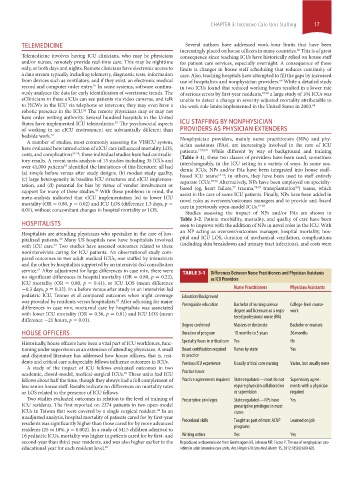
                    costs, and complications 55-58 ; these individual studies have had contradic-  (Table 3-1), these two classes of providers have been used, sometimes
                    tory results. A recent meta-analysis of 13 studies including 35 ICUs and   interchangeably, in the ICU setting in a variety of ways. In some aca-
                    over 41,000 patients  identified the limitations of this literature: all had   demic ICUs, NPs and/or PAs have been integrated into house staff–
                                  53
                    (a) simple before versus after study designs, (b) modest study quality,    based ICU teams 72-74 ; in others, they have been used to staff entirely
                    (c) large heterogeneity in baseline ICU structures and eICU implemen-  separate ICUs. 75,76  Alternatively, NPs have been employed on specialty-
                    tation, and (d) potential for bias by virtue of vendor involvement or   based (eg, heart failure,  trauma, 78,79  transplantation ) teams, which
                                                                                           77
                                                                                                                 80
                    support for many of these studies.  With these problems in mind, the   assist in the care of some ICU patients. Finally, NPs have been added in
                                             59
                    meta-analysis  indicated  that  eICU  implementation  led  to  lower  ICU   novel roles as overseers/outcomes managers and to provide unit-based
                    mortality (OR = 0.80, p = 0.02) and ICU LOS (difference 1.3 days, p =   care in previously open-model ICUs. 81-83
                    0.01), without concomitant changes in hospital mortality or LOS.
                                                                           Studies assessing the impact of NPs and/or PAs are shown in
                                                                          Table 3-2. Patient morbidity, mortality, and quality of care have been
                    HOSPITALISTS                                          seen to improve with the addition of NPs in novel roles in the ICU. With
                    Hospitalists are attending physicians who specialize in the care of hos-  an NP acting as overseer/outcomes manager, hospital mortality, hos-
                    pitalized patients.  Many US hospitals now have hospitalists involved   pital and ICU LOS, duration of mechanical ventilation, complications
                                60
                    with ICU care.  Two studies have assessed outcomes related to these   (including skin breakdown and urinary tract infections), and costs were
                               17
                    nonintensivists caring for ICU patients. An observational study com-
                    pared outcomes in two adult medical ICUs, one staffed by intensivists
                    and the other by hospitalists supported by an intensivist-led consultation
                    service.  After adjustment for large differences in case mix, there were     TABLE 3-1     Differences Between Nurse Practitioners and Physician Assistants
                         61
                    no significant differences in hospital mortality (OR = 0.80, p = 0.22),   as ICU Providers
                    ICU mortality (OR = 0.80, p = 0.41), or ICU LOS (mean difference
                    −0.3 days, p = 0.32). In a before versus after study in an intensivist-led   Nurse Practitioners  Physician Assistants
                    pediatric ICU, Tenner et al compared outcomes when night coverage   Education/Background
                    was provided by residents versus hospitalists.  After adjusting for major
                                                    62
                    differences in case mix, nocturnal care by hospitalists was associated   Prerequisite education  Bachelor of nursing science   College-level course-
                    with lower ICU mortality (OR = 0.36, p = 0.01) and ICU LOS (mean        degree and licensure as a regis- work
                    difference −21 hours, p = 0.01).                                        tered professional nurse (RN)
                                                                          Degree conferred  Masters or doctorate  Bachelor or masters
                    HOUSE OFFICERS                                        Duration of program  18 months to 5 years  26 months
                    Historically, house officers have been a vital part of ICU workforces, func-  Specialty focus in critical care  Yes  No
                    tioning under supervision as an extension of attending physicians. A small   Board certification required   Varies by state  Yes
                    and disjointed literature has addressed how house officers, that is, resi-  to practice
                    dents and critical care subspecialty fellows influence outcomes in ICUs.  Previous ICU experience  Usually critical care nursing  Varies, but usually none
                     A study of the impact of ICU fellows evaluated outcomes in two
                    academic, closed-model, medical-surgical ICUs.  These units had ICU   Practice Issues
                                                      63
                    fellows about half the time, though they always had a full complement of   Practice agreements required State regulated—most do not   Supervisory agree-
                    less senior house staff. Results indicate no differences on mortality rates   require physician collaboration   ments with a physician
                    or LOS related to the presence of ICU fellows.                          or supervision     required
                     Two studies evaluated outcomes in relation to the level of training of   Prescriptive privileges  State regulated—NPs have   Yes
                    ICU residents. The first reported on 2274 patients in two open-model    prescriptive privileges in most
                    ICUs in Taiwan that were covered by a single surgical resident.  In an   states
                                                                  64
                    unadjusted analysis, hospital mortality of patients cared for by first-year
                    residents was significantly higher than those cared for by more advanced   Procedural skills  Taught as part of most ACNP   Learned on job
                    residents (25 vs 18%, p = 0.002). In a study of 5415 children admitted to   programs
                    16 pediatric ICUs, mortality was higher in patients cared for by first- and   Writing orders  Yes  Yes
                    second-year than third-year residents, and was also higher earlier in the   Reproduced with permission from Gershengorn HB, Johnson MP, Factor P. The use of nonphysician pro-
                    educational year for each resident level. 65          viders in adult intensive care units. Am J Respir Crit Care Med. March 15, 2012;185(6):600-605.


            Section01.indd   17                                                                                        1/22/2015   9:36:45 AM

