


Page 58 - Hall et al (2015) Principles of Critical Care-McGraw-Hill
P. 58
CHAPTER 4: Infection Prevention and Surveillance in the Intensive Care Unit  27


                    ANTIBIOTIC RESISTANCE IN THE ICU                      within the United States and consists of identifying patients colonized
                                                                          with resistant microorganisms by review of clinical specimens. While
                    Intensive care units have long been associated with an increased preva-  this strategy requires the least amount of labor and supplies, it fails to
                    lence of antibiotic-resistant organisms compared with other areas of the   identify a significant proportion of colonized patients.  In active sur-
                                                                                                                  64
                    hospital. The frequent use of broad-spectrum antibiotics, a patient popu-  veillance, cultures are obtained for the specific purpose of identifying
                    lation with prolonged lengths of stay and the need for invasive devices,   colonized patients. These cultures can be performed on every patient
                    and the close interactions between health care workers and critically ill   or on selected high-risk subsets (see Table 4-4). Selective screening of
                    patients all contribute to the propagation of antibiotic-resistant microor-  high-risk patients, combined with other infection control interventions,
                    ganisms within the ICU. The recent emergence of highly resistant virulent   reduced the prevalence of ICU-acquired MRSA infections in a medi-
                    organisms, such as vancomycin-resistant  S aureus, multidrug-resistant   cal ICU and was cost effective.  Published guidelines recommended
                                                                                                 65
                    (MDR) gram-negative bacilli, and C difficile highlight the importance of   active  surveillance  culture  for  detecting  MRSA-colonized  patients. 66-68
                    understanding and controlling antibiotic resistance within the ICU.  However, a European randomized controlled study demonstrated that
                        ■  THE EPIDEMIOLOGY OF ANTIBIOTIC RESISTANCE      active  surveillance for MRSA did not reduce the incidence of MRSA
                                                                          infection.  In a recent North American trial, targeted versus universal
                                                                                69
                    The resistant organisms seen most commonly in the ICU include meth-  decolonization to prevent ICU infection were compared in a prospective
                                                                                              70
                    icillin-resistant  S aureus (MRSA), vancomycin-resistant  Enterococcus   randomized (by center) trial.  Universal decolonization with chlorhexi-
                    faecium or E. faecalis (VRE), and MDR gram-negative bacilli, such as   dine bathing and adjunct therapy appeared more effective at reducing
                    P.  aeruginosa, Stenotrophomonas maltophilia,  Acinetobacter baumanii,   nosocomial ICU infection than MRSA-specific screening and isolation
                    and extended-spectrum  β-lactamase–producing  Enterobacteriaceae.   policies. Whether this approach is cost effective for ICUs to use for other
                    While each of these organisms has individual differences that affect ICU   pathogens is an area of further study.
                    transmission, patients who are colonized or infected with these organ-    ■
                    isms tend to share common characteristics (Table 4-4). 97  ANTIBIOTIC USE AND CONTROL
                     Patients can either enter the ICU with endogenous-resistant bac-  Inadequate initial antibiotic therapy of infections has been associated
                    teria already present or become colonized during their ICU stay   with increased mortality among ICU patients.  This observation argues
                                                                                                           71
                    owing to cross-contamination from  other colonized patients. Brun-  for the use of broad-spectrum antibiotics. However, the increasing use
                    Buisson and colleagues demonstrated through serial rectal swabs that   of broad-spectrum antibiotics has been associated with the acquisition
                    90% of all patients subsequently found to be colonized with MDR   of antibiotic-resistant pathogens. Exposure to broad-spectrum antibiot-
                    Enterobacteriaceae were negative on admission to a medical ICU and   ics can alter the normal flora of patients and can facilitate colonization
                    had a mean time to colonization of 14 days.  The primary mechanism   with resistant organisms or expansion of populations of already-existing
                                                    61
                    by which patient-to-patient transmission of resistant microorganisms   organisms. The dilemma created by these competing pressures has
                    occurs within the ICU is on the hands of health care workers. Resistant   shaped efforts to control the use of antibiotics within the ICU, particu-
                    bacteria can be carried on health care workers’ hands and clothing.    larly drugs with a broad-spectrum of activity.
                                                                      62
                    Another source of transmission of antibiotic-resistant microorganisms   Antibiotic use in the ICU can be divided into empirical use against
                    is the ICU environment itself. This is particularly true for hydrophilic,   a suspected community-acquired or health care–associated infec-
                    gram-negative bacilli, such as  Pseudomonas spp,  Stenotrophomonas   tion, targeted use against a specific pathogen, and prophylactic use.
                    spp, and Acinetobacter spp, VRE, and C difficile. These organisms are   There is considerable overlap between these concepts. For example,
                    particularly resistant to the effects of drying; therefore, they can survive   critically ill patients often are started empirically on broad-spectrum
                    on inanimate objects in the environment for extended periods of time.   antibiotics and then switched to an antibiotic with a more targeted
                    Outbreaks of health care–associated infections associated with these   spectrum once the pathogen-causing infection is known. Selective
                    bacteria can persist if the environmental source is not addressed. 63  digestive decontamination as a method to prevent nosocomial infec-
                                                                          tions is an example of the prophylactic use of antibiotics in the ICU,
                    PREVENTING ANTIBIOTIC RESISTANCE IN THE ICU           which was discussed earlier in this chapter. Strategies that have been
                                                                          applied to control antibiotic use include closed or restricted pharmacy
                        ■  SURVEILLANCE                                   formularies, rapid narrowing of antibiotic spectrum of activity once
                    Understanding  the  extent  to which ICU  patients  are  colonized  or   a pathogen is known, discontinuation of empirical antibiotic therapy
                                                                          based on set clinical parameters, cycling or rotation of empirical anti-
                    infected with antibiotic-resistant microorganisms is important for   biotics with gram-negative activity, and decision-support systems for
                    identifying outbreaks or high endemic rates of particular pathogens and   physician prescribing.
                    targeting methods for control. Strategies include both passive and active   Often, antibiotic therapy that is started empirically in a critically ill
                    surveillance. Passive surveillance is employed most frequently in ICUs   patient is continued even after evidence suggests that infection is not
                                                                          present. In a study by Singh and colleagues,  patients suspected of hav-
                                                                                                         72
                                                                          ing ventilator-associated pneumonia were scored using a validated clini-
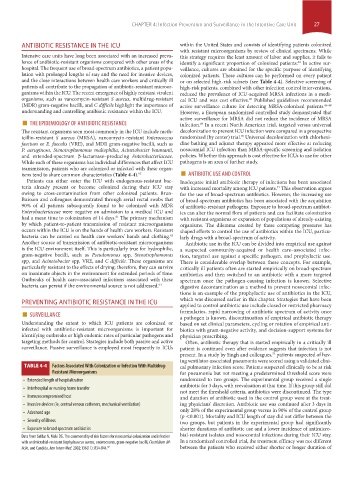
                      TABLE 4-4     Factors Associated With Colonization or Infection With Multidrug-  cal pulmonary infection score. Patients suspected clinically to be at risk
                              Resistant Microorganisms                    for pneumonia but not meeting a predetermined threshold score were
                    •  Extended length of hospitalization                 randomized to two groups. The experimental group received a single
                                                                          antibiotic for 3 days, with reevaluation at that time. If this group still did
                    •  Interhospital or nursing home transfer
                                                                          not meet the threshold criteria, antibiotics were discontinued. The type
                    •  Immunocompromised host                             and duration of antibiotic used in the control group were at the treat-
                    •  Invasive devices (ie, central venous catheters, mechanical ventilation)  ing physicians’ discretion. Antibiotic use was continued after 3 days in
                    •  Advanced age                                       only 28% of the experimental group versus in 90% of the control group
                                                                          (p <0.001). Mortality and ICU length of stay did not differ between the
                    •  Severity of illness                                two groups, but patients in the experimental group had significantly
                    •  Exposure to broad spectrum antibiotics             shorter durations of antibiotic use and a lower incidence of antimicro-
                    Data from Safdar N, Maki DG. The commonality of risk factors for nosocomial colonization and infection   bial-resistant isolates and nosocomial infections during their ICU stay.
                    with antimicrobial-resistant Staphylococcus aureus, enterococcus, gram-negative bacilli, Clostridium dif-  In a randomized controlled trial, the treatment efficacy was not different
                    ficile, and Candida. Ann Intern Med. 2002;136(11): 834-844. 97  between the patients who received either shorter or longer duration of


            Section01.indd   27                                                                                        1/22/2015   9:36:48 AM

