


Page 57 - Hall et al (2015) Principles of Critical Care-McGraw-Hill
P. 57
26      PART 1: An Overview of the Approach to and Organization of Critical Care


                 respiratory equipment has been implicated as the source of outbreaks   Staphylococcus aureus being the most common organisms identified. 49,50
                 of nosocomial pneumonia. Devices that generate aerosols, such as   Prevention involves avoiding nasotracheal intubation, placing feeding
                 nebulizer reservoirs used for humidification  and multidose medication   tubes through the mouth rather than through the nose, and minimizing
                                                 41
                 nebulizers,  have been associated with outbreaks caused by hydrophilic   sedative use.
                         42
                 bacteria. Bronchoscopes have also been a source of health care–associ-
                 ated pneumonia in the ICU, usually as a result of an incomplete or com-    ■  INTRACRANIAL PRESSURE MONITORING DEVICES
                 promised disinfection between procedures. 43          Several infectious complications can result from the use of intracra-
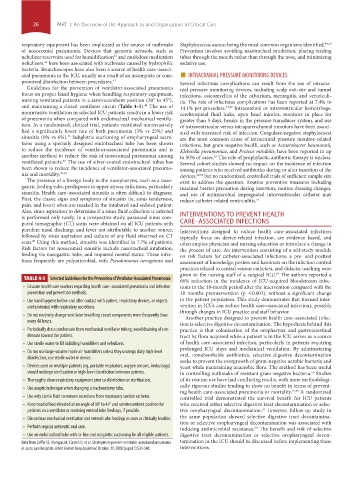
                   Guidelines  for  the  prevention  of  ventilator-associated  pneumonia   nial pressure monitoring devices, including scalp exit-site and tunnel
                 focus on proper hand hygiene when handling respiratory equipment,   infections, osteomyelitis of the calvarium, meningitis, and ventriculi-
                 nursing ventilated patients in a semirecumbent position (30° to 45°),   tis. The rate of infectious complications has been reported at 7.4% to
                 and maintaining a closed ventilator circuit (Table 4-3).  The use of   14.1% per procedure. 51,52  Intracerebral or intraventricular hemorrhage,
                                                           44
                 noninvasive ventilation in selected ICU patients results in a lower risk   cerebrospinal fluid leaks, open head injuries, monitors in place for
                 of pneumonia when compared with endotracheal mechanical ventila-  greater than 5 days, breaks in the pressure transducer system, and use
                 tion. In a randomized, clinical trial, patients ventilated noninvasively   of intraventricular versus intraparenchymal monitors have been associ-
                 had a significantly lower rate of both pneumonia (3% vs 25%) and   ated with increased risk of infection. Coagulase-negative staphylococci
                 sinusitis (0% vs 6%).  Subglottic suctioning of oropharyngeal secre-  are  the  most  common  cause  of  intracranial  pressure  monitor–related
                                 45
                 tions using a specially designed endotracheal tube has been shown   infections, but gram-negative bacilli, such as Acinetobacter baumannii,
                 to reduce the incidence of ventilator-associated pneumonia and is   Klebsiella pneumoniae, and Proteus mirabilis, have been reported in up
                 another method to reduce the risk of nosocomial pneumonia among   to 50% of cases.  The role of prophylactic antibiotic therapy is unclear.
                                                                                   53
                 ventilated patients.  The use of silver-coated endotracheal tubes has   Several cohort studies showed no impact on the incidence of infection
                               46
                 been shown to reduce the incidence of ventilator-associated pneumo-  among patients who received antibiotics during or after insertion of the
                 nia and mortality. 47,48                              devices, 52,54  but no randomized, controlled trials of sufficient sample size
                   The presence of a foreign body in the nasopharynx, such as a naso-  exist to address the question. Routine preventive measures including
                 gastric feeding tube, predisposes to upper airway infections, particularly   maximal barrier precaution during insertion, routine dressing changes,
                 sinusitis. Health care–associated sinusitis is often difficult to diagnose.   and use  of antimicrobial  impregnated intraventricular catheter may
                 First, the classic signs and symptoms of sinusitis (ie, sinus tenderness,   reduce catheter-related ventriculitis. 55
                 pain, and fever) often are masked in the intubated and sedated patient.
                 Also, sinus aspiration to determine if a sinus fluid collection is infected
                 is performed only rarely. In a prospective study, paranasal sinus com-  INTERVENTIONS TO PREVENT HEALTH
                 puted tomographic (CT) scans were obtained on all ICU patients with   CARE–ASSOCIATED INFECTIONS
                 purulent nasal discharge and fever not attributable to another source,   Interventions designed to reduce health care–associated infections
                 followed by sinus aspiration and culture of any fluid observed on CT   typically focus on device-related infection, are evidence based, and
                 scan.  Using this method, sinusitis was identified in 7.7% of patients.   often employ physician and nursing education or introduce a change in
                     49
                 Risk factors for nosocomial sinusitis include nasotracheal intubation,   the process of care. An intervention consisting of a self-study module
                 feeding via nasogastric tube, and impaired mental status. These infec-  on risk factors for catheter-associated infections, a pre- and posttest
                 tions frequently are polymicrobial, with Pseudomonas aeruginosa and   assessment of knowledge, posters and handouts on the infection control
                                                                       practices related to central venous catheters, and didactic teaching were
                                                                       given to the nursing staff of a surgical ICU.  The authors reported a
                                                                                                        28
                   TABLE 4-3    Selected Guidelines for the Prevention of Ventilator-Associated Pneumonia  66% reduction in the incidence of ICU-acquired bloodstream infec-
                  •   Educate health care workers regarding health care–associated pneumonia and infection   tions in the 18-month period after the intervention compared with the
                   prevention and prevention methods.                  18 months preintervention (p  <0.001), without a significant change
                  •   Use hand hygiene before and after contact with patient, respiratory devices, or objects   in the patient population. This study demonstrates that focused inter-
                   contaminated with respiratory secretions.           vention in ICUs can reduce health care–associated infections, possibly
                                                                       through changes in ICU practice and staff behavior.
                  •   Do not routinely change ventilator breathing circuit components more frequently than   Another practice designed to prevent health care–associated infec-
                   every 48 hours.                                     tion is selective digestive decontamination. The hypothesis behind this
                  •   Periodically drain condensate from mechanical ventilator tubing; avoid draining of con-  practice is that colonization of the oropharynx and gastrointestinal
                   densate toward the patient.                         tract by flora acquired while a patient is in the ICU serves as a source
                  •  Use sterile water to fill bubbling humidifiers and nebulizers.  of health care–associated infection, particularly in patients requiring
                                                                       prolonged ICU stays and mechanical ventilation. By administering
                  •   Do not use large-volume room-air humidifiers unless they undergo daily high-level   oral, nonabsorbable antibiotics, selective digestive decontamination
                   disinfection; use sterile water in device.
                                                                       seeks to prevent the overgrowth of gram-negative aerobic bacteria and
                  •   Devices used on multiple patients (eg, portable respirators, oxygen sensors, Ambu bags)   yeast while maintaining anaerobic flora. The method has been useful
                   should undergo sterilization or high-level disinfection between patients.  in controlling outbreaks of resistant gram-negative bacteria.  Studies
                                                                                                                    56
                  •  Thoroughly clean respiratory equipment prior to disinfection or sterilization.  of its routine use have had conflicting results, with more methodologi-
                                                                       cally rigorous studies tending to show no benefit in terms of prevent-
                  •  Use aseptic technique when changing a tracheostomy tube.
                                                                       ing health care–associated pneumonia or mortality. 57,58  A randomized
                  •  Use only sterile fluid to remove secretions from respiratory suction catheter.  controlled trial demonstrated the survival benefit for ICU patients
                  •  Keep head of bed elevated at an angle of 30° to 45° and semirecumbent position for   who received either selective digestive tract decontamination or selec-
                   patients on a ventilator or receiving enteral tube feedings, if possible.  tive oropharyngeal decontamination.  However, follow-up study in
                                                                                                   59
                                                                       the same population showed selective digestive tract decontamina-
                  •  Discontinue mechanical ventilation and enteral tube feedings as soon as clinically feasible.
                                                                       tion or selective oropharyngeal decontamination was associated with
                  •  Perform regular antiseptic oral care.             inducing antimicrobial resistance.  The benefit and risk of selective
                                                                                                 60
                  •  Use an endotracheal tube with in-line and subglottic suctioning for all eligible patients.  digestive tract decontamination or selective oropharyngeal decon-
                 Data from Coffin SE, Klompas M, Classen D, et al. Strategies to prevent ventilator-associated pneumonia   tamination in the ICU should be discussed before implementing these
                 in acute care hospitals. Infect Control Hosp Epidemiol. October 29, 2008;(suppl 1):S31-S40.  interventions.


            Section01.indd   26                                                                                        1/22/2015   9:36:47 AM

