


Page 56 - Hall et al (2015) Principles of Critical Care-McGraw-Hill
P. 56
CHAPTER 4: Infection Prevention and Surveillance in the Intensive Care Unit  25


                                                                          systems are similar to those recommended for central venous catheters.
                                                                                                                            35
                      TABLE 4-1     Specific Recommendations for Preventing Intravascular Catheter–
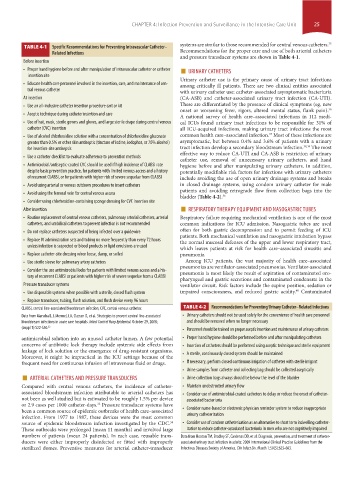
                              Related Infections                          Recommendations for the proper care and use of both arterial catheters
                                                                          and pressure transducer systems are shown in Table 4-1.
                    Before insertion
                    •   Proper hand hygiene before and after manipulation of intravascular catheter or catheter     ■  URINARY CATHETERS
                       insertion site
                                                                          Urinary  catheter  use  is  the  primary  cause  of  urinary  tract  infections
                    •   Educate health care personnel involved in the insertion, care, and maintenance of cen-  among critically ill patients. There are two clinical entities associated
                      tral venous catheter                                with urinary catheter use: catheter-associated asymptomatic bacteriuria
                    At insertion                                          (CA-ASB) and catheter-associated urinary tract infection (CA-UTI).
                    •  Use an all-inclusive catheter insertion procedure cart or kit  These are differentiated by the presence of clinical symptoms (eg, new
                                                                          onset  or  worsening  fever,  rigors,  altered  mental  status,  flank  pain).
                                                                                                                            36
                    •  Aseptic technique during catheter insertion and care
                                                                          A national survey of health care–associated infections in 112 medi-
                    •   Use of hat, mask, sterile gowns and gloves, and large sterile drape during central venous   cal  ICUs  found urinary  tract infections to  be  responsible  for 31%  of
                      catheter (CVC) insertion                            all ICU-acquired infections, making urinary tract infections the most
                                                                                                        37
                    •   Use of alcohol chlorhexidine solution with a concentration of chlorhexidine gluconate   common health care–associated infection.  Most of these infections are
                      greater than 0.5% or other skin antiseptic (tincture of iodine, iodophor, or 70% alcohol)   asymptomatic, but between 0.4% and 3.6% of patients with a urinary
                      for insertion-site antisepsis                       tract infection develop a secondary bloodstream infection. 38,39  The most
                                                                          effective way to reduce CA-UTI and CA-ASB is restriction of urinary
                    •  Use a catheter checklist to evaluate adherence to prevention methods
                                                                          catheter  use,  removal  of  unnecessary  urinary  catheters,  and  hand
                    •   Antimicrobial/antiseptic-coated CVC should be used if high incidence of CLABSI rate   hygiene before and after manipulating urinary catheters. In addition,
                      despite basic prevention practice, for patients with limited venous access and a history   potentially modifiable risk factors for infections with urinary catheters
                      of recurrent CLABSI, or for patients with higher risk of severe sequelae from CLABSI  include avoiding the use of open urinary drainage systems and breaks
                    •  Avoid using arterial or venous cutdown procedures to insert catheters  in closed drainage systems, using condom urinary catheter for male
                                                                          patients and avoiding retrograde flow from collection bags into the
                    •  Avoid using the femoral vein for central venous access
                                                                          bladder (Table 4-2). 36
                    •  Consider using chlorhexidine-containing sponge dressing for CVC insertion site
                    After insertion                                           ■  RESPIRATORY THERAPY EQUIPMENT AND NASOGASTRIC TUBES
                    •   Routine replacement of central venous catheters, pulmonary arterial catheters, arterial   Respiratory failure requiring mechanical ventilation is one of the most
                      catheters, and umbilical catheters to prevent infection is not recommended  common indications for ICU admission. Nasogastric tubes are used
                    •  Do not replace catheters suspected of being infected over a guidewire  often for both gastric decompression and to permit feeding of ICU
                                                                          patients. Both mechanical ventilation and nasogastric intubation bypass
                    •   Replace IV administration sets and tubing no more frequently than every 72 hours   the normal mucosal defenses of the upper and lower respiratory tract,
                      unless infection is suspected or blood products or lipid emulsions are used  which  leaves patients  at risk  for health care–associated  sinusitis  and
                    •  Replace catheter-site dressing when loose, damp, or soiled   pneumonia.
                    •  Use sterile sleeve for pulmonary artery catheters   Among ICU patients, the vast majority of health care–associated
                                                                          pneumonias are ventilator-associated pneumonias. Ventilator-associated
                    •   Consider the use antimicrobial locks for patients with limited venous access and a his-  pneumonia is most likely the result of aspiration of contaminated oro-
                      tory of recurrent CLABSI or patients with higher risk of severe sequelae from a CLABSI  pharyngeal and gastric secretions and contaminated condensate in the
                    Pressure transducer systems                           ventilator circuit. Risk factors include the supine position, sedation or
                                                                                                                 40
                    •  Use disposable systems when possible with a sterile, closed flush system  impaired consciousness, and reduced gastric acidity.  Contaminated
                    •  Replace transducer, tubing, flush solution, and flush device every 96 hours
                    CLABSI, central line-associated bloodstream infection; CVC, central venous catheter.    TABLE 4-2    Recommendations for Preventing Urinary Catheter–Related Infections
                    Data from Marschall, J, Mermel, LA, Classen D, et al. Strategies to prevent central line-associated    •   Urinary catheters should not be used solely for the convenience of health care personnel
                    bloodstream infections in acute care hospitals. Infect Control Hosp Epidemiol. October 29, 2008;   and should be removed when no longer necessary
                    (suppl 1):S22-S30. 32                                 •  Personnel should be trained on proper aseptic insertion and maintenance of urinary catheters
                    antimicrobial solution into an unused catheter lumen. A few potential   •  Proper hand hygiene should be performed before and after manipulating catheters
                    concerns of antibiotic lock therapy include systemic side effects from   •  Insertion of catheters should be performed using aseptic technique and sterile equipment
                    leakage of lock solution or the emergence of drug-resistant organisms.   •  A sterile, continuously closed system should be maintained
                    Moreover, it might be impractical in the ICU settings because of the
                    frequent need for continuous infusion of intravenous fluid or drugs.  •  If necessary, perform closed continuous irrigation of catheter with sterile irrigant
                        ■  ARTERIAL CATHETERS AND PRESSURE TRANSDUCERS    •  Urine samples from catheter and collecting bag should be collected aseptically
                                                                          •  Urine collection bags always should be below the level of the bladder
                    Compared with central venous catheters, the incidence of catheter-  •  Maintain unobstructed urinary flow
                    associated bloodstream infection attributable to arterial catheters has   •   Consider use of antimicrobial-coated catheters to delay or reduce the onset of catheter-
                    not been as well studied but is estimated to be roughly 1.5% per device   associated bacteriuria
                    or 2.9 cases per 1000 catheter-days.  Pressure transducer systems have
                                             33
                    been a common source of epidemic outbreaks of health care–associated   •   Consider nurse-based or electronic physician reminder system to reduce inappropriate
                    infection. From 1977 to 1987, these devices were the most common   urinary catheterization
                    source of epidemic bloodstream infection investigated by the CDC.    •   Consider use of condom catheterization as an alternative to short term indwelling catheter-
                                                                      34
                    These outbreaks were prolonged (mean 11 months) and involved large   ization to reduce catheter-associated bacteriuria in men who are not cognitively impaired
                    numbers of patients (mean 24 patients). In each case, reusable trans-  Data from Hooton TM, Bradley SF, Cardenas DD, et al. Diagnosis, prevention, and treatment of catheter-
                    ducers were either improperly disinfected or fitted with improperly   associated urinary tract infection in adults: 2009 International Clinical Practice Guidelines from the
                    sterilized domes. Preventive measures for arterial catheter-transducer   Infectious Diseases Society of America. Clin Infect Dis. March 1;50(5):625-663.


            Section01.indd   25                                                                                        1/22/2015   9:36:47 AM

