


Page 588 - Hall et al (2015) Principles of Critical Care-McGraw-Hill
P. 588
408     PART 4: Pulmonary Disorders


                                                                       this phenomenon varies widely, ranging from as low as 3% to as high as
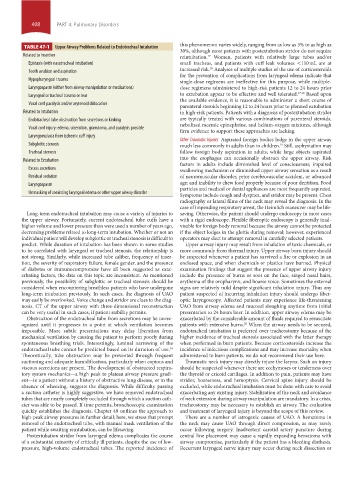
                   TABLE 47-1    Upper Airway Problems Related to Endotracheal Intubation
                                                                       30%, although most patients with postextubation stridor do not require
                  Related to Insertion                                 reintubation.  Women, patients with relatively large tubes and/or
                                                                                 17
                    Epistaxis (with nasotracheal intubation)           small tracheas, and patients with cuff leak volumes  <110 mL are at
                                                                                 18
                    Tooth avulsion and aspiration                      increased risk.  Analyses of multiple studies of the use of corticosteroids
                                                                       for the prevention of complications from laryngeal edema indicate that
                    Hypopharyngeal trauma                              single-dose regimens are ineffective for this purpose, while multiple-
                    Laryngospasm (either from airway manipulation or medications)  dose regimens administered to high-risk patients 12 to 24 hours prior
                    Laryngeal or tracheal trauma or tear               to extubation appear to be effective and well tolerated. 17,18  Based upon
                                                                       the available evidence, it is reasonable to administer a short course of
                    Vocal cord paralysis and/or arytenoid dislocation
                                                                       parenteral steroids beginning 12 to 24 hours prior to planned extubation
                  Related to Intubation                                in high-risk patients. Patients with a diagnosis of postextubation stridor
                    Endotracheal tube obstruction from secretions or kinking  are typically treated with various combinations of parenteral steroids,
                                                                       nebulized racemic epinephrine, and helium-oxygen mixtures, although
                    Vocal cord injury: edema, ulceration, granuloma, and paralysis possible
                                                                       firm evidence to support these approaches are lacking.
                    Laryngomalacia from ischemic cuff injury
                                                                       Other Traumatic Injuries  Aspirated foreign bodies lodge in the upper airway
                    Subglottic stenosis                                much less commonly in adults than in children.  Still, asphyxiation may
                                                                                                         19
                    Tracheal stenosis                                  follow  foreign  body  aspiration  in  adults,  while  large  objects  aspirated
                                                                       into the esophagus can occasionally obstruct the upper airway. Risk
                  Related to Extubation
                                                                       factors in adults include diminished level of consciousness; impaired
                    Excess secretions                                  swallowing mechanism or diminished upper airway sensation as a result
                    Residual sedation                                  of neuromuscular disorder, prior cerebrovascular accident, or advanced
                    Laryngospasm                                       age; and inability to chew food properly because of poor dentition. Food
                                                                       particles and medical or dental appliances are most frequently aspirated.
                    Unmasking of coexisting laryngeal edema or other upper airway disorder  Symptoms include cough and dyspnea, and stridor may be present. Chest
                                                                       radiography or lateral films of the neck may reveal the diagnosis. In the
                                                                       case of impending respiratory arrest, the Heimlich maneuver may be life-
                   Long-term endotracheal intubation may cause a variety of injuries to   saving. Otherwise, the patient should undergo endoscopy in most cases
                 the upper airway. Fortunately, current endotracheal tube cuffs have a   with a rigid endoscope. Flexible fiberoptic endoscopy is generally inad-
                 higher volume and lower pressure than were used a number of years ago,   visable for foreign body removal because the airway cannot be protected
                 decreasing problems related to long-term intubation. Whether or not an   if the object lodges in the glottis during removal; however, experienced
                 individual patient will develop subglottic or tracheal stenosis is difficult to     operators may elect to attempt removal in carefully selected patients.
                 predict. While duration of intubation has been shown in some studies     Upper airway injury may result from inhalation of toxic chemicals, or
                 to be correlated with laryngeal or tracheal stenosis, the relationship is   more commonly from thermal injury. Upper airway burn injury should
                 not strong. Similarly, while increased tube caliber, frequency of inser-  be suspected whenever a patient has survived a fire or explosion in an
                 tion, the severity of respiratory failure, female gender, and the presence   enclosed space, and when chemicals or plastics have burned. Physical
                 of  diabetes  or  immunocompromise  have  all  been  suggested  as  exac-  examination findings that suggest the presence of upper airway injury
                 erbating factors, the data on this topic are inconsistent. As mentioned   include the presence of burns or soot on the face, singed nasal hairs,
                 previously, the possibility of subglottic or tracheal stenosis should be   erythema of the oropharynx, and hoarse voice. Sometimes the external
                 considered when encountering breathless patients who have undergone   signs are relatively mild despite significant inhalation injury. Thus any
                 long-term intubation previously. In such cases, the diagnosis of UAO   patient suspected of incurring inhalation injury should undergo fiber-
                 may easily be overlooked. Voice change and stridor are clues to the diag-  optic  laryngoscopy. Affected  patients  may  experience  life-threatening
                 nosis. CT of the upper airway with three-dimensional reconstruction   UAO from airway edema and mucosal sloughing anytime from initial
                 can be very useful in such cases, if patient stability permits.  presentation to 24 hours later. In addition, upper airway edema may be
                   Obstruction of the endotracheal tube from secretions may be unrec-  exacerbated by the considerable amount of fluids required to resuscitate
                 ognized until  it  progresses  to  a  point  at  which  ventilation  becomes   patients with extensive burns.  When the airway needs to be secured,
                                                                                             20
                 impossible. More subtle presentations may delay liberation from   endotracheal intubation is preferred over tracheostomy because of the
                 mechanical ventilation by causing the patient to perform poorly during   higher incidence of tracheal stenosis associated with the latter therapy
                 spontaneous breathing trials. Interestingly, luminal narrowing of the   when performed in burn patients. Because corticosteroids increase the
                 endotracheal tube cannot be predicted based on its duration of use.    incidence of infectious complications and may increase mortality when
                                                                    16
                 Theoretically,  tube obstruction may be  prevented through frequent   administered to burn patients, we do not recommend their use here.
                 suctioning and adequate humidification, particularly when copious and   Traumatic neck injury may directly injure the larynx. Such an injury
                   viscous secretions are present. The development of obstructed respira-  should be suspected whenever there are ecchymoses or tenderness over
                 tory system mechanics—a high peak to plateau airway pressure gradi-  the thyroid or cricoid cartilages. In addition to pain, patients may have
                 ent—in a patient without a history of obstructive lung disease, or in the   stridor, hoarseness, and hemoptysis. Cervical spine injury should be
                 absence of wheezing, suggests the diagnosis. While difficulty passing   excluded, while endotracheal intubation must be done with care to avoid
                 a suction catheter is highly suggestive, we have removed endotracheal   exacerbating any existing injury. Stabilization of the neck and avoidance
                 tubes that are nearly completely occluded through which a suction cath-  of neck extension during airway manipulation are mandatory. In a crisis,
                 eter was able to be passed. If time permits, bronchoscopic examination   tracheostomy may be necessary to establish an airway. The evaluation
                 quickly establishes the diagnosis. Chapter 49 outlines the approach to   and treatment of laryngeal injury is beyond the scope of this review.
                 high-peak airway pressures in further detail; here, we stress that prompt   There are a number of iatrogenic causes of UAO. A hematoma in
                 removal of the endotracheal tube, with manual mask ventilation of the   the neck may cause UAO through direct compression, as may rarely
                 patient while awaiting reintubation, can be lifesaving.  occur following surgery. Inadvertent carotid artery puncture during
                   Postextubation stridor from laryngeal edema complicates the course   central line placement may cause a rapidly expanding hematoma with
                 of a substantial minority of critically ill patients, despite the use of low-  airway compromise, particularly if the patient has a bleeding diathesis.
                 pressure,  high-volume endotracheal tubes. The  reported incidence of   Recurrent laryngeal nerve injury may occur during neck dissection or


            section04.indd   408                                                                                       1/23/2015   2:19:02 PM

