


Page 592 - Hall et al (2015) Principles of Critical Care-McGraw-Hill
P. 592
412     PART 4: Pulmonary Disorders


                   It is easiest to derive clinically useful information about the patient’s                        Ppeak
                 respiratory system when volume-preset modes such as ACV or SIMV                          b  x      Pplat
                 are used. At least when the patient is passive, the pressure at the air-
                 way opening (Pao) and the pressure versus time waveform reflect the   Pao
                 mechanical properties of the respiratory system, yielding valuable          a               a
                 clinical information. During pressure-preset modes, such as pressure-                              PEEP
                 support ventilation (PSV) and pressure-control ventilation (PCV), some
                 information can be derived from the flow versus time waveform, but
                 this information is generally less readily interpreted than that obtained
                 during  volume-preset  ventilation. Below we review the determinants   Pelast
                 of the pressure and flow versus time waveforms during volume-preset,
                 then pressure-preset, ventilation, including how to recognize and quan-
                 titate autoPEEP as well as a method for using this information to adjust
                 the ventilator. Volume-pressure loops are reviewed in terms of how   Presist
                 they may aid management of the patient with acute lung injury (ALI)
                 or acute respiratory distress syndrome (ARDS) but we also review the   PEEP
                 simpler use of the stress index for this same purpose. The potentially
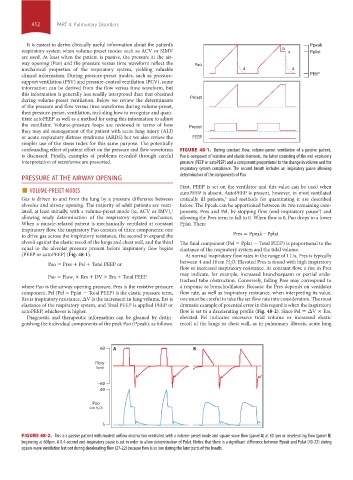
                 confounding effect of patient effort on the pressure and flow waveforms   FIGURE 48-1.  During constant flow, volume-preset ventilation of a passive patient,
                 is discussed. Finally, examples of problems revealed through careful   Pao is composed of resistive and elastic elements, the latter consisting of the end-expiratory
                 interpretation of waveforms are presented.            pressure (PEEP or autoPEEP) and a component proportional to the change in volume and the
                                                                       respiratory  system  compliance. The  second breath includes  an  inspiratory  pause  allowing
                                                                       determination of the components of Pao.
                 PRESSURE AT THE AIRWAY OPENING
                     ■  VOLUME-PRESET MODES                            First, PEEP is set on the ventilator and this value can be used when
                                                                       autoPEEP is absent. AutoPEEP is present, however, in most ventilated
                 Gas is driven to and from the lung by a pressure difference between   critically ill patients,  and methods  for quantitating it are described
                                                                                       2
                 alveolus and airway opening. The majority of adult patients are venti-  below. The Ppeak can be apportioned between its two remaining com-
                 lated, at least initially, with a volume-preset mode (ie, ACV or IMV),    ponents, Pres and Pel, by stopping flow (end-inspiratory pause ) and
                                                                    1
                                                                                                                      3
                 allowing ready determination  of  the respiratory system  mechanics.   allowing the Pres term to fall to 0. When flow is 0, Pao drops to a lower
                 When a muscle-relaxed patient is mechanically ventilated at constant   Pplat. Then:
                 inspiratory flow, the inspiratory Pao consists of three components: one
                 to drive gas across the inspiratory resistance, the second to expand the   Pres = Ppeak – Pplat
                 alveoli against the elastic recoil of the lungs and chest wall, and the third   The final component (Pel = Pplat − Total PEEP) is proportional to the
                 equal to the alveolar pressure present before inspiratory flow begins   elastance of the respiratory system and the tidal volume.
                 (PEEP or autoPEEP) (Fig. 48-1).                         At normal inspiratory flow rates in the range of 1 L/s, Pres is typically
                          Pao = Pres + Pel + Total PEEP or             between 4 and 10 cm H O. Elevated Pres is found with high inspiratory
                                                                                        2
                                                                       flow or increased inspiratory resistance. At constant flow, a rise in Pres
                                                                       may indicate, for example, increased bronchospasm or partial endo-
                          Pao = Flow  × Rrs + DV × Ers + Total PEEP
                                   I                                   tracheal tube obstruction. Conversely, falling Pres may correspond to
                 where Pao is the airway opening pressure, Pres is the resistive pressure   a response to bronchodilators. Because the Pres depends on ventilator
                 component, Pel (Pel = Pplat − Total PEEP) is the elastic pressure term,   flow rate, as well as inspiratory resistance, when interpreting its value,
                 Rrs is inspiratory resistance, ΔV is the increment in lung volume, Ers is   one must be careful to take the set flow rate into consideration. The most
                 elastance of the respiratory system, and Total PEEP is applied PEEP or   dramatic example of potential error in this regard is when the inspiratory
                 autoPEEP, whichever is higher.                        flow is set to a decelerating profile (Fig. 48-2). Since Pel = ΔV × Ers,
                   Diagnostic  and  therapeutic  information  can  be  gleaned  by  distin-  elevated Pel indicates excessive tidal volume or increased elastic
                 guishing the individual components of the peak Pao (Ppeak), as follows.   recoil of the lungs or chest wall, as in pulmonary fibrosis, acute lung


                                            60  A                           B

                                          Flow
                                           (lpm)


                                           −60
                                            40

                                         Pao
                                        (cm H O)
                                           2
                                             5

                 FIGURE 48-2.  This is a passive patient with modest airflow obstruction ventilated with a volume-preset mode and square wave flow (panel A) at 60 lpm or decelerating flow (panel B)
                 beginning at 60 lpm. A 0.4-second end-inspiratory pause is set in order to allow determination of Pplat. Notice that there is a significant difference between Ppeak and Pplat (40-22) during
                 square wave ventilation but not during decelerating flow (27-22) because flow is so low during the later parts of the breath.


            section04.indd   412                                                                                       1/23/2015   2:19:04 PM

