


Page 593 - Hall et al (2015) Principles of Critical Care-McGraw-Hill
P. 593
CHAPTER 48: Ventilator Waveforms: Clinical Interpretation  413


                        cm H 2 O           Pressure-time           s          l/s                 Flow-time                s
                        90                                                  1.2


                                                                             0                                           6
                         0

                                                                           −1.2
                         l/s                Flow-time        Flow-time
                        1.2
                                                                             cm H O             Pressure-time              s
                                                                                2
                                                                             40
                         0


                       −1.2
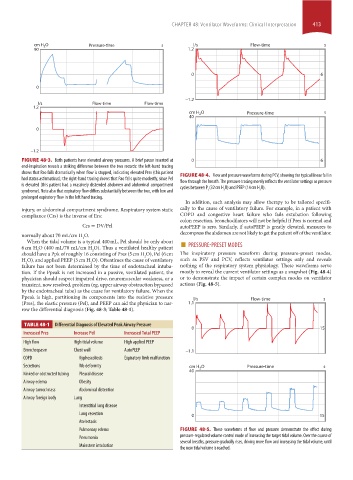
                    FIGURE 48-3.  Both patients have elevated airway pressures. A brief pause inserted at   0            6
                    end-inspiration reveals a striking difference between the two records: the left-hand tracing
                    shows that Pao falls dramatically when flow is stopped, indicating elevated Pres (this patient   FIGURE 48-4.  Flow and pressure waveforms during PCV, showing the typical linear fall in
                    had status asthmaticus); the right-hand tracing shows that Pao falls quite modestly, since Pel   flow through the breath. The pressure tracing merely reflects the ventilator settings as pressure
                    is elevated (this patient had a massively distended abdomen and abdominal compartment   cycles between P (32 cm H O) and PEEP (14 cm H O).
                    syndrome). Note also that expiratory flow differs substantially between the two, with low and   I  2  2
                    prolonged expiratory flow in the left hand tracing.
                                                                           In addition, such analysis may allow therapy to be tailored specifi-
                    injury, or abdominal compartment syndrome. Respiratory system static   cally to the cause of ventilatory failure. For example, in a patient with
                    compliance (Crs) is the inverse of Ers:               COPD and congestive heart failure who fails extubation following
                                                                          colon  resection, bronchodilators will not be helpful if Pres is normal and
                                        Crs = DV/Pel                        autoPEEP is zero. Similarly, if autoPEEP is greatly elevated, measures to
                    normally about 70 mL/cm H O.                          decompress the abdomen are not likely to get the patient off of the ventilator.
                    6 cm H O (400 mL/70 mL/cm H O). Thus a ventilated healthy patient   ■  PRESSURE-PRESET MODES
                                        2
                     When the tidal volume is a typical 400 mL, Pel should be only about
                         2
                                            2
                    should have a Ppk of roughly 16 consisting of Pres (5 cm H O), Pel (6 cm   The inspiratory pressure waveform during pressure-preset modes,
                                                             2
                    H O), and applied PEEP (5 cm H O). Oftentimes the cause of ventilatory   such as  PSV and PCV,  reflects ventilator  settings  only and reveals
                                           2
                     2
                    failure has not been determined by the  time of endotracheal intuba-  nothing  of  the  respiratory  system  physiology.  These  waveforms  serve
                    tion. If the Ppeak is not increased in a passive, ventilated patient, the   mostly to reveal the current ventilator settings as a snapshot (Fig. 48-4)
                    physician should suspect impaired drive, neuromuscular weakness, or a    or to demonstrate the impact of certain complex modes on ventilator
                    transient, now resolved, problem (eg, upper airway obstruction bypassed   actions (Fig. 48-5).
                    by the endotracheal tube) as the cause for ventilatory failure. When the
                    Ppeak is high, partitioning its components into the resistive pressure   l/s  Flow-time               s
                    (Pres), the elastic pressure (Pel), and PEEP can aid the physician to nar-  1.1
                    row the differential diagnosis (Fig. 48-3; Table 48-1).
                      TABLE 48-1    Differential Diagnosis of Elevated Peak Airway Pressure
                                                                              0                                          15
                    Increased Pres   Increase Pel      Increased Total PEEP
                    High flow        High tidal volume  High applied PEEP
                    Bronchospasm     Chest wall        AutoPEEP             −1.1
                    COPD               Kyphoscoliosis  Expiratory limb malfunction
                    Secretions         Rib deformity                         cm H O             Pressure-time             s
                                                                                2
                                                                             40
                    Kinked or obstructed tubing   Pleural disease
                    Airway edema       Obesity
                    Airway tumor/mass    Abdominal distention
                    Airway foreign body  Lung
                                       Interstitial lung disease
                                       Lung resection                         0                                          15
                                       Atelectasis
                                       Pulmonary edema                    FIGURE 48-5.  These waveforms of flow and pressure demonstrate the effect during
                                       Pneumonia                          pressure- regulated volume control mode of increasing the target tidal volume. Over the course of
                                                                          several breaths, pressure gradually rises, driving more flow and increasing the tidal volume, until
                                       Mainstem intubation                the new tidal volume is reached.


            section04.indd   413                                                                                       1/23/2015   2:19:05 PM

