


Page 629 - Hall et al (2015) Principles of Critical Care-McGraw-Hill
P. 629
448     PART 4: Pulmonary Disorders


                 frequencies (∼3-15 Hz), so as to avoid tidal overstretch and recruitment/   ECLS.  In this trial, 180 patients were randomized to receive venous-
                                                                            137
                 derecruitment. Preliminary studies in children  and adults  appeared   venous ECMO or conventional ventilation. Patients randomized to ECLS
                                                            131
                                                   130
                 to support these theoretical advantages and suggested that HFO was at   were transferred to and treated in a single reference center. Of the patients
                 least as safe as conventional ventilator strategies and that it was effective   transferred, 25% did not receive ECMO (improved or died shortly after
                 in improving oxygenation. However, these studies were hampered by   transfer). The group that were transferred to the center of excellence had
                 their small size and the fact that the control groups likely did not repre-  better 6 months survival compared to control patients who were treated in
                 sent the current standard of care, namely V  <6 mL/kg PBW. In the face   regional hospitals where the “best practice” for mechanical ventilation was
                                                t
                 of persuasive biological rationale and promising preliminary trials,  the   left to the discretion of the treating physicians. The trial has been criticized
                                                                 132
                 results of the OSCILLATE and OSCAR trials were surprising and disap-  because all of the ECMO patients went to a specialized center, whereas the
                 pointing. 133,134  Both trials compared HFO to a lung-protective strategy   control group were treated in multiple nonspecialized hospitals. As the side
                 that employed low tidal volume and higher PEEP levels to fully recruit   effects of various types of ECMO are decreasing, this mode of gas exchange
                 the lung. In the UK study, 398 patients were randomized to HFO and    may prove to be very useful.
                 397 patients to a conventional lung-protective strategy. There was no dif-
                 ference in mortality between the two groups. Death at 30 days occurred  SUMMARY
                 in 42% in the HFO group compared to 41% in the conventional ventila-
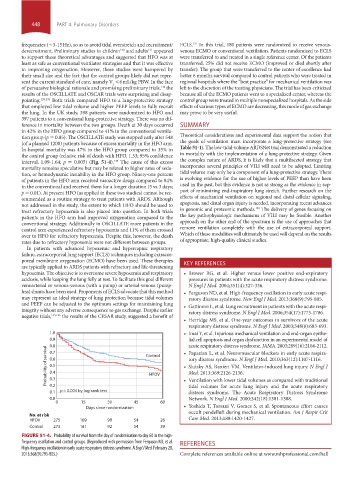
                 tion group (p = 0.85). The OSCILLATE study was stopped early after 548   Theoretical considerations and experimental data support the notion that
                 (of a planned 1200) patients because of excess mortality in the HFO arm.   the goals of ventilation must incorporate a lung-protective strategy (see
                 In-hospital mortality was 47% in the HFO group compared to 35% in   Table 51-1). The low-tidal-volume ARDSNet trial demonstrated a reduction
                 the control group (relative risk of death with HFO, 1.33; 95% confidence   in mortality with the implementation of a lung-protective strategy. Given
                 interval, 1.09-1.64;  p  = 0.005) (Fig. 51-4).  The cause of this excess   the complex nature of ARDS, it is likely that a multifaceted strategy that
                                                 133
                 mortality remains speculative but may be related to higher rates of seda-  incorporates several principles of VILI will need to be adopted. Limiting
                 tion, or hemodynamic instability in the HFO group. Ninety-one percent     tidal volume may only be a component of a lung-protective strategy. There
                 of patients in the HFO arm received vasoactive drugs compared to 84%   is evolving evidence for the use of higher levels of PEEP than have been
                 in the conventional and received them for a longer duration (5 vs 3 days;    used in the past, but this evidence is not as strong as the evidence in sup-
                 p = 0.01). At present HFO (as applied in these two studies) cannot be rec-  port of minimizing end-inspiratory lung stretch. Further research on the
                 ommended as a routine strategy to treat patients with ARDS. Although   effects of mechanical ventilation on regional and distal cellular signaling,
                 not addressed in the study, the extent to which HFO should be used to   apoptosis, and distal organ injury is needed, incorporating recent advances
                                                                                                 138
                 treat refractory hypoxemia is also placed into question. In both trials   in genomic and proteomic methods.  The delivery of genes focusing on
                 patients in the HFO arm had improved oxygenation compared to the   the key pathophysiologic mechanisms of VILI may be feasible. Another
                 conventional strategy. Additionally in OSCILLATE more patients in the   approach on the other end of the spectrum is the use of approaches that
                 control arm experienced refractory hypoxemia and 11% of them crossed   remove   ventilation completely with the use of extracorporeal support.
                 over to HFO for refractory hypoxemia. Despite this, however, the death   Which of these  modalities will ultimately be used will depend on the results
                 rates due to refractory hypoxemia were not different between groups.  of appropriate, high-quality clinical studies.
                   In patients with advanced hypoxemic and hypercapnic respiratory
                 failure, extracorporeal lung support (ECLS) techniques including extracor-
                 poreal membrane oxygenation (ECMO) have been used. These therapies   KEY REFERENCES
                 are typically applied to ARDS patients with refractory and life-threatening
                 hypoxemia. The objective is to overcome severe hypoxemia and respiratory     • Brower RG, et al. Higher versus lower positive end-expiratory
                 acidosis, while keeping the lung fully at rest. To facilitate this goal different   pressures in patients with the acute respiratory distress syndrome.
                 venoarterial or venous-venous (with a pump) or arterial-venous (pump-  N Engl J Med. 2004;351(4):327-336.
                 less) shunts have been used. Proponents of ECLS advocate that this method     • Ferguson ND, et al. High-frequency oscillation in early acute respi-
                 may represent an ideal strategy of lung protection because tidal volumes   ratory distress syndrome. New Engl J Med. 2013;368(9):795-805.
                 and PEEP can be adjusted to the optimum settings for maintaining lung     • Gattinoni L, et al. Lung recruitment in patients with the acute respi-
                 integrity without any adverse consequence to gas exchange. Despite earlier   ratory distress syndrome. N Engl J Med. 2006;354(17):1775-1786.
                 negative trials, 135,136  the results of the CESAR study, suggested a benefit of
                                                                           • Herridge MS, et al. One-year outcomes in survivors of the acute
                                                                          respiratory distress syndrome. N Engl J Med. 2003;348(8):683-693.
                           1.0                                             • Imai Y, et al. Injurious mechanical ventilation and end-organ epithe-
                           0.9                                            lial cell apoptosis and organ dysfunction in an experimental model of
                                                                          acute respiratory distress syndrome. JAMA. 2003;289(16):2104-2112.
                           0.8                              Control        • Papazian L, et al. Neuromuscular blockers in early acute respira-
                          Probability of survival  0.6       HFOV          • Slutsky AS, Ranieri VM. Ventilator-induced lung injury. N Engl J
                           0.7
                                                                          tory distress syndrome. N Engl J Med. 2010;363(12):1107-1116.
                           0.5
                                                                          Med. 2013;369:2126-2136.
                           0.4
                           0.3
                                                                           • Ventilation with lower tidal volumes as compared with traditional
                           0.2
                                                                          distress syndrome. The Acute Respiratory Distress Syndrome
                           0.1  p = 0.004 by log-rank test                tidal volumes for acute lung injury and the acute respiratory
                           0.0                                            Network. N Engl J Med. 2000;342(18):1301-1308.
                             0       15       30       45       60         • Yoshida T, Torsani V, Gomes S, et al. Spontaneous effort causes
                                       Days since randomization
                    No. at risk                                           occult pendelluft during mechanical ventilation. Am J Respir Crit
                                                                          Care Med. 2013;188:1420-1427.
                    HFOV    275      169      98       54       26
                    Control  273     181      92       54       39
                 FIGURE 51-4.  Probability of survival from the day of randomization to day 60 in the high-
                 frequency oscillation and control groups. (Reproduced with permission from Ferguson ND, et al.   REFERENCES
                 High-frequency oscillation in early acute respiratory distress syndrome. N Engl J Med. February 28,
                 2013;368(9):795-805.)                                 Complete references available online at www.mhprofessional.com/hall


            section04.indd   448                                                                                       1/23/2015   2:19:32 PM

