


Page 632 - Hall et al (2015) Principles of Critical Care-McGraw-Hill
P. 632
CHAPTER 52: Acute Lung Injury and the Acute Respiratory Distress Syndrome  451


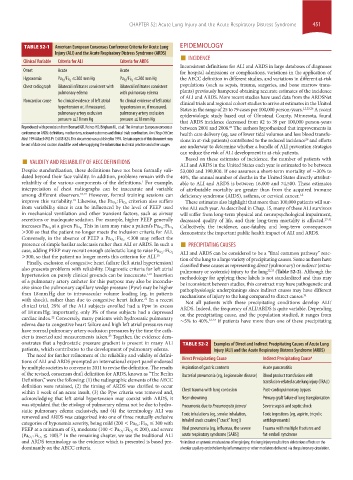
                      TABLE 52-1     American European Consensus Conference Criteria for Acute Lung   EPIDEMIOLOGY
                               Injury (ALI) and the Acute Respiratory Distress Syndrome (ARDS)    ■
                    Clinical Variable  Criteria for ALI  Criteria for ARDS  INCIDENCE
                                                                          Inconsistent definitions for ALI and ARDS in large databases of diagnoses
                    Onset       Acute                Acute                for hospital admissions or complications, variations in the application of
                    Hypoxemia   Pa O 2 /Fi O 2  ≤300 mm Hg  Pa O 2 /Fi O 2  ≤200 mm Hg  the AECC definition in different studies, and variations in different at-risk
                    Chest radiograph  Bilateral infiltrates consistent with  Bilateral infiltrates consistent   populations  (such  as  sepsis,  trauma,  surgeries,  and  bone  marrow  trans-
                                pulmonary edema      with pulmonary edema  plants) previously hampered obtaining accurate estimates of the incidence
                                                                          of ALI and ARDS. More recent studies have used data from the ARDSNet
                    Noncardiac cause  No clinical evidence of left atrial   No clinical evidence of left atrial   clinical trials and regional cohort studies to arrive at estimates in the United
                                  hypertension or, if measured,   hypertension or, if measured,   States in the range of 25 to 79 cases per 100,000 person-years. 1,2,25,26  A recent
                                  pulmonary artery occlusion     pulmonary artery occlusion   epidemiologic  study  based  out  of  Olmstead  County,  Minnesota,  found
                                  pressure ≤18 mm Hg    pressure ≤18 mm Hg
                                                                          that ARDS incidence decreased from 82 to 39 per 100,000 person-years
                    Reproduced with permission from Bernard GR, Reines HD, Brigham KL, et al: The American European consensus   between 2001 and 2008.  The authors hypothesized that improvements in
                                                                                          26
                    conference on ARDS: definitions, mechanisms, relevant outcomes and clinical trials coordination. Am J Resp Crit Care   health care delivery (eg, use of lower tidal volumes and less blood transfu-
                    Med. 1994 Mar;149(3 Pt 1):818-824. This document was published in 1994. Certain aspects of this document may   sions in at-risk patients) contributed to the reduced incidence  and efforts
                                                                                                                    26
                    be out of date and caution should be used when applying the information in clinical practice and other usages.  are underway to determine whether a bundle of ALI prevention strategies
                                                                          can reduce the risk of ALI development in at-risk patients.
                        ■  VALIDITY AND RELIABILITY OF AECC DEFINITIONS    Based on these estimates of incidence, the number of patients with
                    Despite standardization, these definitions have not been formally vali-  ALI and ARDS in the United States each year is estimated to be between
                                                                          53,000 and 190,000. If one assumes a short-term mortality of ∼30% to
                    dated beyond their face validity. In addition, problems remain with the   40%, the annual number of deaths in the United States directly attribut-
                    reliability of the various components of the definitions.  For example,   able to ALI and ARDS is between 16,000 and 74,500. These estimates
                                                             1
                    interpretation of chest radiographs can be inaccurate and variable   of attributable mortality are greater than from the acquired immune
                    among different observers. 18,19  However, formal training sessions can   deficiency syndrome (AIDS), asthma, or cervical cancer. 1,2
                                     19                 criterion also suffers   These estimates also highlight that more than 100,000 patients will sur-
                    improve this variability.  Likewise, the Pa O 2  : Fi O 2
                    from variability since it can be influenced by the level of PEEP used   vive ALI each year. As described in Chap. 15, many of these ALI survivors
                    in mechanical ventilation and other transient factors, such as airway   will suffer from long-term physical and neuropsychological impairment,
                    secretions or inadequate sedation. For example, higher PEEP generally   decreased quality of life, and their long-term mortality is affected. 27-31
                                                                          Collectively, the incidence, case-fatality, and long-term consequences
                    increases Pa O 2  at a given Fi O 2 . This in turn may raise a patient’s Pa O 2  : Fi O 2
                    >300 so that the patient no longer meets the inclusion criteria for ALI.   demonstrate the important public health impact of ALI and ARDS.
                                                        <300 may reflect the
                    Conversely, in the absence of PEEP a Pa O 2  : Fi O 2     ■
                    presence of simple basilar atelectasis rather than ALI or ARDS. In such a   PRECIPITATING CAUSES

                    case, adding PEEP may recruit enough atelectatic lung to raise Pa O 2  : Fi O 2  ALI and ARDS can be considered to be a “final common pathway” reac-
                    >300, so that the patient no longer meets this criterion for ALI. 20  tion of the lung to a large variety of precipitating causes. Some authors have
                     Finally, exclusion of congestive heart failure (left atrial hypertension)   classified these causes as representing direct (pulmonary) or indirect (extra-
                    also presents problems with reliability. Diagnostic criteria for left atrial   pulmonary or systemic) injury to the lung 32,33  (Table 52-2). Although the
                    hypertension on purely clinical grounds can be inaccurate.  Insertion   methodology for applying these labels is not standardized and thus may
                                                              1,21
                    of a pulmonary artery catheter for this purpose may also be inconclu-  be inconsistent between studies, this construct may have pathogenetic and
                    sive since the pulmonary capillary wedge pressure (Ppw) may be higher   pathophysiologic underpinnings since indirect causes may have different
                    than 18 mm Hg due to intravascular volume loading (eg, in patients   mechanisms of injury to the lung compared to direct causes. 34
                    with shock), rather than due to congestive heart failure.  In a recent   Not  all  patients  with  these  precipitating  conditions develop  ALI/
                                                             21
                    clinical trial, 29% of the ALI subjects enrolled had a Ppw in excess   ARDS. Indeed, the frequency of ALI/ARDS is quite variable. Depending
                    of 18 mm Hg; importantly, only 3% of these subjects had a depressed   on the precipitating cause, and the population studied, it ranges from
                    cardiac index.  Conversely, many patients with hydrostatic pulmonary   ∼5% to 40%. 32-37  If patients have more than one of these precipitating
                              22
                    edema due to congestive heart failure and high left atrial pressures may
                    have normal pulmonary artery occlusion pressures by the time the cath-
                    eter is inserted and measurements taken.  Together, the evidence dem-
                                                 23
                    onstrates that a hydrostatic pressure gradient is  present in many ALI     TABLE 52-2     Examples of Direct and Indirect Precipitating Causes of Acute Lung
                    patients, which contributes to the development of pulmonary edema.  Injury (ALI) and the Acute Respiratory Distress Syndrome (ARDS)
                     The need for further refinement of the reliability and validity of defini-                       a
                    tions of ALI and ARDS prompted an international expert panel endorsed   Direct Precipitating Cause  Indirect Precipitating Cause
                    by multiple societies to convene in 2011 to revise the definition. The results   Aspiration of gastric contents  Acute pancreatitis
                    of the revised, consensus draft definition for ARDS, known as “The Berlin   Bacterial pneumonia (eg, Legionnaire disease)  Blood product transfusions with
                    Definition,” were the following: (1) the radiographic elements of the AECC          transfusion-related acute lung injury (TRALI)
                    definition were retained, (2) the timing of ARDS was clarified to occur
                    within 1 week of an acute insult, (3) the Ppw criteria was removed and,   Chest trauma with lung contusion  Post-cardiopulmonary bypass
                    acknowledging that left atrial hypertension may coexist with ARDS, it   Near-drowning  Primary graft failure of lung transplantation
                    was stipulated that the etiology of pulmonary edema not be due to hydro-  Pneumonia due to Pneumocystis jiroveci  Severe sepsis and septic shock
                    static pulmonary edema exclusively, and (4) the terminology ALI was
                    removed and ARDS was categorized into one of three mutually exclusive   Toxic inhalations (eg, smoke inhalation,   Toxic ingestions (eg, aspirin, tricyclic
                                                                ≤ 300 with   inhaled crack cocaine [“crack” lung])    antidepressants)
                    categories of hypoxemia severity, being mild (200 < Pa O 2  : Fi O 2
                                                           ≤ 200), and severe    Viral pneumonia (eg, influenza, the severe   Trauma with multiple fractures and
                    PEEP at a minimum of 5), moderate (100 < Pa O 2  : Fi O 2
                            ≤ 100).  In the remaining chapter, we use the traditional ALI   acute respiratory syndrome [SARS])  fat-emboli syndrome
                                24
                    (Pa O 2  : Fi O 2
                    and ARDS terminology as the evidence which is presented is based pre-  a In indirect or systemic mechanisms of lung injury, the lung injury results from deleterious effects on the
                    dominantly on the AECC criteria.                      alveolar capillary endothelium by inflammatory or other mediators delivered via the pulmonary circulation.


            section04.indd   451                                                                                       1/23/2015   2:19:33 PM

