


Page 634 - Hall et al (2015) Principles of Critical Care-McGraw-Hill
P. 634
CHAPTER 52: Acute Lung Injury and the Acute Respiratory Distress Syndrome  453


                    progresses, there is extensive necrosis of type I alveolar epithelial cells. If   in late-phase ARDS typically had a large dead space fraction, a high
                    the patient with ARDS does not recover or die during the first week, they   minute ventilation requirement, progressive pulmonary hypertension,
                    may have a prolonged course of illness, termed late-phase ARDS.  slightly improved intrapulmonary shunt that is less responsive to PEEP,
                     The later phase of ARDS is dominated by disordered healing. This can   and a further reduction in lung compliance. 73
                    occur as early as 7 to 10 days after initial injury and may eventually result
                    in extensive pulmonary fibrosis. This has been termed the proliferative   PATHOGENESIS
                    or fibroproliferative phase. Type II alveolar cells proliferate along alveolar
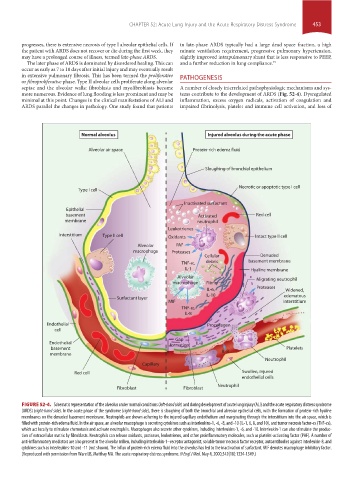
                    septae and the alveolar walls; fibroblasts and myofibroblasts become   A number of closely interrelated pathophysiologic mechanisms and sys-
                    more numerous. Evidence of lung flooding is less prominent and may be   tems contribute to the development of ARDS (Fig. 52-4). Dysregulated
                    minimal at this point. Changes in the clinical manifestations of ALI and   inflammation, excess oxygen radicals, activation of coagulation and
                    ARDS parallel the changes in pathology. One study found that patients   impaired fibrinolysis, platelet and immune cell activation, and loss of


                                        Normal alveolus                            Injured alveolus during the acute phase


                                          Alveolar air space                  Protein-rich edema fluid


                                                                                  Sloughing of bronchial epithelium


                                                                                              Necrotic or apoptotic type I cell
                                       Type I cell
                                                                           Inactivated surfactant
                                   Epithelial
                                   basement                                     Activated           Red cell
                                  membrane                                     neutrophil
                                                                      Leukotrienes
                                Interstitium   Type II cell           Oxidants                     Intact type II cell
                                                           Alveolar     PAF
                                                          macrophage   Proteases
                                                                                  Cellular           Denuded
                                                                          TNF- ,  debris         basement membrane
                                                                           IL-1                   Hyaline membrane
                                                                         Alveolar                   Migrating neutrophil
                                                                       macrophage  Fibrin
                                                                                   IL-6,            Proteases  Widened,
                                                                                  IL-10                      edematous
                                                    Surfactant layer
                                                                      MIF                                    interstitium
                                                                          TNF- ,
                                                                           IL-8
                            Endothelial                                            Procollagen
                               cell
                                                                        Gap
                             Endothelial                              formation  IL-8
                              basement                                                                        Platelets
                             membrane                                                   IL-8
                                                                                                       Neutrophil
                                                             Capillary
                                      Red cell                                                 Swollen, injured
                                                                                               endothelial cells
                                                                                      Neutrophil
                                                    Fibroblast             Fibroblast

                    FIGURE 52-4.  Schematic representation of the alveolus under normal conditions (left-hand side) and during development of acute lung injury (ALI) and the acute respiratory distress syndrome
                    (ARDS) (right-hand side). In the acute phase of the syndrome (right-hand side), there is sloughing of both the bronchial and alveolar epithelial cells, with the formation of protein-rich hyaline
                    membranes on the denuded basement membrane. Neutrophils are shown adhering to the injured capillary endothelium and marginating through the interstitium into the air space, which is
                    filled with protein-rich edema fluid. In the air space, an alveolar macrophage is secreting cytokines such as interleukins-1, -6, -8, and -10 (IL-1, 6, 8, and 10), and tumor necrosis factor-α (TNF-α),
                    which act locally to stimulate chemotaxis and activate neutrophils. Macrophages also secrete other cytokines, including interleukins-1, -6, and -10. Interleukin-1 can also stimulate the produc-
                    tion of extracellular matrix by fibroblasts. Neutrophils can release oxidants, proteases, leukotrienes, and other proinflammatory molecules, such as platelet-activating factor (PAF). A number of
                    anti-inflammatory mediators are also present in the alveolar milieu, including interleukin-1–receptor antagonist, soluble tumor necrosis factor receptor, autoantibodies against interleukin-8, and
                    cytokines such as interleukins-10 and -11 (not shown). The influx of protein-rich edema fluid into the alveolus has led to the inactivation of surfactant. MIF denotes macrophage inhibitory factor.
                    (Reproduced with permission from Ware LB, Matthay MA. The acute respiratory distress syndrome. N Engl J Med. May 4, 2000;342(18):1334-1349.)


            section04.indd   453                                                                                       1/23/2015   2:19:39 PM

