


Page 633 - Hall et al (2015) Principles of Critical Care-McGraw-Hill
P. 633
452     PART 4: Pulmonary Disorders


                 causes, they are at an even higher increased risk for development of   Despite recent advances in therapy, the mortality rates reported in clini-
                 ALI or ARDS. On average, ALI develops early in the course of the   cal trials in the past decade have ranged from ∼25% to more than 50%. 3-9,22
                 hospitalization in at-risk patients. In two, large multicenter observa-  The lowest mortality rates have been achieved with low-tidal-volume venti-
                 tional cohort studies, ALI developed on average by hospital day 2 and   lation, which also limited end-inspiratory (plateau) pressure. 3,4,22  Although
                 the vast majority within 4 days. 35,36  Patients with a direct injury to the   no recent studies have explicitly examined the cause of death in nonsurvi-
                 lung developed ALI on average 3 days earlier than patients with an   vors, previously the majority of deaths were found to be due to multiorgan
                 indirect injury. 35                                   failure or sepsis, while progressive respiratory failure accounted for a small
                     ■  RISK FACTORS FOR THE DEVELOPMENT OF ALI        minority of deaths (eg, ∼15%). 65,66
                                                                         ALI and ARDS impact the health and lives of survivors beyond the
                    AND ARDS AND PREDICTION MODELS                     ICU. Long-term physical, neuropsychiatric, and cognitive impairments
                 Why certain individuals with the same precipitating cause develop ALI   in ALI survivors are common and are associated with reduced quality
                 and ARDS while others do not is unknown. Some of this differential risk   of life (see Chap. 15). 27-31,67-70  In the aggregate, these deficits are extreme
                 can be attributed to other acquired risk factors, such as chronic alcohol-  examples  of  the post-intensive  care syndrome,  and they  represent an
                 ism.  In addition, certain individuals may have an inherent predisposition   important aspect of the impact of ARDS.
                    37
                 to developing ALI or ARDS while others may have inherent protections
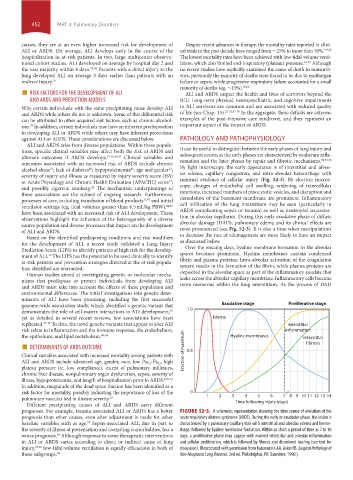
                 against ALI or ARDS. These considerations are discussed below.  PATHOLOGY AND PATHOPHYSIOLOGY
                   ALI and ARDS arise from diverse populations. Within these popula-
                 tions, specific clinical variables may affect both the risk of ARDS and   It can be useful to distinguish between the early phases of lung injury and
                 ultimate outcomes  if  ARDS develops. 34-36,38,39  Clinical  variables  and   subsequent events, as the early phases are characterized by exuberant infla-
                                                                                                                       38,71,72
                 outcomes associated with an increased risk of ARDS include chronic   m mation and the later phases by repair and fibrotic mechanisms.
                 alcohol abuse ; lack of diabetes ; hypoproteinemia ; age and gender ;   By light microscopy, the early appearance is of interstitial and alveo-
                                                      41
                                                                   13
                           37
                                        40
                 severity of injury and illness as measured by injury severity score (ISS)   lar edema, capillary congestion, and intra-alveolar hemorrhage with
                 or Acute Physiology and Chronic Health Evaluation (APACHE) score ;   minimal evidence of cellular injury (Fig. 52-3). By electron micros-
                                                                   13
                 and possibly cigarette smoking.  The mechanistic underpinnings of   copy, changes of endothelial cell swelling, widening of intercellular
                                         42
                 these associations are the subject of ongoing research. Furthermore,     junctions, increased numbers of pinocytotic vesicles, and disruption and
                 processes of care, including transfusion of blood products 13,43  and initial     denudation of the basement membrane are prominent. Inflammatory
                 ventilator settings (eg, tidal volumes greater than 6.5 mL/kg PBW), 44,45    cell infiltration of the lung interstitium may be seen (particularly in
                 have been associated with an increased risk of ALI development. These   ARDS complicating sepsis or trauma) as well as neutrophil sequestra-
                 observations highlight the influence of the heterogeneity of a diverse   tion in alveolar capillaries. During this early exudative phase of diffuse
                 source population and diverse processes that impact on the development   alveolar damage (DAD), pulmonary edema and its clinical effects are
                 of ALI and ARDS.                                      most pronounced (see Fig. 52-3). It is also a time when manipulations
                   Based on the identified predisposing conditions and risk modifiers   to decrease the rate of edemagenesis are most likely to have an impact
                 for the development of ALI, a recent study validated a Lung Injury   as discussed below.
                 Prediction Score (LIPS) to identify patients at high risk for the develop-  Over the ensuing days, hyaline membrane formation in the alveolar
                 ment of ALI.  The LIPS has the potential to be used clinically to identify   spaces  becomes  prominent.  Hyaline membranes contain  condensed
                          36
                 at-risk patients and prevention strategies directed at the at-risk popula-  fibrin and plasma proteins. Intra-alveolar activation of the coagulation
                 tion identified are warranted.                        system results in the formation of the fibrin, while plasma proteins are
                   Human studies aimed at investigating genetic or molecular mecha-  deposited in the alveolar space as part of the inflammatory exudate that
                 nisms that predispose or protect individuals from developing ALI   leaks across the alveolar-capillary membrane. Inflammatory cells become
                 and ARDS must take into account the effects of these population and   more numerous within the lung interstitium. As the process of DAD
                 environmental differences. The initial investigations into genetic deter-
                 minants  of ALI  have been promising,  including  the first successful
                 genome-wide association study, which identified a genetic variant that   Exudative stage   Proliferative stage
                 demonstrates the role of cell-matrix interactions in ALI development,    1.0
                                                                    46
                 yet as detailed in several recent reviews, few associations have been   Edema
                 replicated. 47-49  To date, the novel genetic variants that appear to alter ALI            Interstitial
                 risk relate to inflammation and the immune response, the endothelium,                     inflammation
                 the epithelium, and lipid metabolism. 49-54                            Hyaline membranes        Interstitial
                     ■  DETERMINANTS OF ARDS OUTCOME                                                              fibrosis

                 Clinical variables associated with increased mortality among patients with   Fraction of maximum  0.5
                                                                 , high
                 ALI and ARDS include advanced age, gender, race, low Pa O 2  : Fi O 2
                 plateau pressure (ie, low compliance), extent of pulmonary infiltrates,
                 chronic liver disease, nonpulmonary organ dysfunction, sepsis, severity of
                 illness, hypoproteinemia, and length of hospitalization prior to ARDS. 4,55-61
                 In addition, magnitude of the dead space fraction has been identified as a
                 risk factor for mortality, possibly indicating the importance of loss of the   0
                 pulmonary vascular bed in disease severity. 62                 1   2    3   4    5   6   7 89 10 11 12 13 14
                   Different precipitating causes of ALI and ARDS carry different         Time following injury (days)
                 prognoses. For example, trauma-associated ALI or ARDS has a better   FIGURE 52-3.  A schematic representation showing the time course of evolution of the
                 prognosis than other causes, even after adjustment is made for other   acute respiratory distress syndrome (ARDS). During the early or exudative phase, the lesion is
                 baseline variables such as age.  Sepsis-associated ALI, due in part to   characterized by a pulmonary capillary leak with interstitial and alveolar edema and hemor-
                                        57
                 the severity of illness at presentation and coexisting comorbidities, has a   rhage, followed by hyaline membrane formation. Within as short a period of time as 7 to 10
                 worse prognosis.  Although response to some therapeutic interventions   days, a proliferative phase may appear with marked interstitial and alveolar inflammation
                             58
                 in ALI or ARDS varies according to direct or indirect cause of lung   and cellular proliferation, which is followed by fibrosis and disordered healing (see text for
                 injury, 33,63  low-tidal-volume ventilation is equally efficacious in both of   discussion). (Reproduced with permission from Katzenstein AA, Askin FB. Surgical Pathology of
                 these subgroups. 64                                   Non-Neoplastic Lung Diseases. 2nd ed. Philadelphia, PA: Saunders; 1990.)


            section04.indd   452                                                                                       1/23/2015   2:19:34 PM

