


Page 661 - Hall et al (2015) Principles of Critical Care-McGraw-Hill
P. 661
480     PART 4: Pulmonary Disorders


                                                                 Inclusion criteria
                                             1. Severe ARDS defined according to usual criteria, and
                                             2. Meeting one of the three following criteria of severity:
                                                   /Fi ratio <50 mm Hg with Fi  ≥80% for >3 hours, despite
                                                 a. Pa O 2  O 2       O 2
                                                      optimization of mechanical ventilation and despite possible recourse to
                                                     usual adjunctive therapies (NO, recruitment maneuvers, prone position,
                                                     HFO ventilation, almitrine infusion) OR
                                                   /Fi  ratio <80 mm Hg with Fi  ≥80% for >6 hours, despite
                                                 b. Pa O 2
                                                    O 2               O 2
                                                     optimization of mechanical ventilation and despite possible recourse to
                                                      usual adjunctive therapies (NO, recruitment maneuvers, prone position,
                                                      HFO ventilation, almitrine infusion) OR
                                                 c. pH <7.25 for > 6 hours (RR increased to 35/min) resulting from MV
                                                     settings adjusted to keep Pplat ≤32 cm H O (first, V  reduction by steps of
                                                                          2
                                                                                 T
                                                                                       O
                                                     1 to 4 mL/kg then PEEP reduction to a minimum of 8 cm H 2
                                             3. Obtain patient’s consent or emergency consent
                                                                 Randomization


                                          Experimental treatment arm        Control conventional treatment arm
                                    – Venovenous ECMO will be started as rapidly  – Conventional management of ARDS
                                       as possible                       – Ventilatory settings: volume-assist control
                                    – Mechanical ventilation settings: volume-  mode, V 6 mL/kg of ideal body weight and
                                                                              T
                                                     30%-60%, PEEP ≥10 cm  PEEP adapted so as not to exceed plateau
                                    assist control mode, Fi O 2
                                    H 2 O, V  lowered to obtain a plateau pressure  pressure of 28-30 cm H 2 O
                                         T
                                    ≤20 cm H O, RR 10-30/minute or APRV mode  – In the case of refractory hypoxemia, the usual
                                           2
                                                           O an low         adjunctive therapeutics can be used: NO,
                                    with high pressure level ≤20 cm H 2
                                    pressure level ≥10 cm H O               prone position, HFO ventilation,
                                                    2
                                    – ECMO weaning according to protocol     almitrine infusion
                                                                         – Cross-over option to ECMO possible if
                                                                                                  <80%
                                                                         refractory hypoxemia defined as Sa O 2
                                                                         for >6 hours, despite mandatory use of
                                                                         recruitment maneuvers, and inhaled
                                                                         NO/prostacyclin and if technically possible a
                                                                         test of prone position.
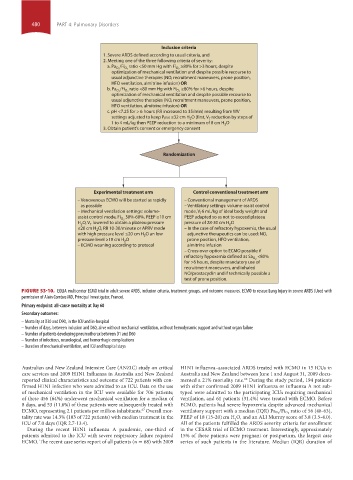
                 FIGURE 53-10.  EOLIA multicenter ECMO trial in adult severe ARDS, inclusion criteria, treatment groups, and outcome measures. ECMO to rescue Lung Injury in severe ARDS (Used with
                 permission of Alain Combes MD, Principal Investigator, France).
                 Primary endpoint: all-cause mortality at Day 60
                 Secondary outcomes:
                  – Mortality at D30 and D90, in the ICU and in-hospital
                  – Number of days, between inclusion and D60, alive without mechanical ventilation, without hemodynamic support and without organ failure
                  – Number of patients developing pneumothorax between D1 and D60
                  – Number of infectious, neurological, and hemorrhagic complications
                  – Duration of mechanical ventilation, and ICU and hospital stays


                 Australian and New Zealand Intensive Care (ANZIC) study on critical   H1N1 influenza–associated ARDS treated with ECMO in 15 ICUs in
                 care services and 2009 H1N1 Influenza in Australia and New Zealand   Australia and New Zealand between June 1 and August 31, 2009 docu-
                 reported clinical characteristics and outcome of 722 patients with con-  mented a 21% mortality rate.  During the study period, 194 patients
                                                                                             68
                 firmed H1N1 infection who were admitted to an ICU. Data on the use   with either confirmed 2009 H1N1 influenza or influenza A not sub-
                 of mechanical ventilation in the ICU were available for 706 patients;   typed were admitted to the participating ICUs requiring mechanical
                 of these 456 (64%) underwent mechanical ventilation for a median of     ventilation, and 61 patients (31.4%) were treated with ECMO. Before
                 8 days, and 53 (11.6%) of these patients were subsequently treated with   ECMO, patients had severe hypoxemia despite advanced mechanical
                 ECMO, representing 2.1 patients per million inhabitants.  Overall mor-  ventilatory support with a median (IQR) Pa O 2 /Fi O 2  ratio of 56 (48-63),
                                                          67
                 tality rate was 14.3% (103 of 722 patients) with median treatment in the   PEEP of 18 (15-20) cm H O, and an ALI Murray score of 3.8 (3.5-4.0).
                                                                                          2
                 ICU of 7.0 days (IQR 2.7-13.4).                       All of the patients fulfilled the ARDS severity criteria for enrollment
                   During the recent H1N1 influenza A pandemic, one-third of   in the CESAR trial of ECMO treatment. Interestingly, approximately
                 patients admitted to the ICU with severe respiratory failure required   15% of these patients were pregnant or postpartum, the largest case
                 ECMO. The recent case series report of all patients (n = 68) with 2009   series of such patients in the literature. Median (IQR) duration of


            section04.indd   480                                                                                       1/23/2015   2:20:02 PM

