


Page 662 - Hall et al (2015) Principles of Critical Care-McGraw-Hill
P. 662
CHAPTER 53: Extracorporeal Lung Support  481


                    mechanical ventilation before initiation of ECMO was 2 (1-5) days.
                    The initial mode of ECMO was veno-venous in 93% and veno-arterial
                    in 7% of patients. Median (IQR) duration of ECMO support was
                    10  (7-15) days. Hemorrhagic   complications occurred in 54% of
                    patients, most commonly at the ECMO cannulation sites. At the time
                    of reporting, 48 of the 68 patients (71%; 95% CI 60%-82%) survived to
                    ICU discharge, of whom 32 survived to hospital discharge. Fourteen
                    patients (21%; 95% CI 11%-30%) had died and 6 remained in the ICU,
                    2 of whom were still receiving ECMO. The patients treated with ECMO
                    had longer duration of mechanical ventilation (median [IQR], 18 [9-27]
                    vs 8 [4-14] days;  p  = .001), ICU stay (median [IQR], 22 [13-32]
                    vs 12 [7-18] days; p = .001), and greater ICU mortality (14 [23%] vs
                    12 [9%]; p = .01).
                     A report from France of the use of ECMO in patients with H1N1-
                    related ARDS documented that mean duration of ECMO support was
                    12  ± 14 days (3-47 days) with a survival rate of 83.3% with a mean
                    follow-up period of approximately 14 months. These patients had severe
                                                            1.0. The patients
                    hypoxemia with a mean Pa O 2  of 57 (range 41-74) on Fi O 2
                    who died on ECMO support had refractory septic shock. 69
                     In comparison, the University of Utah reported experience in 47 patients
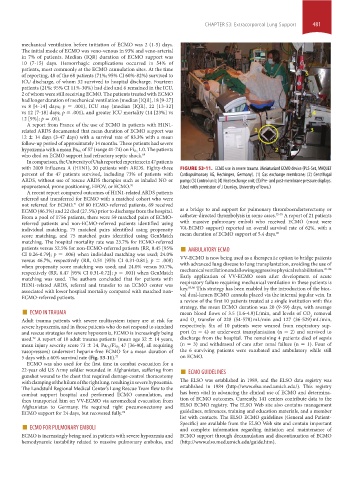
                    with  2009 Influenza A (H1N1),  30 patients  with ARDS.  Eighty-three   FIGURE 53-11.  ECMO use in severe trauma. Miniaturized ECMO device (PLS-Set, MAQUET
                    percent of the 47 patients survived, including 73% of patients with   Cardiopulmonary AG, Hechingen, Germany).  (1) Gas exchange membrane; (2)  Centrifugal
                    ARDS, without use of rescue ARDS therapies such as inhaled NO or   pump; (3) Control unit; (4) Heat exchange unit; (5) Pre- and post-membrane pressure displays.
                    epoprostenol, prone positioning, HFOV, or ECMO. 70    (Used with permission of J Crumley, University of Iowa.)
                     A recent report compared outcomes of H1N1-related ARDS patients
                    referred and transferred for ECMO with a matched cohort who were
                    not referred for ECMO.  Of 80 ECMO-referred patients, 69 received
                                     71
                    ECMO (86.3%) and 22 died (27.5%) prior to discharge from the hospital.     as a bridge to and support for pulmonary thromboendarterectomy or
                    From a pool of 1756 patients, there were 59 matched pairs of ECMO-  catheter-directed thrombolysis in some cases. 75-79  A report of 21 patients
                    referred patients and non-ECMO-referred patients identified using   with massive pulmonary emboli who received ECMO (most were
                    individual matching,  75 matched pairs identified using propensity   VA-ECMO  support)  reported  an  overall  survival  rate  of  62%,  with  a
                    score matching, and 75 matched pairs identified using GenMatch   mean duration of ECMO support of 5.4 days. 80
                    matching. The hospital mortality rate was 23.7% for ECMO-referred
                    patients versus 52.5% for non-ECMO-referred patients (RR, 0.45 [95%     ■  AMBULATORY ECMO
                    CI 0.26-0.79];  p  = .006) when individual matching was used; 24.0%
                    versus 46.7%, respectively (RR, 0.51 [95% CI 0.31-0.81];  p  = .008)   VV-ECMO is now being used as a therapeutic option to bridge patients
                    when propensity score matching was used; and 24.0% versus 50.7%,   with advanced lung disease to lung transplantation, avoiding the use of
                                                                                                                           81-84
                    respectively (RR, 0.47 [95% CI 0.31-0.72]; p = .001) when GenMatch   mechanical ventilation and allowing aggressive physical rehabilitation.
                    matching was used. The authors concluded  that  for patients with   Early application of VV-ECMO soon after development of acute
                    H1N1-related ARDS, referral and transfer to an ECMO center was   respiratory failure requiring mechanical ventilation in these patients is
                                                                            85,86
                    associated with lower hospital mortality compared with matched non-  key.   This strategy has been enabled by the introduction of the bica-
                    ECMO-referred patients.                               val dual-lumen ECMO cannula placed via the internal jugular vein. In
                                                                          a review of the first 10 patients treated at a single institution with this
                        ■  ECMO IN TRAUMA                                 strategy, the mean ECMO duration was 20 (9-59) days, with average
                                                                          mean blood flows of 3.5 (1.6-4.9) L/min, and levels of CO  removal
                                                                                                                      2
                    Adult  trauma  patients  with  severe  multisystem  injury  are  at risk  for   and O  transfer of 228 (54-570) mL/min and 127 (36-529) mL/min,
                                                                              2
                    severe hypoxemia, and in those patients who do not respond to standard   respectively. Six of 10 patients were weaned from respiratory sup-
                    and rescue strategies for severe hypoxemia, ECMO is increasingly being   port (n = 4) or underwent transplantation (n = 2) and survived to
                    used.  A report of 10 adult trauma patients (mean age 32 ± 14 years,   discharge from the hospital. The remaining 4 patients died of sepsis
                       72
                                                      47 [36-90], all requiring   (n  = 3) and withdrawal of care after renal failure (n  = 1). Four of
                    mean injury severity score 73 ± 14, Pa O 2 /Fi O 2
                    vasopressors) underwent heparin-free ECMO for a mean duration of    the 6 surviving patients were extubated and ambulatory while still
                    5 days with a 60% survival rate (Fig. 53-11). 73      on ECMO.
                     ECMO was also used for the first time in combat evacuation for a
                    22-year old US Army soldier wounded in Afghanistan, suffering from     ■  ECMO GUIDELINES
                    gunshot wound to the chest that required damage-control thoracotomy
                    with clamping of the hilum of the right lung, resulting in severe hypoxemia.    The ELSO was established in 1989, and the ELSO data registry was
                    The Landstuhl Regional Medical Center’s Lung Rescue Team flew to the    established in 1984 (http://www.elso.med.umich.edu/). This registry
                    combat support hospital and performed ECMO cannulation, and   has been vital in advancing the clinical use of ECMO and determina-
                    then transported him on VV-ECMO via aeromedical evacuation from   tion of ECMO outcomes. Currently, 141 centers contribute data to the
                    Afghanistan to Germany. He required right pneumonectomy and   ELSO ECMO registry. The ELSO Web site also contains management
                    ECMO support for 24 days, but recovered fully. 74     guidelines, references, training and education materials, and a member
                                                                          list with contacts. The ELSO ECMO guidelines (General and Patient-
                        ■  ECMO FOR PULMONARY EMBOLI                      Specific) are available from the ELSO Web site and contain important
                                                                          and complete information regarding initiation and maintenance of
                    ECMO is increasingly being used in patients with severe hypoxemia and   ECMO support through decannulation and discontinuation of ECMO
                    hemodynamic instability related to massive pulmonary embolus, and   (http://www.elso.med.umich.edu/guide.htm).


            section04.indd   481                                                                                       1/23/2015   2:20:04 PM

