


Page 687 - Hall et al (2015) Principles of Critical Care-McGraw-Hill
P. 687
506     PART 4: Pulmonary Disorders


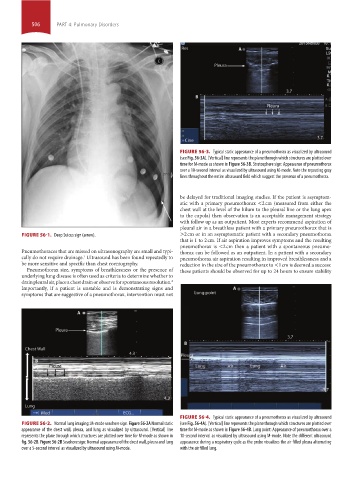
                                                                       FIGURE 56-3.  Typical static appearance of a pneumothorax as visualized by ultrasound
                                                                       (see Fig. 56-3A). [Vertical] line represents the plane through which structures are plotted over
                                                                       time for M-mode as shown in Figure 56-3B. Stratosphere sign: Appearance of pneumothorax
                                                                       over a 10-second interval as visualized by ultrasound using M-mode. Note the repeating gray
                                                                       lines throughout the entire ultrasound field which suggest the presence of a pneumothorax.


                                                                       be delayed for traditional imaging studies. If the patient is asymptom-
                                                                       atic with a primary pneumothorax <2 cm (measured from either the
                                                                       chest wall at the level of the hilum to the pleural line or the lung apex
                                                                       to the cupola) then observation is an acceptable management strategy
                                                                       with follow up as an outpatient. Most experts recommend aspiration of
                                                                       pleural air in a breathless patient with a primary pneumothorax that is
                 FIGURE 56-1.  Deep Sulcus sign (arrow).               >2 cm or in an asymptomatic patient with a secondary pneumothorax
                                                                       that is 1 to 2 cm. If air aspiration improves symptoms and the resulting
                                                                       pneumothorax is  <2 cm then a patient with a spontaneous pneumo-
                 Pneumothoraces that are missed on ultrasonography are small and typi-  thorax can be followed as an outpatient. In a patient with a secondary
                 cally do not require drainage.  Ultrasound has been found repeatedly to   pneumothorax air aspiration resulting in improved breathlessness and a
                                      7
                 be more sensitive and specific than chest roentography.  reduction in the size of the pneumothorax to <1 cm is deemed a success:
                   Pneumothorax size, symptoms of breathlessness or the presence of   these patients should be observed for up to 24 hours to ensure stability
                 underlying lung disease is often used as criteria to determine whether to
                 drain pleural air, place a chest drain or observe for spontaneous resolution.
                                                                    2
                 Importantly, if a patient is unstable and is demonstrating signs and
                 symptoms that are suggestive of a pneumothorax, intervention must not


                                                                       FIGURE 56-4.  Typical static appearance of a pneumothorax as visualized by ultrasound
                 FIGURE 56-2.  Normal lung imaging: M-mode seashore sign. Figure 56-2A Normal static   (see Fig. 56-4A). [Vertical] line represents the plane through which structures are plotted over
                 appearance of the chest wall, pleura, and lung as visualized by ultrasound. [Vertical] line   time for M-mode as shown in Figure 56-4B. Lung point: Appearance of pneumothorax over a
                 represents the plane through which structures are plotted over time for M-mode as shown in   10-second interval as visualized by ultrasound using M-mode. Note the different ultrasound
                 fig. 56-2B. Figure 56-2B Seashore sign: Normal appearance of the chest wall, pleura and lung   appearance during a respiratory cycle as the probe visualizes the air filled pleura alternating
                 over a 5-second interval as visualized by ultrasound using M-mode.  with the air filled lung.


            section04.indd   506                                                                                       1/23/2015   2:20:19 PM

