


Page 688 - Hall et al (2015) Principles of Critical Care-McGraw-Hill
P. 688
CHAPTER 56: Thoracostomy  507


                    given their underlying lung disease. The presence of breathlessness or a
                    pneumothorax >2 cm in the setting of a secondary pneumothorax or an
                    inadequate response to air aspiration in a primary pneumothorax should
                    prompt the physician to insert a chest drain to fully evacuate pleural air. 2
                        ■  PLEURAL EFFUSION


                    Chest imaging should be performed when a patient’s clinical presenta-
                    tion or exam is suggestive of pleural effusion. A posteroanterior chest
                    x-ray is often helpful in confirming the presence of pleural effusion and
                    a lateral x-ray can often have additional value.  Chest computed tomog-
                                                    30
                    raphy can identify smaller effusions and is better able to delineate the
                    characteristics of a complicated effusion. Increasingly, ultrasonography
                    is used to localize pleural fluid, quantify its size, and guide sampling of
                    the fluid. The use of ultrasound in real-time procedural guidance helps
                    to increase the success rate and decrease the complication rate of thora-
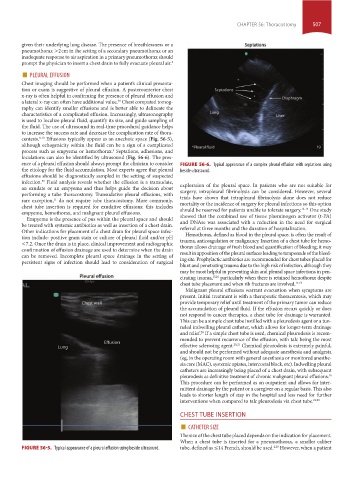
                    centesis. 8-10  Effusions typically appear as an anechoic space (Fig. 56-5),
                    although echogenicity within the fluid can be a sign of a complicated
                    process such as empyema or hemothorax.  Septations, adhesions, and
                                                   3
                    loculations can also be identified by ultrasound (Fig. 56-6). The pres-
                    ence of a pleural effusion should always prompt the clinician to consider   FIGURE 56-6.  Typical appearance of a complex pleural effusion with septations using
                    the etiology for the fluid accumulation. Most experts agree that pleural   beside ultrasound.
                    effusions should be diagnostically sampled in the setting of suspected
                    infection.  Fluid analysis reveals whether the effusion is a transudate,
                          33
                    an exudate or an empyema and thus helps guide the decision about   exploration of the pleural space. In patients who are not suitable for
                                                                            surgery, intrapleural fibrinolysis can be considered. However, several
                    performing  a  tube  thoracostomy.  Transudative  pleural  effusions,  with
                    rare  exception,   do not  require  tube  thoracostomy. More  commonly,   trials have shown that intrapleural fibrinolysis alone does not reduce
                               11
                                                                          mortality or the incidence of surgery for pleural infections so this option
                    chest tube insertion is required for exudative effusions: this includes                        12-14
                    empyema, hemothorax, and malignant pleural effusions.  should be reserved for patients unable to tolerate surgery.   One study
                                                                          showed that the combined use of tissue plasminogen activator (t-PA)
                     Empyema is the presence of pus within the pleural space and should
                    be treated with systemic antibiotics as well as insertion of a chest drain.   and DNAse was associated with a reduction in the need for surgical
                                                                          referral at three months and the duration of hospitalization.
                    Other indications for placement of a chest drain for pleural space infec-
                                                                           Hemothorax, defined as blood in the pleural space, is often the result of
                    tion include: positive gram stain or culture of pleural fluid and/or pH   trauma, anticoagulation or malignancy. Insertion of a chest tube for hemo-
                    <7.2. Once the drain is in place, clinical improvement and radiographic
                    confirmation of effusion drainage are used to determine when the drain   thorax allows drainage of fresh blood and quantification of bleeding; it may
                                                                          result in apposition of the pleural surfaces leading to tamponade of the bleed-
                    can be removed. Incomplete pleural space drainage in the setting of
                      persistent signs of infection should lead to consideration of surgical   ing site. Prophylactic antibiotics are recommended for chest tubes placed for
                                                                          blunt and penetrating trauma due to the high risk of infection, although they
                                                                          may be most helpful in preventing skin and pleural space infections in pen-
                                                                          etrating trauma, 15,16  particularly when there is retained hemothorax despite
                                                                          chest tube placement and when rib fractures are involved. 17-19
                                                                           Malignant pleural effusions warrant evacuation when symptoms are
                                                                          present. Initial treatment is with a therapeutic thoracentesis, which may
                                                                          provide temporary relief until treatment of the primary tumor can reduce
                                                                          the accumulation of pleural fluid. If the effusion recurs quickly or does
                                                                          not respond to cancer therapies, a chest tube for drainage is warranted.
                                                                          This can be a simple chest tube instilled with a pleuredesis agent or a tun-
                                                                          neled indwelling pleural catheter, which allows for longer-term drainage
                                                                          and relief.  If a simple chest tube is used, chemical pleurodesis is recom-
                                                                                 20
                                                                          mended to prevent recurrence of the effusion, with talc being the most
                                                                          effective sclerosing agent. 20,21  Chemical pleurodesis is extremely painful,
                                                                          and should not be performed without adequate anesthesia and analgesia
                                                                          (eg, in the operating room with general anesthesia or monitored anesthe-
                                                                          sia care (MAC), systemic opiates, intercostal block, etc). Indwelling pleural
                                                                          catheters are increasingly being placed of a chest drain, with subsequent
                                                                          pleurodesis as definitive treatment of chronic malignant pleural effusions.
                                                                                                                            36
                                                                          This procedure can be performed as an outpatient and allows for inter-
                                                                          mittent drainage by the patient or a caregiver on a regular basis. This also
                                                                          leads to shorter length of stay in the hospital and less need for further
                                                                          interventions when compared to talc pleurodesis via chest tube. 22,23

                                                                          CHEST TUBE INSERTION
                                                                              ■  CATHETER SIZE

                                                                          The size of the chest tube placed depends on the indication for placement.
                                                                          When a chest tube is inserted for a pneumothorax, a smaller caliber
                                                                                                         2,29
                    FIGURE 56-5.  Typical appearance of a pleural effusion using beside ultrasound.  tube, defined as ≤14 French, should be used.  However, when a patient


            section04.indd   507                                                                                       1/23/2015   2:20:21 PM

