


Page 78 - Hall et al (2015) Principles of Critical Care-McGraw-Hill
P. 78
46      PART 1: An Overview of the Approach to and Organization of Critical Care


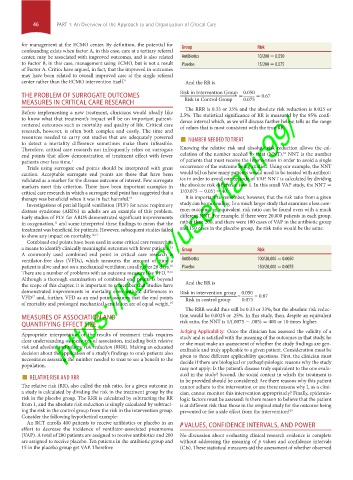
                 for management at the ECMO center. By definition, the potential for   Group      Risk
                 confounding exists when factor A, in this case, care at a tertiary referral
                 center, may be associated with improved outcomes, and is also related   Antibiotics  10/200 = 0.050
                 to Factor B, in this case, management using ECMO, but is not a result   Placebo  15/200 = 0.075
                 of Factor A. Critics have argued, in fact, that the improved in outcomes
                 may have been related to overall improved care at the single referral
                 center rather than the ECMO intervention itself. 9      And the RR is

                 THE PROBLEM OF SURROGATE OUTCOMES                     Risk in Intervention Group  0.050  = 0.67
                                                                                           =
                                                                          Risk in Control Group
                 MEASURES IN CRITICAL CARE RESEARCH                                           0.075
                                https://kat.cr/user/tahir99/
                                                                         The RRR is 0.33 or 33% and the absolute risk reduction is 0.025 or
                 Before implementing a new treatment, clinicians would ideally like   2.5%. The statistical significance of RR is measured by the 95% confi-
                 to know what that treatment’s impact will be on important patient-  dence interval which, as we will discuss further below, tells us the range
                 centered outcomes such as mortality and quality of life. Critical care   of values that is most consistent with the true RR.
                 research, however, is often both complex and costly. The time and
                 resources needed to carry out studies that are adequately powered     ■  NUMBER NEEDED TO TREAT
                 to  detect a  mortality  difference  sometimes  make  them  infeasible.
                 Therefore, critical care research not infrequently relies on surrogate   Knowing the relative risk and absolute risk reduction allows the cal-
                                                                                                          18
                 end points that allow demonstration of treatment effect with fewer   culation of the number needed to treat (NNT).  NNT is the number
                 patients over less time. 1                            of patients that must receive the intervention in order to avoid a single
                   Trials using surrogate end points should be interpreted with great   occurrence of the outcome being studied. Using our example, the NNT
                 caution. Acceptable surrogate end points are those that have been   would tell us how many patients would need to be treated with antibiot-
                 validated as a marker for the disease outcome of interest. Few surrogate   ics in order to avoid one episode of VAP. NNT is calculated by dividing
                 markers  meet  this criterion.  There have  been important  examples  in   the absolute risk difference into 1. In this small VAP study, the NNT =
                 critical care research in which a surrogate end point has suggested that a   1/(0.075 − 0.05) = 40.
                 therapy was beneficial when it was in fact harmful. 10  It is important to remember, however, that the risk ratio from a given
                   Investigations of partial liquid ventilation (PLV) for acute respiratory   study can be misleading. In a much larger study that examines a less com-
                 distress syndrome (ARDS) in adults are an example of this problem.   mon outcome, an equivalent risk ratio can be found even with a much
                 Early studies of PLV for ARDS demonstrated significant improvements   different NNT. For example, if there were 20,000 patients in each group,
                 in oxygenation,  and some interpreted these findings to mean that the   rather than 200, and there were 100 cases of VAP in the antibiotic group
                            11
                 treatment was beneficial for patients. However, subsequent studies failed   and 150 cases in the placebo group, the risk ratio would be the same.
                 to show any impact on mortality. 12,13
                   Combined end points have been used in some critical care research as
                 a means to identify clinically meaningful outcomes with fewer patients.    Group  Risk
                                                                    14
                 A commonly used combined end point in critical care research is
                 ventilator-free  days  (VFDs),  which  measures  the  amount  of  time  a   Antibiotics  100/20,000 = 0.0050
                 patient is alive and not on a mechanical ventilator, usually over 28 days.    Placebo  150/20,000 = 0.0075
                                                                    10
                 There are a number of problems with an outcome measure like VFD. 15,16
                 Although a thorough examination of combined end points is beyond
                 the scope of this chapter, it is important to remember that studies have   And the RR is
                 demonstrated improvements in mortality even without differences in   Risk in intervention group    0.050
                 VFD  and, further, VFD as an end point assumes that the end points       Risk in control group   =  0.075  = 0.67
                     17
                 of mortality and prolonged mechanical ventilation are of equal weight. 15
                                                                         The RRR would thus still be 0.33 or 33%, but the absolute risk reduc-
                 MEASURES OF ASSOCIATION AND                           tion would be 0.0025 or .25%. In this study, then, despite an equivalent
                 QUANTIFYING EFFECT SIZE                               risk ratio, the NNT is 1/(.0075 − .005) = 400 or 10 times higher.
                                                                       Judging Applicability:  Once the clinician has assessed the validity of a
                 Appropriate interpretation of the results of treatment trials requires   study and is satisfied with the meaning of the outcomes in that study, he
                 clear understanding of measures of association, including both relative   or she must make an assessment of whether the study findings are gen-
                 risk and absolute and relative risk reduction (RRR). Making an educated   eralizable and truly applicable to a given patient. Consideration must be
                 decision about the application of a study’s findings to one’s patients also   given to three different applicability questions. First, the clinician must
                 necessitates assessing the number needed to treat to see a benefit to the   decide if there are biological or pathophysiologic reasons why the study
                 population.                                           may not apply: Is the patient’s disease truly equivalent to the one evalu-
                     ■  RELATIVE RISK AND RRR                          ated in the study? Second, the social context in which the treatment is

                 The relative risk (RR), also called the risk ratio, for a given outcome in   to be provided should be considered: Are there reasons why this patient
                                                                       cannot adhere to the intervention or are there reasons why I, as a clini-
                 a study is calculated by dividing the risk in the treatment group by the   cian, cannot monitor this intervention appropriately? Finally, epidemio-
                 risk in the placebo group. The RRR is calculated by subtracting the RR   logic factors must be assessed: Is there reason to believe that the patient
                 from 1, and the absolute risk reduction is simply calculated by subtract-  is at different risk than those in the original study for the outcome being
                 ing the risk in the control group from the risk in the intervention group.   prevented or for a side effect from the intervention? 19
                 Consider the following hypothetical example:
                   An RCT enrolls 400 patients to receive antibiotics or placebo in an
                 effort to decrease the incidence of ventilator-associated pneumonia   P VALUES, CONFIDENCE INTERVALS, AND POWER
                 (VAP). A total of 200 patients are assigned to receive antibiotics and 200   No discussion about evaluating clinical research evidence is complete
                 are assigned to receive placebo. Ten patients in the antibiotic group and   without addressing the meaning of  p values and confidence intervals
                 15 in the placebo group get VAP. Therefore            (CIs). These statistical measures aid the assessment of whether observed


            Section01.indd   46                                                                                        1/22/2015   9:36:58 AM

