


Page 73 - Hall et al (2015) Principles of Critical Care-McGraw-Hill
P. 73
CHAPTER 6: Assessing Cost-Effectiveness in the Intensive Care Unit         41


                                            Require better natural history of ICU conditions
                                     May be instances when provider perspective is

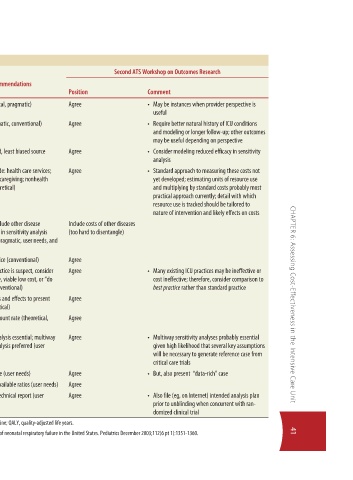
                                                  may be useful depending on perspective and modeling or longer follow-up; other outcomes   Consider modeling reduced efficacy in sensitivity   Standard approach to measuring these costs not  yet developed; estimating units of resource use  and multiplying by standard costs probably most  practical approach currently; detail with which  resource use is tracked should be tailored to  nature of intervention and likely effects on costs  Many existing ICU practices may be ineffective or  cost ineffective; therefore, consider comparison to  best practice rather than standard practice  Multiway sensitiv


                          Second ATS Workshop on Outcomes Research


                                 Comment  •   useful  •   •   analysis  •                     •                      •       critical care trials  •   •   domized clinical trial


                                                                              Include costs of other diseases   (too hard to disentangle)


                                 Position  Agree  Agree  Agree  Agree                     Agree  Agree  Agree  Agree  Agree      Agree  Agree  Agree


                              PCEHM Recommendations   (Rationale)  Societal (ethical, pragmatic)  QALYs (pragmatic, conventional)  Best-designed, least biased source    (pragmatic)  Costs to include: health care services;  patient time; caregiving; nonhealth   impacts (theoretical)  Include or exclude other disease  costs and test in sensitivity analysis  (theoretical, pragmatic, user needs, and   accounting)  Existing practice (conventional)  If existing practice is suspect, consider   best-available, viable low cost, or “do    nothing” (conventional)  Discount costs and effects to present   value (theoretical)  Use a 3% discount rate (theoret


                                 ICU Specific  Long-term follow-up   is rare  Only hospital costs are    usually measured; no    international standard  Determining standard   often difficult  Not usually done  Not usually done  ATS, American Thoracic Society; CEA, cost-effectiveness analysis; ICU, intensive care unit; PCEHM, Panel on Cost-effectiveness in Health and Medicine; QALY, quality-adjusted life years. Data from Angus DC, Clermont G, Watson RS, Linde-Zwirble WT, Clark RH, Roberts MS. Cost-effectiveness of inhaled nitric oxide in the treatment of neonatal respiratory failure in the United States. Pediatrics December 2003;112(6 pt 1):135


                      Methodological Considerations in Cost-Effectiveness Analysis
                          Methodologic Problems  Comparing CEAs  Different  Different out-  comes  Different costs  —  Different rates  —  Not standard


                                 Individual CEA  Not defined  Data are inadequate or dif-  ficult to evaluate  Data are inadequate or dif-  ficult to evaluate  Choice distorts results  Inadequate representation   of the effect of time  Inadequate representation   of uncertainty on results  —


                      TABLE 6-1   Aspect  Perspective  Outcomes (effects)                 Comparators (stan-  dard care)  Discounting  Uncertainty  Reporting


                                                            Costs


 Section01.indd   41                                                                                                                              1/22/2015   9:36:54 AM

