


Page 75 - Hall et al (2015) Principles of Critical Care-McGraw-Hill
P. 75
CHAPTER 6: Assessing Cost-Effectiveness in the Intensive Care Unit  43


                                         $1500
                                                More costly                                     More costly
                                                Less effective         $100,000/1 year survivor  More effective
                                         $1000
                                       Difference in costs (thousand dollars)  −$500

                                          $500


                                            $0
                                  https://kat.cr/user/tahir99/


                                        −$1000
                                                 Less costly                                     Less costly
                                                Less effective                                  More effective
                                        −$1500
                                            −0.1      −0.05       0         5        10        15        20
                                                                   Difference in effectiveness
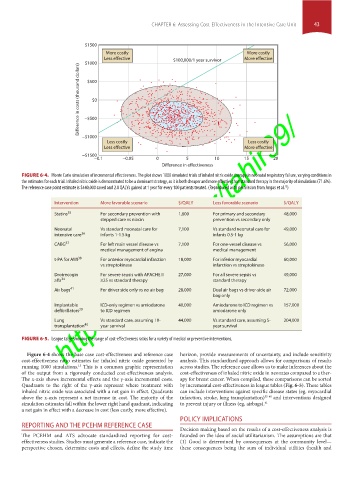
                    FIGURE 6-4.  Monte Carlo simulation of incremental effectiveness. The plot shows 1000 simulated trials of inhaled nitric oxide therapy in neonatal respiratory failure, varying conditions in
                    the estimates for each trial. Inhaled nitric oxide is demonstrated to be a dominant strategy, as it is both cheaper and more effective than standard therapy in the majority of simulations (71.6%).
                                                                                                             15
                    The reference case point estimate is $440,000 saved and 2.8 QALYs gained at 1 year for every 100 patients treated. (Reproduced with permission from Angus et al. )
                               Intervention   More favorable scenario    $/QALY      Less favorable scenario  $/QALY

                               Statins 35     For secondary prevention with  1,600   For primary and secondary  48,000
                                              stepped care vs niacin                 prevention vs secondary only
                               Neonatal       Vs standard neonatal care for  7,100   Vs standard neonatal care for  49,000
                               intensive care 36   infants 1-1.5 kg                  infants 0.5-1 kg
                               CABG 37        For left main vessel disease vs  7,100  For one-vessel disease vs  56,000
                                              medical management of angina           medical management
                               t-PA for AMI 38  For anterior myocardial infarction  18,000  For inferior myocardial  60,000
                                              vs streptokinase                       infarction vs streptokinase
                               Drotrecogin    For severe sepsis with APACHE II  27,000  For all severe sepsis vs  49,000
                               alfa 34         25 vs standard therapy                standard therapy
                               Air bags 41    For driver side only vs no air bag  28,000  Dual air bags vs driver-side air  72,000
                                                                                     bag only
                               Implantable    ICD-only regimen vs amiodarone  40,000  Amiodarone to ICD regimen vs  157,000
                               defibrillators 39  to ICD regimen                     amiodarone only
                               Lung           Vs standard care, assuming 10-  44,000  Vs standard care, assuming 5-  204,000
                               transplantation 40   year survival                    year survival

                    FIGURE 6-5.  League table showing the range of cost-effectiveness ratios for a variety of medical or preventive interventions.

                     Figure 6-4 shows the base case cost-effectiveness and reference case   horizon, provide measurements of uncertainty, and include sensitivity
                    cost-effectiveness ratio estimates for inhaled nitric oxide generated by   analysis. This standardized approach allows for comparisons of results
                    running 1000 simulations.  This is a common graphic representation   across studies. The reference case allows us to make inferences about the
                                       15
                    of the output from a rigorously conducted cost-effectiveness analysis.   cost-effectiveness of inhaled nitric oxide in neonates compared to a ther-
                    The x-axis shows incremental effects and the y-axis incremental costs.   apy for breast cancer. When compiled, these comparisons can be sorted
                    Quadrants to the right of the y-axis represent where treatment with   by incremental cost-effectiveness in league tables (Fig. 6-5). These tables
                    inhaled nitric oxide was associated with a net gain in effect. Quadrants   can include interventions against specific disease states (eg, myocardial
                    above the x-axis represent a net increase in cost. The majority of the   infarction, stroke, lung transplantation) 35-40  and interventions designed
                    simulation estimates fall within the lower right hand quadrant, indicating   to prevent injury or illness (eg, airbags). 41
                    a net gain in effect with a decrease in cost (less costly, more effective).
                                                                          POLICY IMPLICATIONS
                    REPORTING AND THE PCEHM REFERENCE CASE
                                                                          Decision making based on the results of a cost-effectiveness analysis is
                    The PCEHM and ATS advocate standardized reporting for cost-   founded on the idea of social utilitarianism. The assumptions are that
                    effectiveness studies. Studies must generate a reference case, indicate the   (1) Good is determined by consequences at the community level—
                    perspective chosen, determine costs and effects, define the study time   these consequences being the sum of individual utilities (health and


            Section01.indd   43                                                                                        1/22/2015   9:36:57 AM

