


Page 82 - Hall et al (2015) Principles of Critical Care-McGraw-Hill
P. 82
50      PART 1: An Overview of the Approach to and Organization of Critical Care


                                                               Medical informatics

                                                                        Public health informatics

                                                   Epidemiology          Personal health records
                                                                    Biostatistics
                        Computer science  Bioinformatics      Security/Policy   Clinical         informatics        Interoperability
                                                               Clinical informatics
                                                                                                  Imaging


                                                           Clinical data warehousing
                                                    Enrollment to  Carrying  management     Standards
                                                     clinical trials  clinical trials
                                                                                        Biomedical        Medical
                                                                                       Engineering        Physics
                                        Cognitive science

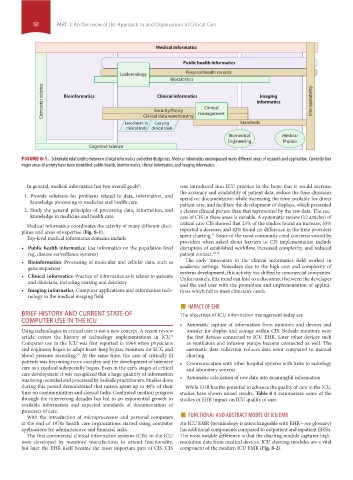
                 FIGURE 8-1.  Schematic relationship between clinical informatics and other disciplines. Medical informatics encompassed many different areas of research and application. Currently four
                 major areas of activity have been identified: public health, bioinformatics, clinical informatics, and imaging informatics.


                   In general, medical informatics has two overall goals : 8  was introduced  into ICU  practice in  the  hope that  it would  increase
                                                                       the accuracy and availability of patient data, reduce the time clinicians
                   1.  Provide solutions for problems related to data, information, and   spend on documentation while increasing the time available for direct
                    knowledge processing in medicine and health care.  patient care, and facilitate the development of displays, which presented
                   2.  Study the general principles of processing data, information, and   a clearer clinical picture than that represented by the raw data. The suc-
                    knowledge in medicine and health care.             cess of CIS in these areas is variable. A systematic review (12 articles) of
                                                                       critical care CIS showed that 25% of the studies found an increase, 33%
                   Medical informatics coordinates the activity of many different disci-
                 plines and areas of expertise (Fig. 8-1).             reported a decrease and 42% found no difference in the time providers
                                                                                  11
                   Top-level medical informatics domains include       spent charting.  Some of the most commonly cited concerns voiced by
                                                                       providers when asked about barriers to CIS implementation include
                    • Public health informatics: Use informatics on the population level   disruption of established workflow, increased complexity, and reduced
                   (eg, disease surveillance systems)                  patient contact. 12,13
                    • Bioinformatics: Processing of molecular and cellular data, such as   The early innovators in the clinical informatics field worked in
                   gene sequences                                      academic settings. Nowadays due to the high cost and complexity of
                    • Clinical informatics: Practice of informatics as it relates to patients     systems development, this activity has shifted to commercial companies.
                                                                       Unfortunately, this trend can lead to a disconnect between the developer
                   and clinicians, including nursing and dentistry     and the end user with the promotion and implementation of applica-
                    • Imaging informatics: Computer applications and information tech-  tions which fail to meet clinician’s needs.
                   nology in the medical imaging field
                                                                           ■  IMPACT OF EHR
                 BRIEF HISTORY AND CURRENT STATE OF                    The objectives of ICU information management today are
                 COMPUTER USE IN THE ICU
                                                                          • Automatic capture of information from monitors and devices and
                 Using technologies in critical care is not a new concept. A recent review   transfer for display and storage within CIS. Bedside monitors were
                 article covers the history of technology implementations in ICU.    the first devices connected to ICU EHR. Later other devices such
                                                                    9
                 Computer use in the ICU was first reported in 1964 when physicians   as  ventilators and  infusion  pumps  become  connected  as  well.  The
                 and engineers began to adapt heart-lung bypass monitors for ECG and   automatic data collection reduces data error compared to manual
                 blood pressure recording.  At the same time, the care of critically ill   charting
                                    10
                 patients was becoming more complex and the development of intensive     • Communication with other hospital systems with links to radiology
                 care as a medical subspecialty began. Even in the early stages of critical   and laboratory systems
                 care development it was recognized that a large quantity of information
                 was being recorded and processed by bedside practitioners. Studies done     • Automatic calculation of raw data into meaningful information
                 during this period demonstrated that nurses spent up to 40% of their   While EHR has the potential to advance the quality of care in the ICU,
                 time on communication and clerical tasks. Continued medical progress   studies have shown mixed results. Table 8-1 summarizes some of the
                 through the intervening decades has led to an exponential growth in   studies of EHR impact on ICU quality of care.
                 available information and expected standards of documentation of
                   With the introduction of microprocessors and personal computers   ■
                 processes of care.                                       FUNCTIONAL AND ABSTRACT MODEL OF ICU EMR
                 at the end of 1970s health care organizations started using computer   An ICU EMR (terminology is interchangeable with EHR—see glossary)
                 applications for administrative and financial tasks.  has additional components compared to outpatient and inpatient EHRs.
                   The first commercial clinical information systems (CIS) in the ICU   The most notable difference is that the charting module captures high-
                 were developed by monitors’ manufactures to extend functionality,   resolution data from medical devices. ICU charting modules are a vital
                 but later the EHR itself became the most important part of CIS. CIS   component of the modern ICU EMR (Fig. 8-2).


            Section01.indd   50                                                                                        1/22/2015   9:36:59 AM

