


Page 79 - Hall et al (2015) Principles of Critical Care-McGraw-Hill
P. 79
CHAPTER 7: Interpreting and Applying Evidence in Critical Care Medicine  47


                    differences in outcomes between groups reflect true differences or sim-  skill in the correct interpretation of diagnostic tests. To correctly inter-
                    ply chance variation, also known as random error.     pret a variety of diagnostic tests, one must understand how well that test
                     At the conceptual level, there are four possible results of any given study:  reflects the actual presence or absence of disease in any given patient.
                                                                          The sensitivity and specificity of a given test reflect how closely the result
                      1.  There is an observed difference in outcomes between two groups,   of that test reflects the truth about a patient’s disease process.
                       which represents a true association between the predictor and the   The sensitivity of a test is the proportion of people with the disease in
                       outcome.                                           question that will have a positive test result. A highly sensitive test will
                      2.  There is no observed difference in outcomes between two groups,   identify the majority of patients who actually have that disease and will
                       which  correctly  represents  a  true  lack  of  association  between  the   yield very few false-negative results. The specificity of a test measures the
                       predictor and the outcome.                         proportion of people without the disease that have a negative test. A highly
                      3.  There is an observed difference in outcomes between two groups when   specific test will identify the majority of those who do not have the dis-
                                  https://kat.cr/user/tahir99/
                       there is no true association between the predictor and the outcome.  ease and will have very few false-positive results. In order to evaluate the
                      4.  There is no observed difference in outcomes between two groups,   sensitivity and specificity of a new diagnostic test, it must be tested against
                                                                          another highly reliable method of identifying the disease, referred to as the
                       when, in fact, there is an association between the predictor and the   “gold standard.” Sensitivity and specificity are best visualized, understood,
                       outcome. 20                                        and calculated using a 2 × 2 table, as shown in the example below:
                     A Type I error is exemplified by number three above, in which the
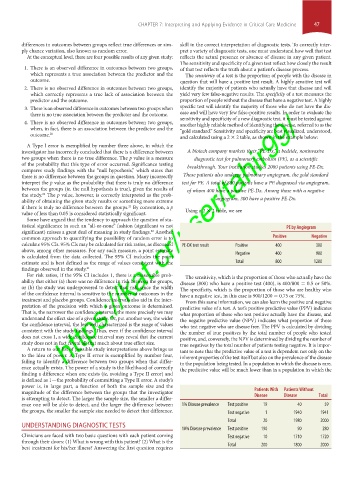
                    investigator has incorrectly concluded that there is a difference between   A biotech company markets their “PE-Dx,” a bedside, noninvasive
                    two groups when there is no true difference. The p value is a measure     diagnostic test for pulmonary embolism (PE), as a scientific
                    of the probability that this type of error occurred. Significance testing   breakthrough. Your  institution studies 2000 patients using PE-Dx.
                    compares study findings with the “null hypothesis,” which states that
                    there is no difference between the groups in question. Many incorrectly   Those patients also undergo pulmonary angiogram, the gold standard
                    interpret the p value as the probability that there is truly no difference   test for PE. A total of 800 patients have a PE diagnosed via angiogram,
                    between the groups (ie, the null hypothesis is true), given the results of   of whom 400 have a positive PE-Dx. Among those with a negative
                    the study.  The p value, however, is correctly interpreted as the prob-
                           21
                    ability of obtaining the given study results or something more extreme   angiogram, 300 have a positive PE-Dx.
                    if there is truly no difference between the groups.  By convention, a p
                                                        21
                    value of less than 0.05 is considered statistically significant.  Using a 2 × 2 table, we see
                     Some have argued that the tendency to approach the question of sta-
                    tistical significance in such an “all-or-none” fashion (significant vs not                PE by Angiogram
                    significant) misses a great deal of meaning in study findings.  Another
                                                                22
                    common approach to quantifying the possibility of random error is to                 Positive     Negative
                    calculate 95% CIs. 95% CIs may be calculated for risk ratios, as discussed   PE-DX test result  Positive  400  300
                    above, among other measures. For any such measure, a point estimate
                    is calculated from the data collected. The 95% CI includes the point    Negative      400           900
                    estimate and is best defined as the range of values consistent with the   Total       800          1200
                    findings observed in the study. 21
                     For risk ratios, if the 95% CI includes 1, there is a reasonable prob-  The sensitivity, which is the proportion of those who actually have the
                    ability that either (a) there was no difference in risk between the groups,   disease (800) who have a positive test (400), is 400/800 = 0.5 or 50%.
                    or (b) the study was underpowered to detect that risk, since the width   The specificity, which is the proportion of those who are healthy who
                    of the confidence interval is sensitive to the number of outcomes in the   have a negative test, in this case is 900/1200 = 0.75 or 75%.
                    treatment and placebo groups. Confidence intervals also aid in the inter-  From this same information, we can also learn the positive and negative
                    pretation of the precision with which a given outcome is determined.   predictive value of a test. A test’s positive predictive value (PPV) indicates
                    That is, the narrower the confidence interval, the more precisely we may   what proportion of those who test positive actually have the disease, and
                    understand the effect size of a given study. Or, put another way, the wider   the negative predictive value (NPV) indicates what proportion of those
                    the confidence interval, the less well characterized is the range of values   who test negative who are disease free. The PPV is calculated by dividing
                    consistent with the study findings. Thus, even if the confidence interval   the number of true positives by the total number of people who tested
                    does not cross 1, a wide confidence interval may reveal that the current   positive, and, conversely, the NPV is determined by dividing the number of
                    study does not in fact reveal all that much about true effect size.  true negatives by the total number of patients testing negative. It is impor-
                     A return to our list of possible study interpretations above brings us   tant to note that the predictive value of a test is dependent not only on the
                    to the idea of power. A Type II error is exemplified by number four,   inherent properties of the test itself but also on the prevalence of the disease
                    failing to identify a difference between two groups when that differ-  in the population being tested. In a population in which the disease is rare,
                    ence actually exists. The power of a study is the likelihood of correctly   the predictive value will be much lower than in a population in which the
                    finding a difference when one exists (ie, avoiding a Type II error) and
                    is defined as 1—the probability of committing a Type II error. A study’s
                    power is, in large part, a function of both the sample size and the
                    magnitude of the difference between the groups that the investigator           Patients With  Patients Without
                    is attempting to detect. The larger the sample size, the smaller a differ-     Disease   Disease     Total
                    ence one will be able to detect, and the larger the difference between   1% Disease prevalence  Test positive  19  40  59
                    the groups, the smaller the sample size needed to detect that difference.  Test negative  1  1940    1941
                                                                                          Total       20        1980     2000
                    UNDERSTANDING DIAGNOSTIC TESTS
                                                                          10% Disease prevalence  Test positive  190  90  280
                    Clinicians are faced with two basic questions with each patient coming   Test negative  10  1710     1720
                    through their doors: (1) What is wrong with this patient? (2) What is the
                    best treatment for his/her illness? Answering the first question requires   Total  200      1800     2000


            Section01.indd   47                                                                                        1/22/2015   9:36:58 AM

