


Page 846 - Hall et al (2015) Principles of Critical Care-McGraw-Hill
P. 846
CHAPTER 65: Pneumonia   577


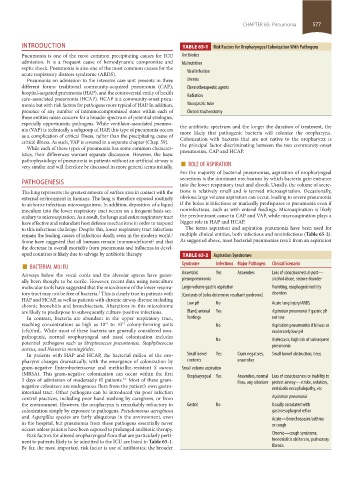
                    INTRODUCTION                                            TABLE 65-1    Risk Factors for Oropharyngeal Colonization With Pathogens

                    Pneumonia is one of the most common precipitating causes for ICU   Antibiotics
                    admission. It is a frequent cause of hemodynamic compromise and   Malnutrition
                    septic shock. Pneumonia is also one of the most common causes for the
                    acute respiratory distress syndrome (ARDS).             Viral Infection
                     Pneumonia on admission to the intensive care unit presents in three     Uremia
                    different forms: traditional community-acquired pneumonia (CAP),       Chemotherapeutic agents
                    hospital-acquired pneumonia (HAP), and the controversial entity of health
                    care–associated pneumonia (HCAP). HCAP is a community-onset pneu-    Radiation
                    monia but with risk factors for pathogens more typical of HAP. In addition,     Nasogastric tube
                    presence of any number of immunocompromised states within each of     Chronic tracheostomy
                    these entities raises concern for a broader spectrum of potential etiologies,
                    especially opportunistic pathogens. While ventilator-associated pneumo-  the antibiotic spectrum and the longer the duration of treatment, the
                    nia (VAP) is technically a subgroup of HAP, this type of pneumonia occurs
                    as a complication of critical illness, rather than the precipitating cause of   more likely that pathogenic bacteria will colonize the oropharynx.
                                                                          Colonization with bacteria that are not native to the oropharynx is
                    critical illness. As such, VAP is covered in a separate chapter (Chap. 59).
                     While each of these types of pneumonia has some common character-  the principal factor discriminating between the two community-onset
                    istics, their differences warrant separate discussion. However, the basic   pneumonias, CAP and HCAP.
                    pathophysiology of pneumonia in patients without an artificial airway is     ■
                    very similar and will therefore be discussed in more general terms initially.  ROLE OF ASPIRATION
                                                                          For the majority of bacterial pneumonias, aspiration of oropharyngeal
                                                                          secretions is the dominant mechanism by which bacteria gain entrance
                    PATHOGENESIS                                          into the lower respiratory tract and alveoli. Usually, the volume of secre-
                    The lung represents the greatest amount of surface area in contact with the   tions is relatively small and is termed microaspiration. Occasionally,
                    external environment in humans. The lung is therefore exposed routinely   obvious large volume aspiration can occur, leading to severe pneumonia
                    to airborne infectious microorganisms. In addition, deposition of a liquid   if the bolus is infectious or markedly predisposes to pneumonia even if
                    inoculum into the lower respiratory tract occurs on a frequent basis sec-  noninfectious, such as with enteral feedings. Microaspiration is likely
                    ondary to microaspiration. As a result, the lungs and entire respiratory tract   the predominant cause in CAP and VAP, while macroaspiration plays a
                    have effective and redundant host defense mechanisms in order to respond   bigger role in HAP and HCAP.
                    to this infectious challenge. Despite this, lower respiratory tract infections   The terms aspiration and aspiration pneumonia have been used for
                    remain the leading causes of infectious death, even in the modern world.    multiple clinical entities, both infectious and noninfectious (Table 65-2).
                                                                       1
                    Some have suggested that all humans remain immunodeficient  and that   As suggested above, most bacterial pneumonias result from an aspiration
                                                                2
                    the decrease in overall mortality from pneumonia and influenza in devel-
                    oped countries is likely due to salvage by antibiotic therapy.    TABLE 65-2    Aspiration Syndromes
                        ■  BACTERIAL MILIEU                               Syndrome    Infectious Major Pathogen  Clinical Scenario
                    Airways below the vocal cords and the alveolar spaces have gener-  Anaerobic   Yes  Anaerobes  Loss of consciousness in past—
                    ally been thought to be sterile. However, recent data using nonculture     pleuropneumonia  alcohol abuse, seizure disorder
                    molecular tools have suggested that the microbiome of the lower respira-  Large-volume gastric aspiration  Vomiting, esophageal motility
                    tory tract may not be free of bacteria.  This is clearly true in patients with   (Contents of bolus determine resultant syndrome)  disorders
                                              3
                    HAP and HCAP, as well as patients with chronic airway disease including
                    chronic bronchitis and bronchiectasis. Alterations in this microbiome     Low pH  No  Acute lung injury/ARDS
                    are likely to predispose to subsequently culture-positive infections.     Bland, enteral  Yes  Aspiration pneumonia if gastric pH
                     In contrast, bacteria  are abundant  in the  upper  respiratory  tract,   feedings  not low
                    reaching concentrations as high as 10  to 10  colony-forming units   No              Aspiration pneumonitis if bilious or
                                                10
                                                      12
                    (cfu)/mL. While most of these bacteria are generally considered non-                 moderately low pH
                    pathogenic, normal oropharyngeal and nasal colonization includes   No                Atelectasis, high risk of subsequent
                    potential pathogens such as  Streptococcus pneumoniae, Staphylococcus
                    aureus, and Neisseria meningitides.                                                  pneumonia
                     In patients with HAP and HCAP, the bacterial milieu of the oro-     Small bowel   Yes  Gram negatives,   Small bowel obstruction, ileus
                    pharynx changes dramatically, with the emergence of colonization by     contents  anaerobes
                    gram-negative Enterobacteriaceae and methicillin-resistant  S aureus   Small volume aspiration
                    (MRSA). This gram-negative colonization can occur within the first       Oropharyngeal Yes  Anaerobes, normal  Loss of consciousness or inability to
                    3 days of admission of moderately ill patients.  Most of these gram-     flora, any colonizer protect airway—stroke, sedation,
                                                      4,5
                    negative colonizers are endogenous flora from the patient’s own gastro-                metabolic encephalopathy, etc
                    intestinal tract. Other pathogens can be introduced via poor infection
                    control practices, including poor hand washing by caregivers, or from                Aspiration pneumonia
                    the environment. However, the oropharynx is remarkably refractory to     Gastric  No  Usually associated with
                    colonization simply by exposure to pathogens. Pseudomonas aeruginosa                   gastroesophageal reflux
                    and Aspergillus species are fairly ubiquitous in the environment, even               Acute—bronchospasm/asthma
                    in the hospital, but pneumonia from these pathogens essentially never                or cough
                    occurs unless patients have been exposed to prolonged antibiotic therapy.
                     Risk factors for altered oropharyngeal flora that are particularly perti-           Chronic—cough syndrome,
                    nent to patients likely to be admitted to the ICU are listed in Table 65-1.          bronchiolitis obliterans, pulmonary
                    By far, the most important risk factor is use of antibiotics; the broader            fibrosis


            section05_c61-73.indd   577                                                                                1/23/2015   12:47:53 PM

