


Page 85 - Hall et al (2015) Principles of Critical Care-McGraw-Hill
P. 85
CHAPTER 8: Principles of Medical Informatics and Clinical Informatics in the ICU  53


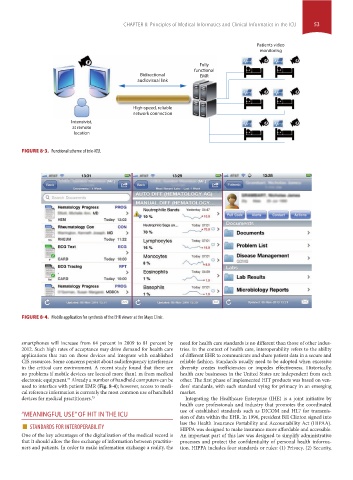
                                                                                                    Patients video
                                                                                                     monitoring

                                                                                Fully
                                                                              functional
                                                            Bidirectional       EMR
                                                           audiovisual link


                                                          High-speed, reliable
                                                          network connection
                                     Intensivist,
                                     at remote
                                     location


                    FIGURE 8-3.  Functional scheme of tele-ICU.


                    FIGURE 8-4.  Mobile application for synthesis of the EHR viewer at the Mayo Clinic.


                    smartphones will increase from 64 percent in 2009 to 81 percent by   need for health care standards is no different than those of other indus-
                    2012. Such high rates of acceptance may drive demand for health care   tries. In the context of health care, interoperability refers to the ability
                    applications that run on those devices and integrate with established   of different EHR to communicate and share patient data in a secure and
                    CIS resources. Some concerns persist about radiofrequency interference   reliable fashion. Standards usually need to be adopted when excessive
                    in the critical care environment. A recent study found that there are   diversity creates inefficiencies or impedes effectiveness. Historically,
                    no problems if mobile devices are located more than1 m from medical   health care businesses in the United States are independent from each
                    electronic equipment.  Already a number of handheld computers can be   other. The first phase of implemented HIT products was based on ven-
                                   24
                    used to interface with patient EMR (Fig. 8-4); however, access to medi-  dors’ standards, with each standard vying for primacy in an emerging
                    cal reference information is currently the most common use of handheld   market.
                    devices for medical practitioners. 25                  Integrating the Healthcare Enterprise (IHE) is a joint initiative by
                                                                          health care professionals and industry that promotes the coordinated
                                                                          use of established standards such as DICOM and HL7 for transmis-
                    “MEANINGFUL USE” OF HIT IN THE ICU                    sion of data within the EHR. In 1996, president Bill Clinton signed into
                        ■  STANDARDS FOR INTEROPERABILITY                 law the Health Insurance Portability and Accountability Act (HIPAA).
                                                                          HIPPA was designed to make insurance more affordable and accessible.
                    One of the key advantages of the digitalization of the medical record is   An important part of this law was designed to simplify administrative
                    that it should allow the free exchange of information between practitio-  processes and protect the confidentiality of personal health informa-
                    ners and patients. In order to make information exchange a reality, the   tion. HIPPA includes four standards or rules: (1) Privacy, (2) Security,


            Section01.indd   53                                                                                        1/22/2015   9:37:03 AM

