


Page 86 - Hall et al (2015) Principles of Critical Care-McGraw-Hill
P. 86
54      PART 1: An Overview of the Approach to and Organization of Critical Care


                   TABLE 8-2    The Standards for Coding and Responsible Maintenance Organizations
                  Standard                    Functionality                      Maintainer                 URL
                  International Classification of Diseases, 9th   ICD-9 published by World Health Organization in 1977 and   The National Center for Health Statistics   http://www.cdc.gov/nchs
                  Edition, Clinical Modification (ICD-9-CM)  currently in public domain. ICD-9-CM, clinical modification   (NCHS) of Centers for Disease Control (CDC)
                                              currently in use in the United States and extended with
                                              additional morbidity details and procedures codes
                  National Drug Codes (NDC)   Product identifiers for human drugs. The current edition of   National Council for Prescription Drug   http://www.ncpdp.org
                                              the National Drug Code Directory is limited to prescription   Programs (NCPDP)
                                              drugs and a few selected over-the-counter products
                  Healthcare Common Procedure Coding    Code set for reporting supplies, orthotic and prosthetic   Center for Medicare and Medicaid Service   http://www.cms.gov
                  System (HCPCS)              devices, and durable medical equipment  (CMS)
                  Current Procedural Terminology, Fourth    Medical nomenclature used to report medical procedures   American Medical Association (AMA), National  http://www.ama-assn.org
                  Edition (CPT-4)             and services under public and private health insurance   Uniform Billing Committee (NUBC), and
                                              programs                           National Uniform Claim Committee (NUCC)
                  Code on Dental Procedures and Nomenclature    Used to record and report dental procedures and treatment Dental Content Committee of the American   http://www.ada.org
                  (CDT)                                                          Dental Association (ADA DCC)
                  Health Level Seven (HL7), Clinical Document   Submission of lab results and patient summaries to public   HL7 International  http://www.hl7.org
                  Architecture (CDA), Continuity of Care    health agencies for surveillance or reporting (excluding
                  Document (CCD)              adverse events reporting); submitting information to
                                              immunization registries


                 (3) Identifiers, and (4) Transactions and Code Sets (HIPAA TCS rule).
                 The HIPAA TCS Rule took effect in October 2003 and includes eight        Cohort
                 ANSI X12N standards (http://www.x12.org/). The Secretary of the         Information  Dashboards
                 Department of Health and Human Services (DHHS) operates the stan-  Identification
                 dards maintenance organizations (DMSO) and takes responsibilities for   & Searching
                 the development, maintenance, and modification of relevant electronic   Research            Provider Reports
                                                                                         Cohorts
                 data interchange standards (Table 8-2).                    Profiling
                   During past decades, a number of controlled terminologies have been                   Quality Reports
                 developed including                                                                  Clinical
                    • Digital imaging and communications in medicine (DICOM)   Pharmaco-  Genomic  Research  Applications  Reporting  Public
                   (http://medical.nema.org/): A standard developed for handling,   Genomics
                   storing, printing, and transmitting information of medical imaging
                   by the joint committee of the American College of Radiology and the          AHR
                   National Electrical Manufacturers Association. DICOM is vendor                                 Pay for
                   independent. Current version is DICOM 3.0. Version 3 of DICOM   Population  Research    Applications  Performance
                   defines image data as well as patient, study, and visit information   Research
                   necessary to provide the context for the images.
                                                                                                             Chronic
                    • Systematized nomenclature of medicine—clinical terms        IT                         Disease
                   (SNOMED  CT): Comprehensive multilingual clinical terminology.   Interventions           Management
                   In 2010, National Institute of Standards and Technology (NIST) pub-              Closed-
                   lished a set of approved procedures for testing information technology   Clinical  Loop (EMR)
                   systems that work with EHRs. This document is step forward to stan-    Trials   Work Flow
                   dardization of EMR.
                     ■  SECONDARY DATA USE FOR PRACTICE MONITORING AND RESEARCH

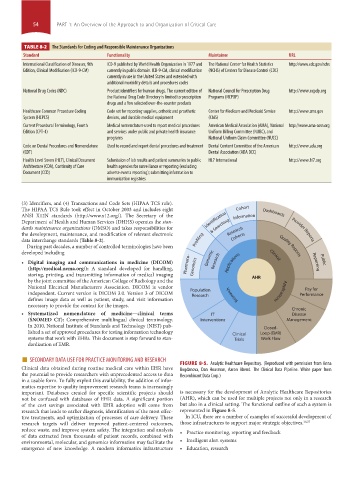
                 Clinical data obtained during routine medical care within EHR have   FIGURE 8-5.  Analytic Healthcare Repository. (Reproduced with permission from Anna
                                                                       Bogdanova, Dan Housman, Aaron Abend. The Clinical Data Pipeline. White paper from
                 the potential to provide researchers with unprecedented access to data   Recombinant Data Corp.)
                 in a usable form. To fully exploit this availability, the addition of infor-
                 matics expertise to quality improvement research teams is increasingly
                 important. Databases created for specific scientific projects should   is necessary for the development of Analytic Healthcare Repositories
                 not be confused with databases of EHR data. A significant portion   (AHR), which can be used for multiple projects not only in a research
                 of the cost savings associated with EHR adoption will come from   but also in a clinical setting. The functional outline of such a system is
                 research that leads to earlier diagnosis, identification of the most effec-  represented in Figure 8-5.
                 tive treatments, and optimization of processes of care delivery. These   In ICU, there are a number of examples of successful development of
                 research targets will deliver improved patient-centered outcomes,   those infrastructures to support major strategic objectives. 26,27
                 reduce waste, and improve system safety. The integration and analysis     • Practice monitoring, reporting and feedback
                 of  data extracted from thousands of  patient records, combined  with
                 environmental, molecular, and genomics information may facilitate the     • Intelligent alert systems
                 emergence of new knowledge. A modern informatics infrastructure     • Education, research


            Section01.indd   54                                                                                        1/22/2015   9:37:03 AM

