


Page 90 - Hall et al (2015) Principles of Critical Care-McGraw-Hill
P. 90
58      PART 1: An Overview of the Approach to and Organization of Critical Care


                   TABLE 9-1    Epidemiology of Natural Disasters        TABLE 9-3    Emergency Department Triage: Conventional Explosions and Other Trauma
                                 Earthquake  Flash Flood  Volcano Eruption  •  Major needs: surgical evaluation and intervention
                  Deaths         Many       Many          Many          •  Resources: trauma teams, diagnostic radiology capacity, blood products, staffed operat-
                                                                         ing rooms, burn beds
                  Injuries       Many       Few           Few           •  Goal: sorting through many less seriously injured patients to identify those who will
                  Damage to health care   Severe  Severe but localized  Severe  benefit from rapid resuscitation and surgery
                  facilities

                                                                         TABLE 9-4    Explosions Versus Outbreaks
                   TABLE 9-2    Disasters With Traumatic Injuries
                                                                        Conventional Explosion    Outbreak
                  Example: Conventional explosions
                     Nearest hospital most impacted                     Casualties can be large   Casualties can be very large
                     Initial wave of patients self-refer and are less injured  Mostly trauma patients  Mostly medical patients
                     <20% survivors critically injured                    Critically injured usually die before hospi-  Large proportion may require critical
                     Most survivors have non-life-threatening soft-tissue injuries  talization, many ED visits, fewer inpatients  care services
                                                                        Nearest hospital most impacted  Patients may present to many hospitals
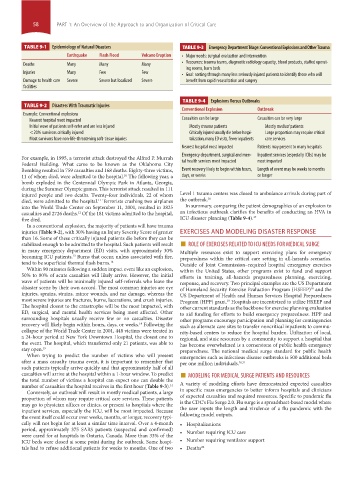
                 For example, in 1995, a terrorist attack destroyed the Alfred P. Murrah   Emergency department, surgical and men-  Inpatient services (especially ICUs) may be
                 Federal Building. What came to be known as the Oklahoma City   tal health services most impacted  most impacted
                 Bombing resulted in 759 casualties and 168 deaths. Eighty-three victims,   Event recovery likely to begin within hours,   Length of event may be weeks to months
                                                    10
                 11 of whom died, were admitted to the hospital.  The following year, a   days, or weeks  or longer
                 bomb exploded in the Centennial Olympic Park in Atlanta, Georgia,
                 during the Summer Olympic games. This terrorist attack resulted in 111
                 injured people and two deaths. Twenty-four individuals, 22 of whom   Level 1 trauma centers was closed to ambulance arrivals during part of
                 died, were admitted to the hospital.  Terrorists crashing two airplanes   the outbreak. 16
                                           11
                 into the World Trade Center on September 11, 2001, resulted in 3825   In summary, comparing the patient demographics of an explosion to
                 casualties and 2726 deaths.  Of the 181 victims admitted to the hospital,   an infectious outbreak clarifies the benefits of conducting an HVA in
                                    12
                 five died.                                            ICU disaster planning (Table 9-4). 17
                   In a conventional explosion, the majority of patients will have trauma
                 injuries (Table 9-2), with 30% having an Injury Severity Score of greater  EXERCISES AND MODELING DISASTER RESPONSE
                 than 16. Some of these critically injured patients die before they can be     ■
                 stabilized enough to be admitted to the hospital. Such patients will result   ROLE OF EXERCISES RELATED TO ICU NEEDS FOR MEDICAL SURGE
                 in many emergency department (ED) visits, with approximately 30%   Multiple  resources  exist  to  support  exercising  plans  for  emergency
                 becoming ICU patients.  Burns that occur, unless associated with fire,   preparedness within the critical care setting in all-hazards scenarios.
                                   13
                 tend to be superficial thermal flash burns. 14        Outside of Joint Commission–required hospital emergency exercises
                   Within 90 minutes following a sudden impact event like an explosion,   within the United States, other programs exist to fund and support
                 50% to 80% of acute casualties will likely arrive. However, the initial   efforts in training, all-hazards preparedness planning, exercising,
                 wave of patients will be minimally injured self-referrals who leave the   response, and recovery. Two principal examples are the US Department
                 disaster scene by their own accord. The most common injuries are eye   of Homeland Security Exercise Evaluation Program (HSEEP)  and the
                                                                                                                    18
                 injuries, sprains, strains, minor wounds, and ear damage, whereas the   US Department of Health and Human Services Hospital Preparedness
                 most severe injuries are fractures, burns, lacerations, and crush injuries.   Program (HPP) grant.  Hospitals are incentivized to utilize HSEEP and
                                                                                       19
                 The hospital closest to the catastrophe will be the most impacted, with   other current standards as the backbone for exercise planning evaluation
                 ED, surgical, and mental health services being most affected. Other   to aid funding for efforts to build emergency preparedness. HPP and
                 surrounding hospitals usually receive few or no casualties. Disaster   other programs encourage participation and planning for contingencies
                                                         14
                 recovery will likely begin within hours, days, or weeks.  Following the   such as alternate care sites to transfer noncritical inpatients to commu-
                 collapse of the World Trade Center in 2001, 448 victims were treated in   nity-based centers to reduce the hospital burden. Utilization of local,
                 a 24-hour period at New York Downtown Hospital, the closest one to   regional, and state resources by a community to support a hospital that
                 the event. The hospital, which transferred only 21 patients, was able to   has become overwhelmed is a cornerstone of public health emergency
                 stay open. 15                                         preparedness. The national medical surge standard for public health
                   When trying to predict the number of victims who will present   emergencies such as infectious disease outbreaks is 500 additional beds
                 after a mass casualty trauma event, it is important to remember that   per one million individuals. 20,21
                 such patients typically arrive quickly and that approximately half of all
                 casualties will arrive at the hospital within a 1-hour window. To predict     ■  MODELING FOR MEDICAL SURGE PATIENTS AND RESOURCES
                 the total number of victims a hospital can expect one can double the
                 number of casualties the hospital receives in the first hour (Table 9-3). 14  A variety of modeling efforts have demonstrated expected casualties
                   Conversely, an outbreak will result in mostly medical patients, a large   in specific mass emergencies to better inform hospitals and clinicians
                 proportion of whom may require critical care services. These patients   of expected casualties and required resources. Specific to pandemic flu
                 may go to physician offices or clinics, or present to hospitals where the   is the CDC’s Flu Surge 2.0. Flu surge is a spreadsheet-based model where
                 inpatient services, especially the ICU, will be most impacted. Because   the user inputs the length and virulence of a flu pandemic with the
                 the event itself could occur over weeks, months, or longer, recovery typi-  following model outputs.
                 cally will not begin for at least a similar time interval. Over a 4-month     • Hospitalizations
                 period, approximately  375 SARS patients (suspected and confirmed)     • Number requiring ICU care
                 were cared for at hospitals in Ontario, Canada. More than 33% of the
                 ICU beds were closed at some point during the outbreak. Some hospi-    • Number requiring ventilator support
                 tals had to refuse additional patients for weeks to months. One of two     • Deaths 22


            Section01.indd   58                                                                                        1/22/2015   9:37:05 AM

