


Page 868 - Hall et al (2015) Principles of Critical Care-McGraw-Hill
P. 868
CHAPTER 67: Endocarditis and Other Intravascular Infections  599


                                                                        Fever


                                       Remove central line  Yes    Purulent or inflamed
                                         Obtain cultures               exit site
                                       Begin empiric therapy
                                                                           No

                                                                        Sepsis
                                            Yes                  No other identified source

                                                                                                 Empiric antibiotics
                                                                          No                       as indicated

                                                         Positive                 Negative
                                                       blood cultures            blood cultures


                                        No          Responds to treatment           Responds to treatment
                                                    Other source confirmed          Other source confirmed

                                                            Yes
                                                                                                     No
                                                     Continue definitive                          Repeat
                                                    antimicrobial therapy  Yes                   evaluation

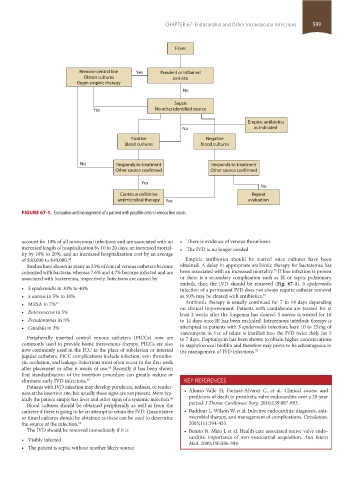
                    FIGURE 67-1.  Evaluation and management of a patient with possible central venous line sepsis.


                    account for 14% of all nosocomial infections and are associated with an     • There is evidence of venous thrombosis
                    increased length of hospitalization by 10 to 20 days, an increased mortal-    • The IVD is no longer needed
                    ity by 10% to 20%, and an increased hospitalization cost by an average
                    of $30,000 to $40,000. 64                              Empiric antibiotics should be started once cultures have been
                     Studies have shown as many as 33% of central venous catheters become    obtained. A delay in appropriate antibiotic therapy for bacteremia has
                                                                                                         70
                    colonized with bacteria, whereas 7.6% and 4.7% become infected and are   been associated with an increased mortality.  If line infection is proven
                    associated with bacteremia, respectively. Infections are caused by  or  there  is  a  secondary  complication  such  as  IE  or  septic  pulmonary
                                                                          emboli, then the IVD should be removed (Fig. 67-1).  S epidermidis
                      • S epidermidis in 30% to 40%                       infection of a permanent IVD does not always require catheter removal
                      • S aureus in 5% to 10%                             as 50% may be cleared with antibiotics. 71
                                                                           Antibiotic therapy is usually continued for 7 to 14 days depending
                      • MRSA in 7% 65                                     on clinical improvement. Patients with candidemia are treated for at
                      • Enterococcus in 5%                                least 2 weeks after the fungemia has cleared. S aureus is treated for 10
                      • Pseudomonas in 5%                                 to 14 days once IE has been excluded. Intravenous interlock therapy is
                      • Candida in 3%                                     attempted in patients with S epidermidis infection; here 10 to 25 mg of
                                                                          vancomycin in 5 cc of saline is instilled into the IVD twice daily for 5
                     Peripherally inserted central venous catheters (PICCs) now are   to 7 days. Daptomycin has been shown to obtain higher concentrations
                    commonly used to provide home intravenous therapy. PICCs are also   in staphylococcal biofilm and therefore may prove to be advantageous in
                    now commonly used in the ICU in the place of subclavian or internal    the management of IVD infections. 72
                    jugular catheters. PICC complications include infection, vein thrombo-
                    sis, occlusion, and leakage. Infections most often occur in the first week
                    after placement or after 6 weeks of use.  Recently it has been shown
                                                 66
                    that standardization of the insertion procedure can greatly reduce or
                    eliminate early IVD infections. 67                     KEY REFERENCES
                     Patients with IVD infection may develop purulence, redness, or tender-
                    ness at the insertion site, but usually these signs are not present. More typ-    • Alonso-Valle H, Farinas-Alvarez C, et al. Clinical course and
                    ically the patient simply has fever and other signs of a systemic infection. 68  predictors of death in prosthetic valve endocarditis over a 20-year
                     Blood cultures should be obtained peripherally as well as from the   period. J Thorac Cardiovasc Surg. 2010;139:887-893.
                    catheter if there is going to be an attempt to retain the IVD. Quantitative     • Baddour L, Wilson W, et al. Infective endocarditis: diagnosis, anti-
                    or timed cultures should be obtained as these can be used to determine   microbial therapy, and management of complications. Circulation.
                    the source of the infection. 69                          2005;111:394-433.
                     The IVD should be removed immediately if it is           • Benito N, Miro J, et al. Health care associated native valve endo-
                      • Visibly infected                                     carditis:  importance  of  non-nosocomial  acquisition.  Ann Intern
                                                                             Med. 2009;150:586-594.
                      • The patient is septic without another likely source


            section05_c61-73.indd   599                                                                                1/23/2015   12:48:02 PM

