


Page 863 - Hall et al (2015) Principles of Critical Care-McGraw-Hill
P. 863
594     PART 5: Infectious Disorders


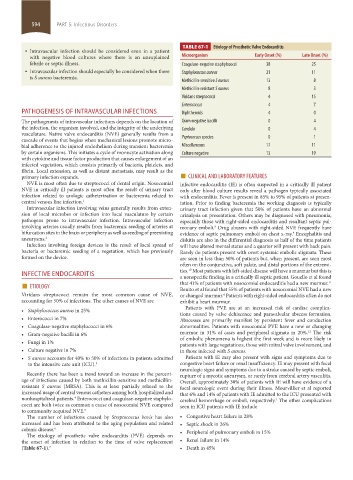
                                                                         TABLE 67-1    Etiology of Prosthetic Valve Endocarditis
                     • Intravascular  infection  should  be  considered  even  in  a  patient
                    with negative blood cultures where there is an unexplained   Microorganism   Early Onset (%)  Late Onset (%)
                    febrile or septic illness.                          Coagulase-negative staphylococci  38        25
                     • Intravascular infection should especially be considered when there   Staphylococcus aureus  21  11
                    is S aureus bacteremia.
                                                                        Methicillin-sensitive S aureus  13           8
                                                                        Methicillin-resistant S aureus  8            3
                                                                        Viridans streptococci        4              15
                                                                        Enterococcus                 4               7
                 PATHOGENESIS OF INTRAVASCULAR INFECTIONS               Diphtheroids                 4               0

                 The pathogenesis of intravascular infections depends on the location of   Gram-negative bacilli  0  4
                 the infection, the organism involved, and the integrity of the underlying   Candida  0              4
                 vasculature. Native valve endocarditis (NVE) generally results from a
                 cascade of events that begins when mechanical lesions promote micro-  Peptococcus species  0        1
                 bial adherence to the injured endothelium during transient bacteremia   Miscellaneous  17          11
                 by certain organisms. This initiates a cycle of monocyte activation along   Culture negative  13   19
                 with cytokine and tissue factor production that causes enlargement of an
                 infected vegetation, which consists primarily of bacteria, platelets, and
                 fibrin. Local extension, as well as distant metastasis, may result as the     ■
                 primary infection expands.                               CLINICAL AND LABORATORY FEATURES
                   NVE is most often due to streptococci of dental origin. Nosocomial   Infective endocarditis (IE) is often suspected in a critically ill patient
                 NVE in critically ill patients is most often the result of urinary tract   only after blood culture results reveal a pathogen typically associated
                 infection related to urologic catheterization or bacteremia related to   with endocarditis. Fever is present in 85% to 95% of patients at presen-
                 central venous line infection. 1                      tation. Prior to finding bacteremia the working diagnosis is typically
                   Intravascular infection involving veins generally results from exten-  urinary tract infection given that 50% of patients have an abnormal
                 sion of local microbes or infection into local vasculature by certain   urinalysis on presentation. Others may be diagnosed with pneumonia,
                 pathogens prone to intravascular infection. Intravascular infection   especially those with right-sided endocarditis and resultant septic pul-
                 involving arteries usually results from bacteremic seeding of arteries at   monary emboli.  Drug abusers with right-sided NVE frequently have
                                                                                   8
                 bifurcation sites in the brain or periphery as well as seeding of preexisting    evidence of septic pulmonary emboli on chest x-ray.  Encephalitis and
                                                                                                              9
                 aneurysms. 2                                          diskitis are also in the differential diagnosis as half of the time patients
                   Infection involving foreign devices is the result of local spread of   will have altered mental status and a quarter will present with back pain.
                 bacteria or  bacteremic  seeding of a vegetation, which has  previously   Rarely do patients present with overt systemic embolic stigmata. These
                 formed on the device.                                 are seen in less than 50% of patients but, when present, are seen most
                                                                       often on the conjunctiva, soft palate, and distal portions of the extremi-
                                                                       ties.  Most patients with left-sided disease will have a murmur but this is
                                                                          10
                 INFECTIVE ENDOCARDITIS                                a nonspecific finding in a critically ill septic patient. Gouello et al found
                     ■  ETIOLOGY                                       that 41% of patients with nosocomial endocarditis had a new murmur.
                                                                                                                          11
                 Viridans streptococci remain the most common cause of NVE,    Benito et al found that 55% of patients with nosocomial NVE had a new
                                                                       or changed murmur.  Patients with right-sided endocarditis often do not
                                                                                      4
                 accounting for 50% of infections. The other causes of NVE are  exhibit a heart murmur.
                                                                         Patients with PVE are at an increased risk of cardiac complica-
                    • Staphylococcus aureus in 25%                     tions caused by valve dehiscence and paravalvular abscess formation.
                    • Enterococci in 7%                                Abscesses are primarily manifest by persistent fever and conduction
                    • Coagulase-negative staphylococci in 6%           abnormalities. Patients with nosocomial PVE have a new or changing
                                                                                                                   12
                    • Gram-negative bacilli in 6%                      murmur in 31% of cases and peripheral stigmata in 20%.  The risk
                    • Fungi in 1%                                      of embolic phenomena is highest the first week and is more likely in
                                                                       patients with large vegetations, those with mitral valve involvement, and
                    • Culture negative in 7%                           in those infected with S aureus.
                    • S aureus accounts for 40% to 50% of infections in patients admitted   Patients with IE may also present with signs and symptoms due to
                   to the intensive care unit (ICU). 3                 congestive heart failure or renal insufficiency. IE may present with focal
                                                                       neurologic signs and symptoms due to a stroke caused by septic emboli,
                   Recently there has been a trend toward an increase in the percent-  rupture of a mycotic aneurysm, or rarely from cerebral artery vasculitis.
                 age of infections caused by both methicillin-sensitive and methicillin-   Overall, approximately 30% of patients with IE will have evidence of a
                 resistant  S aureus (MRSA). This is at least partially related to the   focal neurologic event during their illness. Mourvillier et al reported
                 increased usage of central venous catheters among both hospitalized and   that 6% and 14% of patients with IE admitted to the ICU presented with
                 nonhospitalized patients.  Enterococci and coagulase-negative staphylo-  cerebral hemorrhage or emboli, respectively.  The other complications
                                   4
                                                                                                        3
                 cocci are both twice as common a cause of nosocomial NVE compared   seen in ICU patients with IE include
                 to community acquired NVE. 5
                   The number of infections caused by  Streptococcus bovis has also     • Congestive heart failure in 28%
                 increased and has been attributed to the aging population and related     • Septic shock in 26%
                 colonic disease. 6                                       • Peripheral of pulmonary emboli in 15%
                   The etiology of prosthetic valve endocarditis (PVE) depends on
                 the  onset  of  infection  in  relation  to  the  time  of  valve  replacement     • Renal failure in 14%
                 (Table 67-1). 7                                          • Death in 45%


            section05_c61-73.indd   594                                                                                1/23/2015   12:48:00 PM

