


Page 867 - Hall et al (2015) Principles of Critical Care-McGraw-Hill
P. 867
598     PART 5: Infectious Disorders


                 throat, half develop a tender or swollen neck, and 80% will develop   Resolution of the infection always requires device removal when there
                 pleuropulmonary disease.  Patients with pylephlebitis typically have   is deep pocket involvement or where S aureus is the cause. Intravenous
                                    48
                 abdominal pain and abnormal liver function tests. Those with septic   antibiotics alone may be effective in all other cases of uncomplicated
                 pelvic thrombophlebitis usually have persistent fever and 50% present   infection. Treatment regimens generally are the same used to treat IE. A
                 with pelvic pain. 49                                  2-week course of treatment may be adequate in patients who do not have
                     ■  ETIOLOGY                                       S aureus infection, evidence of IE, and have had all hardware removed.  A
                                                                                                                        57
                                                                       new pacemaker may be placed once the patient’s bacteremia has cleared.
                 of cases. In fact, the isolation of fusobacterium from blood cultures   ■  ARTERIAL GRAFT INFECTIONS
                 Lemierre syndrome is caused by fusobacterium in more than 80%
                 should always raise the question of postanginal sepsis. Secondary     The literature reports the infection rate for arterial grafts to be between
                 infection may occur due to S aureus or other oropharyngeal organisms.    2% and 6%, 58,59  and a reported mortality rate as high as 50%. However,
                                                                    50
                 Pylephlebitis is usually due to enteric pathogens such as E coli, Proteus,   these reported numbers do not reflect the data regarding abdominal
                 and Klebsiella, as well as the anaerobes Bacteroides and Clostridia. Septic   and thoracic endografts where the infection rate is 0.26% and 4.77%,
                 pelvic  thrombophlebitis has been attributed to enteric pathogens as well   respectively.  Bruin et al reported a 6-year experience showing the over-
                                                                                60
                 as streptococci and staphylococci. 51                 all complication rate to be higher with endografts but similar survival
                     ■  DIAGNOSIS AND TREATMENT                        and infection rates between open and endovascular procedures.  Graft
                                                                                                                     61
                                                                       infections present on average 8 months after implantation, but have been
                 Blood  cultures  are  positive  in  80%  of  patients  with  pylephlebitis  but   reported to occur as late as 7 to 10 years after graft placement.
                   usually are not positive in patients with septic pelvic thrombophlebitis   As with other intravascular device infections, the etiology and presen-
                 or postanginal sepsis. Diagnosis is supported by imaging studies with CT   tation vary depending on the onset in relation to surgery. Infections that
                 or MRI having reported sensitivities and specificities of 90% to 100%. 52  occur within 4 months of surgery are considered to be early onset and
                   Treatment with intravenous antibiotics is usually continued until   most often are due to S aureus, whereas late infection is more often due
                 clinical resolution, which is often 3 to 6 weeks in patients with Lemierre   to S epidermidis. Other organisms are encountered less often with only
                 syndrome or pylephlebitis but usually only 48 to 72 hours after deferves-  14% of infections being polymicrobial. 62
                 cence in patients with septic pelvic thrombophlebitis. Anticoagulation   Patients with early onset infection may present with signs of systemic
                 may be beneficial in all, but most clearly so in patients with septic pelvic   illness, whereas patients with late onset infection often present mostly
                 thrombophlebitis. Surgical intervention is at times necessary to treat the   with signs of graft malfunctioning or poor surgical site wound healing.
                 primary infection or complications such as abscess formation.  Blood cultures are often negative, especially in late onset infection.
                                                                       CT scan may reveal fluid around the graft, but this may be a normal
                                                                       early postoperative finding. Technetium or indium scans may be useful
                 DEVICE-RELATED INFECTIONS                             as can sinography.
                     ■  PACEMAKER AND DEFIBRILLATOR INFECTIONS         venous antibiotics directed against the isolated pathogen.
                                                                         Definitive treatment involves surgical graft removal along with intra-
                 as the number of devices implanted has increased 10-fold in recent years   ■  CENTRAL VENOUS LINE INFECTIONS
                 The number of cardiac device–related infections (CDRI) has increased

                 with a rate of 2.11 per 1000 recipients and an incidence of 5% to 6%.    There are approximately 250,000 to 500,000 intravenous device (IVD)–
                                                                    53
                 S aureus or S epidermidis cause most cases of CDRI with gram-negative   related bloodstream infections per year in the United States with 80,000
                 aerobes, Candida, and enterococci being isolated less often. Sohail et al   occurring in ICU patients. The rate of infection associated with IVD
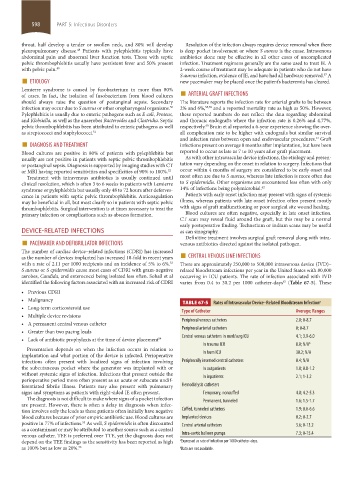
                 identified the following factors associated with an increased risk of CDRI  varies from 0.4 to 30.2 per 1000 catheter-days  (Table 67-5). These
                                                                                                          63
                    • Previous CDRI
                    • Malignancy                                         TABLE 67-5    Rates of Intravascular Device–Related Bloodstream Infection a
                    • Long-term corticosteroid use                      Type of Catheter                       Average; Ranges
                    • Multiple device revisions
                    • A permanent central venous catheter               Peripheral venous catheters            2.0; 0-8.7
                                                                        Peripheral arterial catheters          0; 0-8.7
                    • Greater than two pacing leads
                    • Lack of antibiotic prophylaxis at the time of device placement 54  Central venous catheters in med/surg ICU  4.1; 3.9-6.0
                                                                             In trauma ICU                     8.0; N/A b
                   Presentation depends  on when  the infection occurs  in relation to
                 implantation and what portion of the device is infected. Perioperative        In burn ICU     30.2; N/A
                 infections often present with localized signs of infection involving   Peripherally inserted central catheters  0.4; N/A
                 the  subcutaneous  pocket  where  the  generator  was  implanted with  or        In outpatients  1.0; 0.8-1.2
                 without systemic signs of infection. Infections that present outside the        In inpatients  2.1; 1-3.2
                 perioperative period more often present as an acute or subacute undif-
                 ferentiated  febrile  illness.  Patients  may  also  present  with  pulmonary   Hemodialysis catheters
                 signs and symptoms as patients with right-sided IE often present.       Temporary, noncuffed  4.8; 4.2-5.3
                   The diagnosis is not difficult to make where signs of a pocket  infection        Permanent, tunneled  1.6; 1.5-1.7
                 are present. However, there is often a delay in diagnosis when infec-
                 tion inv olves only the leads as these patients often initially have negative   Cuffed, tunneled catheters  1.9; 0.6-6.6
                 blood cultures because of prior empiric antibiotic use. Blood cultures are   Implanted devices  0.2; 0-2.7
                 positive in 77% of infections.  As well, S epidermidis is often discounted   Central arterial catheters  3.6; 0-13.2
                                      55
                 as a contaminant or may be attributed to another source such as a central
                 venous catheter. TEE is preferred over TTE, yet the diagnosis does not   Intra-aortic balloon pumps  7.3; 0-15.4
                 depend on the TEE findings as the sensitivity has been reported as high   a Expressed as rate of infection per 1000 catheter-days.
                 as 100% but as low as 20%. 56                         b Data are not available.


            section05_c61-73.indd   598                                                                                1/23/2015   12:48:01 PM

