


Page 906 - Hall et al (2015) Principles of Critical Care-McGraw-Hill
P. 906
CHAPTER 69: Human Immunodeficiency Virus (HIV) and AIDS in the Intensive Care Unit  637


                    is also frequent. Bronchoscopic evaluation usually rules out a super-  are  meningitis,  dementia,  encephalopathy,  focal  neurologic  deficits,
                    imposed treatable HIV-related disease in patients with pulmonary KS.   myelopathy, peripheral neuropathy, and myopathy. 138,139  Often the neu-
                    Bronchoscopy and BAL may also allow visualization of the characteristic   rologic  disease  may  be  associated  with  systemic  illness  rather  than  a
                    red-violaceous  lesions  in  the  endobronchial  tree.  Although  biopsy  of   focal neurologic insult. The prevalence of CNS opportunistic infections
                    these bronchial lesions at times can provide diagnostic confirmation,   is again dependent on the level of immune suppression. In addition to
                    this is rarely required  and is not recommended due to concern regard-  common  viral  and  bacterial  etiologies  of  meningoencephalitis,  which
                                   135
                    ing hemorrhage. Despite improvements in outcomes with ART-related   can affect even immune-competent individuals, unusual infections
                    immune reconstitution and the use of chemotherapeutic regimens such   such as  Cryptococcus neoformans and Toxoplasma are AIDS-defining
                    as  liposomal  doxorubicin  (alternatively  paclitaxel),  mortality  of  KS   conditions. With advanced disease (CD4 cell counts <200 cells/mm )
                                                                                                                            3
                    remains high. 136,137  Corticosteroids may cause progression of cutaneous   progressive multifocal leukoencephalopathy (PML) associated with JC
                    or visceral KS and are contraindicated.               virus and primary CNS lymphomas must be considered although are
                        ■  NEUROLOGIC MANIFESTATIONS IN HIV-INFECTED PATIENTS  most commonly seen in those with CD4 cell counts <50 cells/mm .
                                                                                                                          3
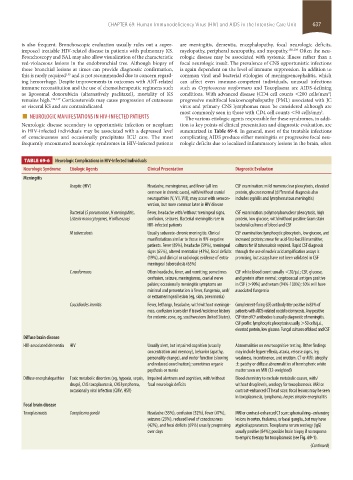
                                                                           The various etiologic agents responsible for these syndromes, in addi-
                    Neurologic  disease  secondary  to  opportunistic  infection  or  neoplasm   tion to key points of clinical presentation and diagnostic evaluation, are
                    in HIV-infected individuals  may be  associated with  a depressed level   summarized in Table 69-6. In general, most of the treatable infections
                    of consciousness and occasionally precipitates ICU care. The most   complicating AIDS produce either meningitis or progressive focal neu-
                    frequently encountered neurologic syndromes in HIV-infected patients   rologic deficits due to localized inflammatory lesions in the brain, often


                      TABLE 69-6    Neurologic Complications in HIV-Infected Individuals
                    Neurologic Syndrome  Etiologic Agents      Clinical Presentation        Diagnostic Evaluation
                    Meningitis
                                    Aseptic (HIV)              Headache, meningismus, and fever (all less   CSF examination: mild mononuclear pleocytosis, elevated
                                                               common in chronic cases), with/without cranial   protein, glucose normal (differential diagnosis also
                                                               neuropathies (V, VII, VIII); may occur with serocon- includes syphilis and lymphomatous meningitis)
                                                               version, but more common later in HIV disease
                                    Bacterial (S pneumoniae, N meningiditis,   Fever, headache with/without meningeal signs,   CSF examination: polymorphonuclear pleocytosis, high
                                    Listeria monocytogenes, H influenzae)  confusion, seizures. Bacterial meningitis rare in   protein, low glucose, with/without positive Gram stain
                                                               HIV-infected patients        bacterial cultures of blood and CSF
                                    M tuberculosis             Usually subacute-chronic meningitis. Clinical   CSF examination: lymphocytic pleocytosis, low glucose, and
                                                               manifestations similar to those in HIV-negative   increased protein; smear for acid-fast-bacilli insensitive;
                                                               patients. Fever (89%), headache (59%), meningeal  cultures for M tuberculosis required. Rapid CSF diagnosis
                                                               signs (65%), altered mentation (43%), focal deficits  through the use of nucleic acid amplification assays is
                                                               (19%), and clinical or radiologic evidence of extra-  promising, but assays have not been validated in CSF
                                                               meningeal tuberculosis (65%)
                                    C neoformans               Often headache, fever, and vomiting; sometimes   CSF white blood count usually <20/µL; CSF, glucose,
                                                               confusion, seizure, meningismus, cranial nerve    and protein often normal; cryptococcal antigen positive
                                                               palsies; occasionally meningitis symptoms are   in CSF (>90%) and serum (94%-100%); 50% will have
                                                               minimal and presentation is fever, fungemia, and/  associated fungemia
                                                               or extrameningeal lesion (eg, skin, pneumonia)
                                    Coccidioides immitis       Fever, lethargy, headache, with/without meningis- Complement-fixing (CF) antibody titer positive in 83% of
                                                               mus, confusion (consider if travel/residence history  patients with AIDS-related coccidioidomycosis. Any positive
                                                               for endemic zone, eg, southwestern United States). CSF titer of CF antibodies is usually diagnostic of meningitis.
                                                                                            CSF profile: lymphocytic pleocytosis usually >50 cells/µL,
                                                                                            elevated protein, low glucose. Fungal cultures of blood and CSF
                    Diffuse brain disease
                    HIV-associated dementia  HIV               Usually alert, but impaired cognition (usually   Abnormalities on neurocognitive testing. Other findings
                                                               concentration and memory), behavior (apathy,   may include hyperreflexia, ataxia, release signs, leg
                                                               personality change), and motor function (slowing   weakness, incontinence, and mutism. CT or MRI: atrophy
                                                               and reduced coordination); sometimes organic   ± patchy or diffuse abnormalities of hemispheric white
                                                               psychosis or mania           matter seen on MRI (T2-weighted)
                    Diffuse encephalopathies  Toxic metabolic disorders (eg, hypoxia, sepsis,  Impaired alertness and cognition, with/without   Blood chemistry to exclude metabolic causes, with/
                                    drugs), CNS toxoplasmosis, CNS lymphoma,   focal neurologic deficits  without drug levels, serology for toxoplasmosis. MRI or
                                    occasionally viral infection (CMV, HSV)                 contrast-enhanced CT head scan: focal lesions may be seen
                                                                                            in  toxoplasmosis, lymphoma, herpes simplex encephalitis
                    Focal brain disease
                    Toxoplasmosis   Toxoplasma gondii          Headache (55%), confusion (52%), fever (47%),   MRI or contrast-enhanced CT scan: spherical ring–enhancing
                                                                 seizures (29%), reduced level of consciousness   lesions in cortex, thalamus, or basal ganglia, but may have
                                                               (42%), and focal deficits (69%) usually progressing  atypical appearances. Toxoplasma serum serology (IgG)
                                                               over days                    usually positive (84%); possible brain biopsy if no response
                                                                                            to empiric therapy for toxoplasmosis (see Fig. 69-1).
                                                                                                                      (Continued)


            section05_c61-73.indd   637                                                                                1/23/2015   12:48:22 PM

