


Page 903 - Hall et al (2015) Principles of Critical Care-McGraw-Hill
P. 903
634     PART 5: Infectious Disorders


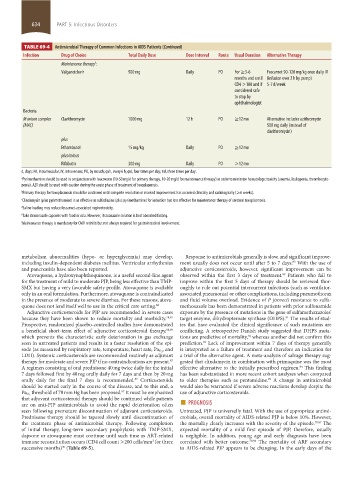
                   TABLE 69-4    Antimicrobial Therapy of Common Infections in AIDS Patients (Continued)
                  Infection    Drug of Choice         Total Daily Dose   Dose Interval  Route  Usual Duration  Alternative Therapy
                               Maintenance therapy: f
                               Valganciclovir         900 mg             Daily      PO    For ≥3-6   Foscarnet 90-120 mg/kg once daily IV
                                                                                          months and until  (infusion over 2 h by pump)
                                                                                          CD4 >100 and if  5-7 d/week
                                                                                          considered safe
                                                                                          to stop by
                                                                                          ophthalmologist
                  Bacteria
                  M avium complex   Clarithromycin    1000 mg            12 h       PO    ≥12 mo     Alternative includes  azithromycin
                  (MAC)                                                                              500 mg daily (instead of
                                                                                                       clarithromycin)
                               plus
                               Ethambutol             15 mg/kg           Daily      PO    ≥12 mo
                               plus/minus
                               Rifabutin              300 mg             Daily      PO    >12 mo
                 d, days; IM, intramuscular; IV, intravenous; PO, by mouth; q6h, every 6 h; qid, four times per day; tid, three times per day.
                 a Pyrimethamine should be used in conjunction with leucovorin (10-50 mg/d for primary therapy, 10-20 mg/d for maintenance therapy) in order to minimize hematologic toxicity (anemia, leukopenia, thrombocyto-
                 penia). AZT should be used with caution during the acute phase of treatment of toxoplasmosis.
                 b Primary therapy for toxoplasmosis should be continued until complete resolution or marked improvement has occurred clinically and radiologically (≥6 weeks).
                 c Clindamycin (plus pyrimethamine) is as effective as sulfadiazine (plus pyrimethamine) for induction but less effective for maintenance therapy of cerebral toxoplasmosis.
                 d Saline loading may reduce foscarnet-associated nephrotoxicity.
                 e Take itraconazole capsules with food or cola. However, itraconazole solution is best absorbed fasting.
                 f Maintenance therapy is mandatory for CMV retinitis but not always required for gastrointestinal involvement.


                 metabolism abnormalities (hypo- or hyperglycemia) may develop,   Response to antimicrobials generally is slow, and significant improve-
                 including insulin-dependent diabetes mellitus. Ventricular arrhythmias   ment usually does not occur until after 5 to 7 days.  With the use of
                                                                                                              83
                 and pancreatitis have also been reported.             adjunctive corticosteroids, however, significant improvement can be
                   Atovaquone, a hydroxynaphthoquinone, is a useful second-line agent   observed within the first 3 days of treatment.  Patients who fail to
                                                                                                          89
                 for the treatment of mild to moderate PJP, being less effective than TMP-  improve within the first 5 days of therapy should be reviewed thor-
                 SMX but having a very favorable safety profile. Atovaquone is available   oughly to rule out potential intercurrent infections (such as ventilator-
                 only in an oral formulation. Furthermore, atovaquone is contraindicated   associated pneumonia) or other complications, including pneumothorax
                 in the presence of moderate to severe diarrhea. For these reasons, atova-  and fluid volume overload. Evidence of P jirovecii resistance to sulfa-
                 quone does not lend itself well to use in the critical care setting. 86  methoxazole has been demonstrated in patients with prior sulfonamide
                   Adjunctive corticosteroids for PJP are recommended in severe cases   exposure by the presence of mutations in the gene of sulfamethaxazoles’
                 because they have been shown to reduce mortality and morbidity. 78,87    target enzyme, dihydropteroate synthase (DHPS).  The results of stud-
                                                                                                           91
                 Prospective, randomized placebo-controlled studies have demonstrated   ies that have evaluated the clinical significance of such mutations are
                 a beneficial short-term effect of adjunctive corticosteroid therapy, 88,89    conflicting. A retrospective Danish study suggested that DHPS muta-
                                                                                              92
                 which prevents the characteristic early deterioration in gas exchange   tions are predictive of mortality,  whereas another did not confirm this
                 seen in untreated patients and results in a faster resolution of the epi-  prediction.  Lack of improvement within 7 days of therapy generally
                                                                               93
                                                                 , and   is interpreted as a failure of treatment and therefore an indication for
                 sode (as measured by respiratory rate, temperature, heart rate, Pa O 2
                 LDH). Systemic corticosteroids are recommended routinely as adjuvant   a trial of the alternative agent. A meta-analysis of salvage therapy sug-
                 therapy for moderate and severe PJP if no contraindications are present.    gested that clindamycin in combination with primaquine was the most
                                                                    87
                 A regimen consisting of oral prednisone 40 mg twice daily for the initial   effective alternative to the initially prescribed regimen.  This finding
                                                                                                                94
                 7 days followed first by 40 mg orally daily for 7 days and then by 20 mg   has been substantiated in more recent cohort analyses when compared
                 orally daily for the final 7 days is recommended.  Corticosteroids   to older therapies such as pentamidine.  A change in antimicrobial
                                                        87
                                                                                                     95
                 should be started early in the course of the disease, and to this end, a   would also be warranted if severe adverse reactions develop despite the
                     threshold of 70 mm Hg has been proposed.  It must be emphasized
                                                                       use of adjunctive corticosteroids.
                                                   87
                 are  on  anti-PJP  antimicrobials  to  avoid  the  rapid  deterioration  often   ■  PROGNOSIS
                 Pa O 2
                 that adjuvant corticosteroid therapy should be continued while patients
                 seen following premature discontinuation of adjuvant corticosteroids.   Untreated, PJP is universally fatal. With the use of appropriate antimi-
                 Prednisone therapy should be tapered slowly until discontinuation of   crobials, overall mortality of AIDS-related PJP is below 10%. However,
                 the  treatment  phase  of  antimicrobial  therapy.  Following  completion   the mortality clearly increases with the severity of the episode. 78,87  The
                 of initial therapy, long-term secondary prophylaxis with TMP-SMX,   expected mortality of a mild first episode of PJP, therefore, usually
                 dapsone or atovaquone must continue until such time as ART-related   is negligible. In addition, young age and early diagnosis have been
                 immune reconstitution occurs (CD4 cell count >200 cells/mm  for three   correlated with better outcome. 78,96  The mortality of ARF secondary
                                                              3
                               90
                 successive months)  (Table 69-5).                     to AIDS-related PJP appears to be changing. In the early days of the

            section05_c61-73.indd   634                                                                                1/23/2015   12:48:21 PM

