


Page 911 - Hall et al (2015) Principles of Critical Care-McGraw-Hill
P. 911
642     PART 5: Infectious Disorders


                 cardiac output, and hypotension.  The clinical approach to management   with a high prevalence of AIDS patients, active peer support groups may
                                        98
                 is similar to that for other critically ill patients, detailed in Chap. 64. The   be extremely helpful. In addition, family physicians and referring spe-
                 evaluation of adrenal insufficiency and use of corticosteroids for septic   cialists who have long-term care relationships with patients can provide
                 shock  are relevant; furthermore, patients with PJP or suspected PJP   valuable support to the critical care team.
                     173
                 should be treated with hydrocortisone, as discussed earlier.
                   Enteropathy, malnutrition, and weight loss are very common gastroin-  ICU ELIGIBILITY OF AIDS PATIENTS
                 testinal problems in AIDS patients. Up to 30% of AIDS patients have mul-
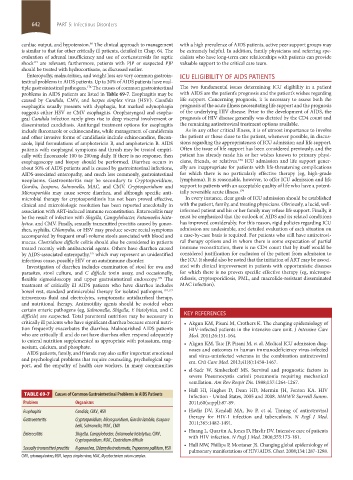
                 tiple gastrointestinal pathogens.  The causes of common gastrointestinal   The two fundamental issues determining ICU eligibility in a patient
                                        174
                 problems in AIDS patients are listed in Table 69-7. Esophagitis may be   with AIDS are the patient’s prognosis and the patient’s wishes regarding
                 caused by  Candida, CMV, and  herpes simplex virus (HSV).  Candida   life support. Concerning prognosis, it is necessary to assess both the
                 esophagitis usually presents with dysphagia, but marked odynophagia   prognosis of the acute illness necessitating life support and the prognosis
                 suggests either HSV or CMV esophagitis. Oropharyngeal and esopha-  of the underlying HIV disease. Prior to the development of AIDS, the
                 geal Candida infection rarely gives rise to deep visceral involvement or   prognosis of HIV disease generally was dictated by the CD4 count and
                 disseminated candidiasis. Antifungal treatment options for esophagitis   the remaining antiretroviral treatment options available.
                 include fluconazole or echinocandins, while management of candidemia   As in any other critical illness, it is of utmost importance to involve
                 and other invasive forms of candidiasis include echinocandins, flucon-  the patient or those close to the patient, whenever possible, in discus-
                 azole, lipid formulations of amphotericin B, and amphotericin B. AIDS   sions regarding the appropriateness of ICU admission and life support.
                 patients with esophageal symptoms and thrush may be treated empiri-  Often the issue of life support has been considered previously, and the
                 cally with fluconazole 100 to 200 mg daily. If there is no response, then   patient has already made his or her wishes known to primary physi-
                                                                                           178
                 esophagoscopy and biopsy should be performed. Diarrhea occurs in   cians, friends, or relatives.  ICU admission and life support gener-
                 about 50% of AIDS patients and is caused by gastrointestinal infections,   ally are inappropriate for patients with life-threatening complications
                 AIDS-associated enteropathy, and much less commonly, gastrointestinal     for which there is no particularly effective therapy (eg, high-grade
                 neoplasms.  Gastroenteritis  may  be  secondary  to  Cryptosporidium,   lymphoma). It is reasonable, however, to offer ICU admission and life
                 Giardia, Isospora, Salmonella, MAC, and CMV.  Cryptosporidium and     support to patients with an acceptable quality of life who have a potent-
                 Microsporidia may cause severe diarrhea, and although specific anti-  ially reversible acute illness. 179
                 microbial therapy for cryptosporidiosis has not been proved effective,   In every instance, clear goals of ICU admission should be established
                 clinical and microbiologic resolution has been reported anecdotally in   with the patient, family, and treating physicians. Obviously, a lucid, well-
                 association with ART-induced immune reconstitution. Enterocolitis may   informed patient and his or her family may refuse life support. Finally, it
                 be the result of infection with Shigella, Campylobacter, Entamoeba histo-  must be emphasized that the outlook of AIDS and its related conditions
                 lytica, and CMV. Finally, sexually transmitted proctitis caused by gonor-  has improved considerably. For this reason, rigid policies regarding ICU
                 rhea, syphilis, Chlamydia, or HSV may produce severe rectal symptoms   admission are undesirable, and detailed evaluation of each situation on
                 accompanied by frequent small-volume stools associated with blood and   a case-by-case basis is required. For patients who still have antiretrovi-
                 mucus. Clostridium difficile colitis should also be considered in patients   ral therapy options and in whom there is some expectation of partial
                 treated recently with antibacterial agents. Others have diarrhea caused   immune reconstitution, there is no CD4 count that by itself would be
                 by AIDS-associated enteropathy,  which may represent an unidentified   considered justification for exclusion of the patient from admission to
                                        175
                 infectious cause, possibly HIV or an autoimmune disorder.  the ICU. It should also be noted that the initiation of ART may be associ-
                   Investigation of diarrhea includes examination of stool for ova and   ated with clinical improvement in patients with opportunistic diseases
                 parasites,  stool  culture, and  C difficile toxin  assay, and  occasionally,   for which there is no proven specific effective therapy (eg, microspo-
                 flexible sigmoidoscopy and upper gastrointestinal endoscopy.  The   ridiosis, cryptosporidiosis, PML, and macrolide-resistant disseminated
                                                                176
                 treatment of critically ill AIDS patients who have diarrhea includes   MAC infection).
                 bowel rest, standard antimicrobial therapy for isolated pathogens, 174,177
                 intravenous fluid and electrolytes, symptomatic antidiarrheal therapy,
                 and nutritional therapy. Antimotility agents should be avoided when
                 certain enteric pathogens (eg, Salmonella, Shigella, E histolytica, and C
                 difficile) are suspected. Total parenteral nutrition may be necessary in   KEY REFERENCES
                 critically ill patients who have significant diarrhea because enteral nutri-    • Akgun KM, Pisani M, Crothers K. The changing epidemiology of
                 tion frequently exacerbates the diarrhea. Malnourished AIDS patients   HIV-infected patients in the intensive care unit. J Intensive Care
                 who are critically ill and do not have diarrhea often respond adequately   Med. 2011;26:151-164.
                 to enteral nutrition supplemented as appropriate with potassium, mag-    • Akgun KM, Tate JP, Pisani M, et al. Medical ICU admission diag-
                 nesium, calcium, and phosphate.                          noses and outcomes in human immunodeficiency virus-infected
                   AIDS patients, family, and friends may also suffer important  emotional   and virus-uninfected veterans in the combination antiretroviral
                 and psychological problems that require counseling, psychological sup-  era. Crit Care Med. 2013;41(6):1458-1467.
                 port, and the empathy of health care workers. In many communities
                                                                           • el-Sadr W, Simberkoff MS. Survival and prognostic factors in
                                                                          severe  Pneumocystis  carinii  pneumonia  requiring mechanical
                                                                          ventilation. Am Rev Respir Dis. 1988;137:1264-1267.
                                                                           • Hall HI, Hughes D, Dean HD, Mermin JH, Fenton KA. HIV
                   TABLE 69-7    Causes of Common Gastrointestinal Problems in AIDS Patients  Infection - United States, 2005 and 2008. MMWR Surveill Summ.
                  Problem           Organisms                             2011;60(suppl):87-89.
                  Esophagitis       Candida, CMV, HSV                      • Havlir DV, Kendall MA, Ive P, et al. Timing of antiretroviral
                                                                          therapy for HIV-1 infection and tuberculosis.  N Engl J Med.
                  Gastroenteritis   Cryptosporidium, Microsporidium, Giardia lamblia, Isospora   2011;365:1482-1491.
                                    belli, Salmonella, MAC, CMV
                                                                           • Huang L, Quartin A, Jones D, Havlir DV. Intensive care of patients
                  Enterocolitis     Shigella, Campylobacter, Entamoeba histolytica, CMV,   with HIV infection. N Engl J Med. 2006;355:173-181.
                                    Cryptosporidium, MAC, Clostridium difficile
                                                                           • Hull MW, Phillips P, Montaner JS. Changing global epidemiology of
                  Sexually transmitted proctitis  N gonorrhea, Chlamydia trachomatis, Treponema pallidum, HSV
                                                                          pulmonary manifestations of HIV/AIDS. Chest. 2008;134:1287-1298.
                 CMV, cytomegalovirus; HSV, herpes simplex virus; MAC, Mycobacterium avium complex.


            section05_c61-73.indd   642                                                                                1/23/2015   12:48:25 PM

