


Page 929 - Hall et al (2015) Principles of Critical Care-McGraw-Hill
P. 929
660     PART 5: Infectious Disorders


                 by hemorrhage. At the time of aspiration, a specimen should be sent for   organism) and the high concentrations it attains in brain abscess pus,
                 Gram stain (and other special stains, eg, Ziehl-Nielsen, modified acid-  even with concomitant corticosteroid administration. In addition, met-
                 fast, and silver stains, when appropriate), routine culture, and anaerobic   ronidazole may improve mortality rates in patients with brain abscess. In
                 culture. In patients with a likely bacterial brain abscess, 16S rDNA   cases in which S aureus is a likely infecting pathogen (eg, cranial trauma
                 metagenomic analysis and amplification may be important in patients   or prior neurosurgery), vancomycin (which penetrates into brain abscess
                 with histologic evidence of brain abscess and negative cultures; two   fluid) should be used empirically while awaiting results of in vitro sus-
                 studies found that this technique dramatically increased the number of   ceptibility testing. The penetration of clindamycin, erythromycin, and the
                 agents identified, 56,57  although confirmation is needed to determine the   first-generation cephalosporins into brain abscesses is usually inadequate
                 importance of these multiple agents as true pathogens in patients with   to achieve therapeutic concentrations, thus precluding their use in this
                 brain abscess. The use of this modality in the treatment of brain abscess   setting. For empirical therapy when members of the Enterobacteriaceae
                 is discussed under Surgical Therapy in the section Treatment.  are suspected (eg, in cases of abscess of otitic origin), a third-generation
                   Lumbar puncture is contraindicated in patients with suspected or   cephalosporin or trimethoprim-sulfamethoxazole should be used.
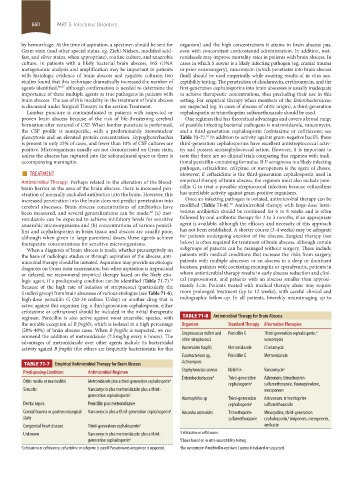
                 proven brain abscess because of the risk of life-threatening cerebral   One regimen that has theoretical advantages and covers a broad range
                 herniation after removal of CSF. When lumbar puncture is performed,   of possible infecting bacterial pathogens is metronidazole, vancomycin,
                 the CSF profile is nonspecific, with a predominantly mononuclear   and a third-generation cephalosporin (cefotaxime or ceftriaxone; see
                 pleocytosis and an elevated protein concentration. Hypoglycorrhachia   Table 71-7).  In addition to activity against gram-negative bacilli, these
                                                                                52
                 is present in only 25% of cases, and fewer than 10% of CSF cultures are   third-generation cephalosporins have excellent antistreptococcal activ-
                 positive. Microorganisms usually are not demonstrated on Gram stain,   ity and possess antistaphylococcal action. However, it is important to
                 unless the abscess has ruptured into the subarachnoid space or there is   note that there are no clinical trials comparing this regimen with tradi-
                 accompanying meningitis.                              tional penicillin-containing formulas. If P aeruginosa is a likely infecting
                     ■  TREATMENT                                      pathogen, ceftazidime, cefepime, or meropenem is the agent of choice.
                                                                       However, if ceftazidime is the third-generation cephalosporin used in
                 Antimicrobial Therapy:  Perhaps related to the alteration of the blood-  empirical therapy of brain abscess, the regimen must also include peni-
                 brain barrier in the area of the brain abscess, there is increased pen-  cillin G to treat a possible streptococcal infection because ceftazidime
                 etration of normally excluded antibiotics into the brain. However, this   has unreliable activity against gram-positive organisms.
                 increased penetration into the brain does not predict penetration into   Once an infecting pathogen is isolated, antimicrobial therapy can be
                                                                                        52
                 cerebral abscesses. Brain abscess concentrations of antibiotics have   modified (Table 71-8).  Antimicrobial therapy with large-dose intra-
                 been measured, and several generalizations can be made:  (a) met-  venous antibiotics should be continued for 6 to 8 weeks and is often
                                                             52
                 ronidazole can be expected to achieve inhibitory levels for sensitive   followed by oral antibiotic therapy for 2 to 3 months, if an appropriate
                 anaerobic microorganisms and (b) concentrations of various penicil-  agent is available, although the efficacy and necessity of this approach
                 lins and cephalosporins in brain tissue and abscess are usually poor,   has not been established. A shorter course (3-4 weeks) may be adequate
                 although when given in large parenteral doses, these agents achieve   for patients undergoing excision of the abscess. Surgical therapy (see
                 therapeutic concentrations for sensitive microorganisms.  below) is often required for treatment of brain abscess, although certain
                   When a diagnosis of brain abscess is made, whether presumptively on   subgroups of patients can be managed without surgery. These include
                 the basis of radiologic studies or through aspiration of the abscess, anti-  patients with medical conditions that increase the risks from surgery,
                 microbial therapy should be initiated. Aspiration may provide an etiologic   patients with multiple abscesses or an abscess in a deep or dominant
                 diagnosis on Gram stain examination, but when aspiration is impractical   location, patients with coexisting meningitis or ependymitis, patients in
                 or delayed, we recommend empirical therapy based on the likely etio-  whom antimicrobial therapy results in early abscess reduction and clini-
                 logic agent, if a predisposing condition can be identified (Table 71-7).    cal improvement, and patients with an abscess smaller than approxi-
                                                                    52
                 Because of the high rate of isolation of streptococci (particularly the    mately 3 cm. Patients treated with medical therapy alone may require
                 S milleri group) from brain abscesses of various etiologies (see Table 71-6),   more prolonged treatment (up to 12 weeks), with careful clinical and
                 high-dose  penicillin  G  (20-24  million  U/day)  or  another  drug that  is   radiographic  follow-up.  In  all  patients,  biweekly neuroimaging  up  to
                 active against this organism (eg, a third-generation cephalosporin, either
                 cefotaxime or ceftriaxone) should be included in the initial therapeutic
                 regimen. Penicillin is also active against most anaerobic species, with     TABLE 71-8    Antimicrobial Therapy for Brain Abscess
                 the notable exception of B fragilis, which is isolated in a high percentage    Organism  Standard Therapy Alternative Therapies
                 (20%-40%) of brain abscess cases. When B fragilis is suspected, we rec-                              a
                 ommend the addition of metronidazole (7.5 mg/kg every 6 hours). The   Streptococcus milleri and   Penicillin G  Third-generation cephalosporin,
                 advantages of metronidazole over other agents include its bactericidal   other streptococci    vancomycin
                 activity against B fragilis (the others are frequently bacteriostatic for this   Bacteroides fragilis  Metronidazole  Clindamycin
                                                                        Fusobacterium sp,   Penicillin G  Metronidazole
                   TABLE 71-7    Empirical Antimicrobial Therapy for Brain Abscess  Actinomyces
                                                                        Staphylococcus aureus  Nafcillin  Vancomycin c
                  Predisposing Condition  Antimicrobial Regimen
                                                                        Enterobacteriaceae b  Third-generation   Aztreonam, trimethoprim-
                  Otitis media or mastoiditis  Metronidazole plus a third-generation cephalosporin a
                                                                                        cephalosporin a  sulfamethoxazole, fluoroquinolone,
                  Sinusitis             Vancomycin plus metronidazole plus a third-                 meropenem
                                        generation cephalosporin a
                                                                        Haemophilus sp  Third-generation   Aztreonam, trimethoprim-
                  Dental sepsis         Penicillin plus metronidazole                   cephalosporin a  sulfamethoxazole
                  Cranial trauma or postneurosurgical   Vancomycin plus a third-generation  cephalosporin a  Nocardia asteroides  Trimethoprim-  Minocycline, third-generation
                  state                                                                 sulfamethoxazole  cephalosporin,  imipenem, meropenem,
                                                                                                            a
                  Congenital heart disease  Third-generation cephalosporin a                        amikacin
                  Unknown               Vancomycin plus metronidazole plus a third-   a Cefotaxime or ceftriaxone.
                                        generation cephalosporin a     b Choice based on in vitro susceptibility testing.
                 a Cefotaxime or ceftriaxone; ceftazidime or cefepime is used if Pseudomonas aeruginosa is suspected.  c Use vancomycin if methicillin-resistant S aureus is isolated or suspected.


            section05_c61-73.indd   660                                                                                1/23/2015   12:48:38 PM

