


Page 925 - Hall et al (2015) Principles of Critical Care-McGraw-Hill
P. 925
656     PART 5: Infectious Disorders


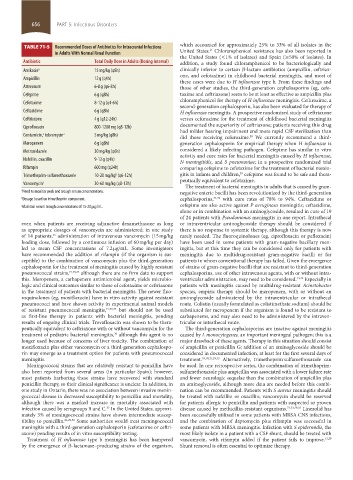
                   TABLE 71-5     Recommended Doses of Antibiotics for Intracranial Infections   which accounted for approximately 25% to 33% of all isolates in the
                                                                                 21
                             in Adults With Normal Renal Function      United States.  Chloramphenicol resistance has also been reported in
                                                                       the United States (<1% of isolates) and Spain (≥50% of isolates). In
                  Antibiotic              Total Daily Dose in Adults (Dosing Interval)  addition, a study found chloramphenicol to be bacteriologically and
                  Amikacin a              15 mg/kg (q8h)               clinically  inferior  to  certain  β-lactam  antibiotics  (ampicillin,  ceftriax-
                                                                       one, and cefotaxime) in childhood bacterial meningitis, and most of
                  Ampicillin              12 g (q4h)
                                                                       these cases were due to H influenzae type b. From these findings and
                  Aztreonam               6-8 g (q6-8h)                those of other studies, the third-generation cephalosporins (eg, cefo-
                  Cefepime                6 g (q8h)                    taxime and ceftriaxone) seem to be at least as effective as ampicillin plus
                                                                       chloramphenicol for therapy of H influenzae meningitis. Cefuroxime, a
                  Cefotaxime              8-12 g (q4-6h)
                                                                       second-generation cephalosporin, has also been evaluated for therapy of
                  Ceftazidime             6 g (q8h)                    H influenzae meningitis. A prospective randomized study of ceftriaxone
                  Ceftriaxone             4 g (q12-24h)                versus cefuroxime for the treatment of childhood bacterial meningitis
                  Ciprofloxacin           800-1200 mg (q8-12h)         documented the superiority of ceftriaxone; patients receiving this drug
                                                                       had milder hearing impairment and more rapid CSF sterilization than
                  Gentamicin,  tobramycin a  5 mg/kg (q8h)             did those receiving cefuroxime.  We currently recommend a third-
                        a
                                                                                               38
                  Meropenem               6 g (q8h)                    generation cephalosporin for empirical therapy when  H influenzae is
                  Metronidazole           30 mg/kg (q6h)               considered a likely infecting pathogen. Cefepime has similar in vitro
                                                                       activity and cure rates for bacterial meningitis caused by H influenzae,
                  Nafcillin, oxacillin    9-12 g (q4h)
                                                                       N  meningitidis, and  S  pneumoniae; in a prospective randomized trial
                  Rifampin                600 mg (q24h)                comparing cefepime to cefotaxime for the treatment of bacterial menin-
                                                                                            39
                  Trimethoprim-sulfamethoxazole  10-20 mg/kg  (q6-12h)  gitis in infants and children,  cefepime was found to be safe and thera-
                                                 b
                                                                       peutically equivalent to cefotaxime.
                  Vancomycin c            30-60 mg/kg (q8-12h)
                                                                         The treatment of bacterial meningitis in adults that is caused by gram-
                 a Need to monitor peak and trough serum concentrations.  negative enteric bacilli has been revolutionized by the third-generation
                 b Dosage based on trimethoprim component.             cephalosporins, 21,29  with cure  rates  of 78% to 94%. Ceftazidime or
                 c Maintain serum trough concentrations of 15-20 µg/mL.  cefepime are also active against P aeruginosa meningitis; ceftazidime,
                                                                       alone or in combination with an aminoglycoside, resulted in cure of 19
                                                                       of 24 patients with Pseudomonas meningitis in one report. Intrathecal
                 even when patients are receiving adjunctive dexamethasone as long   or intraventricular aminoglycoside therapy should be considered if
                 as appropriate dosages of vancomycin are administered; in one study   there is no response to systemic therapy, although this therapy is now
                 of 14 patients,  administration of intravenous vancomycin (15 mg/kg     rarely needed. The fluoroquinolones (eg, ciprofloxacin or pefloxacin)
                            35
                 loading dose, followed by a continuous infusion of 60 mg/kg per day)   have been used in some patients with gram-negative bacillary men-
                 led to mean CSF concentrations of 7.2 µg/mL. Some investigators   ingitis, but at this time they can be considered only for patients with
                 have recommended the addition of rifampin (if the organism is sus-  meningitis  due  to  multidrug-resistant  gram-negative  bacilli  or  for
                 ceptible) to the combination of vancomycin plus the third-generation   patients in whom conventional therapy has failed. Given the emergence
                 cephalosporin for the treatment of meningitis caused by highly resistant   of strains of gram-negative bacilli that are resistant to third-generation
                 pneumococcal strains, 21,29,32  although there are no firm data to support     cephalosporins, use of other intravenous agents, with or without intra-
                 this. Meropenem, a carbapenem antimicrobial agent, yields microbio-  ventricular administration, may need to be considered. 13,32  Especially in
                 logic and clinical outcomes similar to those of cefotaxime or ceftriaxone   patients with meningitis caused by multidrug-resistant  Acinetobacter
                 in the treatment of patients with bacterial meningitis. The newer fluo-  species, empiric therapy should be meropenem, with or without an
                 roquinolones (eg, moxifloxacin) have in vitro activity against resistant   aminoglycoside administered by the intraventricular or intrathecal
                 pneumococci and have shown activity in experimental animal models   route. Colistin (usually formulated as colistimethate sodium) should be
                 of resistant pneumococcal meningitis, 21,29,32  but should not be used     substituted for meropenem if the organism is found to be resistant to
                 as first-line therapy in patients with bacterial meningitis, pending   carbapenems, and may also need to be administered by the intraven-
                 results of ongoing clinical trials. Trovafloxacin was shown to be thera-  tricular or intrathecal route.
                 peutically equivalent to ceftriaxone with or without vancomycin for the   The third-generation cephalosporins are inactive against meningitis
                 treatment of pediatric bacterial meningitis,  although this agent is no   caused by L monocytogenes, an important meningeal pathogen; this is a
                                                 36
                 longer used because of concerns of liver toxicity. The combination of    major drawback of these agents. Therapy in this situation should consist
                 moxifloxacin plus either vancomycin or a third-generation cephalospo-  of ampicillin or penicillin G; addition of an aminoglycoside should be
                 rin may emerge as a treatment option for patients with pneumococcal   considered in documented infection, at least for the first several days of
                 meningitis.                                           treatment. 18,19,21,29,32  Alternatively, trimethoprim sulfamethoxazole can
                                                                                                          -
                   Meningococcal strains that are relatively resistant to penicillin have   be used. In one retrospective series, the combination of trimethoprim-
                 also been reported from several areas (in particular Spain); however,   sulfamethoxazole plus ampicillin was associated with a lower failure rate
                 most  patients  harboring  these  strains  have  recovered  with  standard   and fewer neurologic sequelae than the combination of ampicillin plus
                 penicillin therapy, so their clinical significance is unclear. In addition, in   an aminoglycoside, although more data are needed before this combi-
                 one study in Ontario, there was no association between invasive menin-  nation can be recommended. Patients with S aureus meningitis should
                 gococcal disease in decreased susceptibility to penicillin and mortality,   be treated with nafcillin or oxacillin; vancomycin should be reserved
                 although there was a marked increase in mortality associated with     for patients allergic to penicillin and patients with suspected or proven
                 infection caused by serogroups B and C.  In the United States, approxi-  disease caused by methicillin-resistant organisms. 21,22,29,32  Linezolid has
                                              37
                 mately 3% of meningococcal strains have shown intermediate suscep-  been successfully utilized in some patients with MRSA CNS infections,
                 tibility to penicillin. 21,29,32  Some authorities would treat meningococcal   and the combination of daptomycin plus rifampin was successful in
                 meningitis with a third-generation cephalosporin (cefotaxime or ceftri-  some patients with MRSA meningitis. Infection with S epidermidis, the
                 axone) pending results of in vitro susceptibility testing.  most likely isolate in a patient with a CSF shunt, should be treated with
                   Treatment  of  H  influenzae  type  b  meningitis  has  been  hampered   vancomycin, with rifampin added if the patient fails to improve. 13,29
                 by the emergence of  β-lactamase–producing strains of the organism,   Shunt removal is often essential to optimize therapy.


            section05_c61-73.indd   656                                                                                1/23/2015   12:48:36 PM

