


Page 927 - Hall et al (2015) Principles of Critical Care-McGraw-Hill
P. 927
658     PART 5: Infectious Disorders


                 while in close proximity (≤3 feet) to the index patient. For meningococ-    TABLE 71-6    Predisposing Conditions and Microbiology in Brain Abscess
                 cal meningitis, chemoprophylaxis usually is recommended only for close
                 contacts (eg, household contacts, day-care contacts, nursery school con-  Predisposing Condition  Usual Bacterial Isolates
                 tacts, contacts who eat or sleep in the same dwelling, and close contacts   Otitis media or mastoiditis  Streptococci (anaerobic or aerobic), Bacteroides
                 such as in a military barracks or boarding school); it is not indicated        and Prevotella sp, Enterobacteriaceae
                 for other groups (eg, office coworkers or classmates) unless there has
                 been intimate contact. However, one study has suggested that school-  Sinusitis (frontoethmoidal or    Streptococci, Bacteroides sp, Enterobacteriaceae,
                                                                                                Staphylococcus aureus, Haemophilus sp
                                                                        sphenoidal)
                 aged children may be at increased risk of secondary infection when
                 classrooms are crowded and/or when contact during lunch or recess is   Dental sepsis  Mixed Fusobacterium, Prevotella, Bacteroides,
                 frequent. For travelers, chemoprophylaxis should be considered for any         Actinomyces, and Streptococcus sp
                 passenger who had direct contact with the respiratory secretions of the   Penetrating trauma or postneurosurgical  Staphylococcus aureus, streptococci,
                 index patient, or anyone sitting next to the index patient on a prolonged   state  Enterobacteriaceae, Clostridium sp
                 flight (≥8 hours). Prophylaxis is not necessary for medical personnel   Congenital heart disease  Streptococci, Haemophilus sp
                 caring for cases unless there has been intimate contact (eg, mouth-to-
                 mouth resuscitation, or those who perform endotracheal intubation or   Lung abscess, empyema, bronchiectasis  Fusobacterium, Actinomyces, and Bacteroides
                 endotracheal tube management). Chemoprophylaxis may also need to               sp Nocardia asteroides; streptococci
                 be administered to the index patient before hospital discharge because   Bacterial endocarditis  Staphylococcus aureus, streptococci
                 certain antimicrobial agents (eg, high-dose penicillin or chlorampheni-  Immunosuppressed host  Nocardia, Enterobacteriaceae
                 col) do not reliably eradicate meningococci from the nasopharynx of
                 colonized patients. All contacts (children and adults) of a patient with
                 H influenzae meningitis should receive chemoprophylaxis if exposure
                 has  occurred  in  a  household  or  day-care  center  containing  children    focus of infection, most often in the middle ear, mastoid air cells, or
                 4 years or younger (other than the index case), provided that the expo-  paranasal sinuses. Early studies associated 40% of brain abscesses with
                 sure to H influenzae type b was in the week before presentation.  otitis media, but this number has been decreasing in recent years.
                   The recommended drug of choice for chemoprophylaxis, for contacts   However, if antibiotic therapy of otitis is neglected, there is an increased
                 of patients with either type of meningitis, is rifampin.  For contacts of    risk of intracranial complications. Brain abscess secondary to otitis
                                                        21
                 patients with H influenzae meningitis, rifampin at a daily dose of 20 mg/kg     media is bimodally distributed, with peaks in children (acute otitis
                 (not exceeding 600 mg) for 4 consecutive days is most effective. For   media) and in persons older than 40 years (chronic otitis media). Most
                 contacts of meningococcal cases, one rifampin dose of 10 mg/kg   cases of brain abscess due to otitis media occur in the temporal lobe
                 (not exceeding 600 mg) twice a day for 2 days is effective. One dose   and cerebellum. The etiologic agents in brain abscess secondary to otitis
                 of ciprofloxacin (500 or 750 mg) may also be effective for eradicat-  media include a broad range of bacterial species, including streptococci,
                 ing  nasopharyngeal carriage  of meningococci; ciprofloxacin is not   Bacteroides fragilis, and members of the Enterobacteriaceae.
                 recommended in pregnant women or in persons younger than 18 years   Paranasal sinusitis continues to be an important condition predispos-
                 because of concerns of cartilage damage. Ciprofloxacin may well sup-  ing to brain abscess, most commonly in persons ages 10 to 30 years. The
                 plant rifampin for chemoprophylaxis in adults. However, three cases   frontal lobe is the predominant abscess site; when brain abscess com-
                 of ciprofloxacin-resistant N meningitidis have been reported in North   plicates sphenoid sinusitis, the temporal lobe or sella turcica is usually
                                                                              52,54
                 Dakota and Minnesota,  leading the CDC to no longer recommend   involved.   Streptococci are the predominant bacterial species involved
                                   51
                 ciprofloxacin for meningococcal chemoprophylaxis in selected coun-  in brain abscess secondary to sinusitis, although anaerobes, S aureus,
                 ties in these states. In one study, ceftriaxone (250 mg intramuscularly in   and gram-negative bacilli have been isolated.
                 adults or 125 mg in children) was shown to eliminate the meningococ-  Dental infections are a less common source of brain abscess; infec-
                 cal serogroup A carrier state in 97% of patients for up to 2 weeks and is   tions of molar teeth seem most often to be the cause. The frontal lobe is
                 probably the safest alternative for meningococcal chemoprophylaxis in   usually involved, but temporal lobe extension has also been described.
                 pregnant women. Azithromycin (500 mg orally once) was also shown to   A second mechanism of brain abscess formation is hematogenous
                 be as effective as a four-dose regimen of rifampin in the eradication of   dissemination to the brain from a distant focus of infection. These
                 meningococci from the nasopharynx. 21                 abscesses are usually multiple and multiloculated, and they have a higher
                                                                       mortality rate than do abscesses that arise secondary to contiguous
                                                                       foci of infection. 52,54  The most common sources in adults are chronic
                 BRAIN ABSCESS                                         pyogenic lung diseases, especially lung abscess, bronchiectasis, empy-
                     ■  EPIDEMIOLOGY AND ETIOLOGY                      ema, and cystic fibrosis. Anaerobes (Fusobacterium and  Bacteroides
                                                                       species) and streptococci are likely infecting pathogens in this situation,
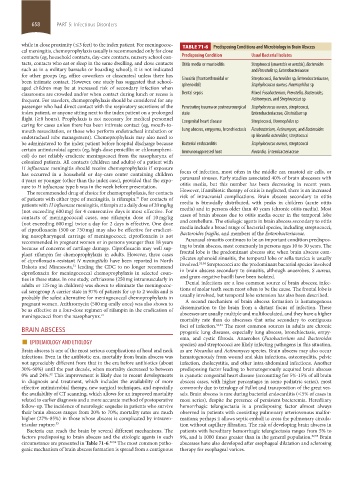
                 Brain abscess is one of the most serious complications of head and neck   as are Nocardia and Actinomyces species. Brain abscess may also occur
                 infections. Even in the antibiotic era, mortality from brain abscess was   hematogenously from wound and skin infections, osteomyelitis, pelvic
                 not appreciably different from that in the era before antibiotics (about   infection, cholecystitis, and other intra-abdominal infections. Another
                 30%-60%) until the past decade, when mortality decreased to between   predisposing factor leading to hematogenously acquired brain abscess
                 0% and 24%.  This improvement is likely due to recent developments   is cyanotic congenital heart disease (accounting for 5%-15% of all brain
                           52
                 in diagnosis and treatment, which includes the availability of more   abscess cases, with higher percentages in some pediatric series), most
                 effective antimicrobial therapy, new surgical techniques, and especially   commonly due to tetralogy of Fallot and transposition of the great ves-
                 the availability of CT scanning, which allows for an improved mortality   sels. Brain abscess is rare during bacterial endocarditis (<5% of cases in
                 related to earlier diagnosis and a more accurate method of postoperative   most series), despite the presence of persistent bacteremia. Hereditary
                 follow-up. The incidence of neurologic sequelae in patients who survive   hemorrhagic telangiectasia is a predisposing factor almost always
                 their brain abscess ranges from 20% to 70%; mortality rates are much   observed in patients with coexisting pulmonary arteriovenous malfor-
                 higher (27%-85%) in those whose abscess is complicated by intraven-  mations; perhaps it allows septic emboli to cross the pulmonary circula-
                 tricular rupture. 53                                  tion without capillary filtration. The risk of developing brain abscess in
                   Bacteria can reach the brain by several different mechanisms. The   patients with hereditary hemorrhagic telangiectasia ranges from 5% to
                 factors predisposing to brain abscess and the etiologic agents in each   9%, and is 1000 times greater than in the general population. 52,55  Brain
                 circumstance are presented in Table 71-6. 52,54  The most common patho-  abscesses have also developed after esophageal dilatation and sclerosing
                 genic mechanism of brain abscess formation is spread from a contiguous   therapy for esophageal varices.


            section05_c61-73.indd   658                                                                                1/23/2015   12:48:37 PM

