


Page 932 - Hall et al (2015) Principles of Critical Care-McGraw-Hill
P. 932
CHAPTER 71: Bacterial Infections of the Central Nervous System  663


                    irrespective of neurologic abnormality at presentation ; however, the   oropharynx, and it may involve additional vessels by propagation
                                                            71
                    numbers of patients in each of the outcome groups were small. In   or discontinuous spread. Septic thrombophlebitis may also occur in
                    another study of 52 patients, 24 of 29 treated with medical therapy alone   association with epidural abscess, subdural empyema, or bacterial
                    had a good or excellent outcome.  There have been no prospective,   meningitis. Occasionally, there is metastatic spread from distant sites
                                             72
                    randomized trials comparing the efficacy of antimicrobial agents plus   of infection. Conditions that increase blood viscosity or coagulability,
                    surgery with antimicrobial therapy alone. Antimicrobial therapy alone   such as dehydration, polycythemia, pregnancy, oral contraceptive use,
                    can be considered in patients who have localized pain and radicular   sickle cell disease, malignancy, and trauma, increase the likelihood of
                    symptoms without long-tract findings, although these patients require   thrombosis.
                    frequent neurologic examinations and serial MRI studies to demon-  The antecedent conditions that predispose to the development of
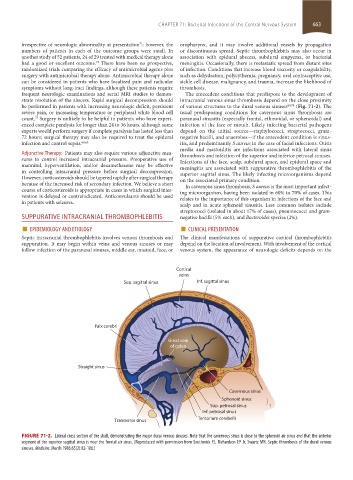
                    strate resolution of the abscess. Rapid surgical decompression should   intracranial venous sinus thrombosis depend on the close proximity
                    be performed in patients with increasing neurologic deficit, persistent   of various structures to the dural venous sinuses 64,74  (Fig. 71-2). The
                    severe pain, or increasing temperature or peripheral white blood cell   usual predisposing conditions for cavernous sinus thrombosis are
                    count.  Surgery is unlikely to be helpful in patients who have experi-  paranasal sinusitis (especially frontal, ethmoidal, or sphenoidal) and
                        73
                    enced complete paralysis for longer than 24 to 36 hours, although some   infection of the face or mouth. Likely infecting bacterial pathogens
                    experts would perform surgery if complete paralysis has lasted less than   depend  on the initial source—staphylococci,  streptococci, gram-
                    72 hours; surgical therapy may also be required to treat the epidural   negative bacilli, and anaerobes—if the antecedent condition is sinus-
                    infection and control sepsis. 64,68                   itis, and predominantly S aureus in the case of facial infections. Otitis
                                                                          media and mastoiditis are infections associated with lateral sinus
                    Adjunctive Therapy:  Patients may also require various adjunctive mea-  thrombosis and infection of the superior and inferior petrosal sinuses.
                    sures to control increased intracranial pressure. Preoperative use of   Infections of the face, scalp, subdural space, and epidural space and
                    mannitol, hyperventilation, and/or dexamethasone may be effective   meningitis are associated with suppurative  thrombophlebitis of  the
                    in controlling intracranial pressure before surgical decompression.   superior sagittal sinus. The likely infecting microorganisms depend
                    However, corticosteroids should be tapered rapidly after surgical therapy   on the associated primary condition.
                    because of the increased risk of secondary infection. We believe a short   In cavernous sinus thrombosis, S aureus is the most important infect-
                    course of corticosteroids is appropriate in cases in which surgical inter-  ing microorganism, having been isolated in 60% to 70% of cases. This
                    vention is delayed or contraindicated. Anticonvulsants should be used   relates to the importance of this organism in infections of the face and
                    in patients with seizures.                            scalp  and  in  acute  sphenoid  sinusitis.  Less  common  isolates  include
                                                                          streptococci (isolated in about 17% of cases), pneumococci and gram-
                    SUPPURATIVE INTRACRANIAL THROMBOPHLEBITIS             negative bacilli (5% each), and Bacteroides species (2%).
                        ■  EPIDEMIOLOGY AND ETIOLOGY                          ■  CLINICAL PRESENTATION

                    Septic intracranial thrombophlebitis involves venous thrombosis and   The  clinical  manifestations  of  suppurative  cortical  thrombophlebitis
                    suppuration.  It  may  begin  within  veins  and  venous  sinuses  or  may   depend on the location of involvement. With involvement of the cortical
                    follow infection of the paranasal sinuses, middle ear, mastoid, face, or     venous system, the appearance of neurologic deficits depends on the


                                                                        Cortical
                                                                         veins
                                                      Sup. sagittal sinus      Inf. sagittal sinus


                                             Falx cerebri

                                                                      Great vein
                                                                      of galen


                                       Straight sinus


                                                                                          Cavernous sinus
                                                                                        Sphenoid sinus
                                                                                    Sup. petrosal sinus
                                                                                 Inf. petrosal sinus
                                                   Transverse sinus             Tentorium cerebelli


                    FIGURE 71-2.  Lateral cross section of the skull, demonstrating the major dural venous sinuses. Note that the cavernous sinus is close to the sphenoid air sinus and that the anterior
                    segment of the superior sagittal sinus is near the frontal air sinus. (Reproduced with permission from Southwick FS, Richardson EP Jr, Swartz MN. Septic thrombosis of the dural venous
                    sinuses. Medicine. March 1986;65(2):82-106.)


            section05_c61-73.indd   663                                                                                1/23/2015   12:48:41 PM

