


Page 924 - Hall et al (2015) Principles of Critical Care-McGraw-Hill
P. 924
CHAPTER 71: Bacterial Infections of the Central Nervous System  655


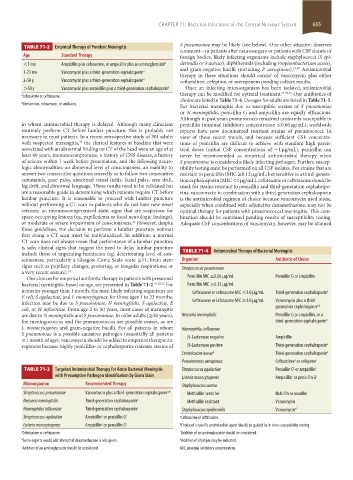
                                                                          S pneumoniae may be likely (see below). One other situation deserves
                      TABLE 71-2    Empirical Therapy of Purulent Meningitis
                                                                          comment—in patients after neurosurgery or patients with CSF shunts or
                    Age          Standard Therapy                         foreign bodies, likely infecting organisms include staphylococci (S epi-
                    <1 mo        Ampicillin plus cefotaxime, or ampicillin plus an aminoglycoside b  dermidis or S aureus), diphtheroids (including Propionibacterium acnes),
                                                                          and gram-negative bacilli (including  P aeruginosa). 13,29  Antimicrobial
                    1-23 mo      Vancomycin plus a third-generation cephalosporin a
                                                                          therapy in these situations should consist of vancomycin plus either
                    2-50 y       Vancomycin plus a third-generation cephalosporin a  ceftazidime, cefepime, or meropenem pending culture results.
                    >50 y        Vancomycin plus ampicillin plus a third-generation cephalosporin a  Once an infecting microorganism has  been isolated, antimicrobial
                                                                          therapy can be modified for optimal treatment. 21,29,32  Our antibiotics of
                    a Cefotaxime or ceftriaxone.
                                                                          choice are listed in Table 71-4. Dosages for adults are listed in Table 71-5.
                    b Gentamicin, tobramycin, or amikacin.                For  bacterial  meningitis  due  to  susceptible  strains  of  S  pneumoniae
                                                                          or  N meningitidis, penicillin G and ampicillin are equally efficacious.
                                                                          Although in past years pneumococci remained uniformly susceptible to
                    in whom antimicrobial therapy is delayed. Although many clinicians   penicillin (minimal inhibitory concentration ≤0.06 µg/mL), worldwide
                    routinely perform CT before lumbar puncture, this is probably not   reports have now documented resistant strains of pneumococci. In
                    necessary in most patients. In a recent retrospective study of 301 adults   view  of  these  recent  trends,  and  because  sufficient  CSF  concentra-
                    with suspected meningitis,  the clinical features at baseline that were   tions of penicillin are difficult to achieve with standard high paren-
                                       33
                    associated with an abnormal finding on CT of the head were an age of at   teral doses (initial CSF concentrations of  ∼1 µg/mL), penicillin can
                    least 60 years, immunocompromise, a history of CNS disease, a history   never be recommended as empirical antimicrobial therapy when
                    of seizure within 1 week before presentation, and the following neuro-  S pneumoniae is considered a likely infecting pathogen. Further, suscep-
                    logic abnormalities: an abnormal level of consciousness, an inability to   tibility testing must be performed on all CSF isolates. For strains that are
                    answer two consecutive questions correctly or to follow two consecutive   resistant to penicillin (MIC ≥0.12 µg/mL, but sensitive to a third-genera-
                    commands, gaze palsy, abnormal visual fields, facial palsy, arm drift,   tion cephalosporin (MIC <1 µg/mL), cefotaxime or ceftriaxone should be
                    leg drift, and abnormal language. These results need to be validated but   used; for strains resistant to penicillin and third-generation cephalospo-
                    are a reasonable guide in determining which patients require CT before   rins, vancomycin in combination with a third-generation cephalosporin
                    lumbar puncture. It is reasonable to proceed with lumbar puncture   is the antimicrobial regimen of choice because vancomycin used alone,
                    without performing a CT scan in patients who do not have new-onset   especially when combined with adjunctive dexamethasone, may not be
                    seizures, an immunocompromised state, signs that are suspicious for   optimal therapy for patients with pneumococcal meningitis. This com-
                    space-occupying lesions (eg, papilledema or focal neurologic findings),   bination should be continued pending results of susceptibility testing.
                    or moderate or severe impairment of consciousness.  However, despite   Adequate CSF concentrations of vancomycin, however, may be attained
                                                         29
                    these guidelines, the decision to perform a lumbar puncture without
                    first doing a CT scan must be individualized. In addition, a normal
                    CT scan does not always mean that performance of a lumbar puncture
                    is safe; clinical signs that suggest the need to delay lumbar puncture
                    include those of impending herniation (eg, deteriorating level of con-    TABLE 71-4    Antimicrobial Therapy of Bacterial Meningitis
                    sciousness, particularly a Glasgow Coma Scale score ≤11; brain stem   Organism        Antibiotic of Choice
                    signs such as pupillary changes, posturing, or irregular respirations; or   Streptococcus pneumoniae
                    a very recent seizure). 34
                     Our choices for empirical antibiotic therapy in patients with presumed     Penicillin MIC ≤0.06 µg/mL  Penicillin G or ampicillin
                    bacterial meningitis, based on age, are presented in Table 71-2. 21,29,32  For     Penicillin MIC ≥0.12 µg/mL
                    neonates younger than 1 month, the most likely infecting organisms are        Ceftriaxone or cefotaxime MIC <1.0 µg/mL  Third-generation cephalosporin a
                    E coli, S agalactiae, and L monocytogenes; for those ages 1 to 23 months,
                    infection may be due to S pneumoniae, N meningitidis, S agalactiae, E        Ceftriaxone or cefotaxime MIC ≥1.0 µg/mL  Vancomycin plus a third-
                    coli, or H influenzae. From age 2 to 50 years, most cases of meningitis               generation cephalosporin a,d
                    are due to N meningitidis and S pneumoniae. In older adults (≥50 years),   Neisseria meningitidis  Penicillin G or ampicillin, or a
                    the meningococcus and the pneumococcus are possible causes, as are                    third-generation cephalosporin a
                    L monocytogenes and gram-negative bacilli. For all patients in whom    Haemophilus influenzae
                    S pneumoniae is a possible causative pathogen (essentially all patients
                    ≥1 month of age), vancomycin should be added to empirical therapeutic     β-Lactamase negative  Ampicillin
                    regimens because highly penicillin- or cephalosporin-resistant strains of     β-Lactamase positive  Third-generation cephalosporin a
                                                                          Enterobacteriaceae b            Third-generation cephalosporin a
                                                                          Pseudomonas aeruginosa          Ceftazidime  or cefepime c
                                                                                                                 c
                                                                                                                c
                      TABLE 71-3     Targeted Antimicrobial Therapy for Acute Bacterial Meningitis    Streptococcus agalactiae  Penicillin G  or ampicillin c
                               with Presumptive Pathogen Identification by Gram Stain  Listeria monocytogenes  Ampicillin  or penicillin G c
                                                                                                                c
                    Microorganism        Recommended Therapy              Staphylococcus aureus
                    Streptococcus pneumoniae  Vancomycin plus a third-generation cephalosporin a,b    Methicillin sensitive  Nafcillin or oxacillin
                    Neisseria meningitidis  Third-generation cephalosporin a    Methicillin resistant     Vancomycin
                    Haemophilus influenzae  Third-generation cephalosporin a  Staphylococcus epidermidis  Vancomycin d
                                               c
                    Streptococcus agalactiae  Ampicillin  or penicillin G c  a Cefotaxime or ceftriaxone.
                    Listeria monocytogenes  Ampicillin  or penicillin G c  b Choice of a specific antimicrobial agent should be guided by in vitro susceptibility testing.
                                               c
                    a Cefotaxime or ceftriaxone.                          c Addition of an aminoglycoside should be considered.
                    b Some experts would add rifampin if dexamethasone is also given.  d Addition of rifampin may be indicated.
                    c Addition of an aminoglycoside should be considered.  MIC, minimal inhibitory concentration.


            section05_c61-73.indd   655                                                                                1/23/2015   12:48:36 PM

