


Page 938 - Hall et al (2015) Principles of Critical Care-McGraw-Hill
P. 938
CHAPTER 72: Encephalomyelitis  669


                      TABLE 72-2    Less Common Causes of Encephalitis, Diagnosis and Treatment Summary (Continued )
                    Etiology      Epidemiology         Clinical Features        Diagnosis               Treatment
                    Cysticercosis  Mexico, Central and South   Most common presentation is new onset   Serology  Decision to treat must be individualized
                    Taenia solium  America, Southeast Asia  seizures due to CNS cysticercosis  CSF antibodies (negative test does not   Albendazole and corticosteroids are
                                  Acquired by ingestion of eggs  Rarely encephalitic presentation with   rule out the diagnosis)  preferred
                                  In humans larval stage causes CNS   very high cyst burden in the brain or after   CT/MRI of brain may show cystic lesions  Praziquantel is an alternative
                                  disease              treatment                with or without calcifications  Surgical resection when indicated
                                                                                Ring enhancement and edema may be seen
                    Baylisascaris    Children often affected  Unilateral neuroretinitis, meningoen-  CSF and peripheral eosinophilia  Albendazole plus diethylcarbamazine
                    procyonis     Contact with dirt contaminated   cephalitis   Serology not readily available  plus
                                  with raccoon feces (playing in or   High rates of permanent neurologic   Larvae identification in tissue  adjunctive corticosteroids should be
                                  eating dirt)         sequelae and mortality                           considered
                                                                                MRI may show white matter lesions
                    Gnathostoma    Southeast Asia and Latin America  Eosinophilic meningoencephalitis (a less   CSF—often xanthochromic or bloody   Albendazole or ivermectin
                    spinigerum    Ingestion of undercooked fish,   common manifestation)  with eosinophilic pleocytosis  Addition of corticosteroids may be
                                  frogs, eels, snakes, and poultry  Sudden onset of headache, radicular   Peripheral eosinophilia  beneficial in suppressing inflammation
                                                       pain, parasthesias followed by paralysis,   Worms identification in tissues
                                                       cranial nerve palsies, and bladder
                                                                                Serology not readily available
                                                       Incontinence


                    survivors end up with significant neurologic deficits.  Empiric ther-  DNA can be detected in the CSF once therapy has been initiated
                                                            2
                    apy should be initiated even with minimal clinical suspicion before   is unclear. Discontinuation of therapy based on negative CSF PCR
                    the onset of dominant temporal lobe hemorrhagic necrosis and sig-  results depends on the clinical probability of HSVE and is a matter of
                    nificant deterioration of consciousness. The recommended treatment   judgment.  Use of corticosteroids is controversial though a few stud-
                                                                                 16
                    of HSVE is acyclovir at a dose of 10 mg/kg every 8 hours for 14 to   ies have shown favorable outcomes. 17
                    21 days. It prevents viral replication by inhibiting the viral (as well   In spite of effective treatment, mortality is still up to 20% to 30%.  The
                                                                                                                         3
                    as the cellular) DNA polymerase in infected cells. Introduced in the   precise factors that determine the therapeutic response are unknown.
                    mid-1980s, it replaced vidarabine and was shown to reduce mortality   Patients  with  low  initial  level  of  consciousness  and  age  over  30  have
                    from 70% to 20%. 13,14  Relapses occur commonly in children within 2   a very poor prognosis in general. Long-term complications of HSVE
                    weeks of completing antiviral therapy necessitating a second course   infection are common and include neurocognitive impairment, residual
                    of acyclovir.  Acyclovir has renal and neurologic toxicity manifesting   dysphasias, paresis, paresthesias, behavioral changes, and a Korsakoff-
                             15
                    as crystalluria, renal failure, and encephalopathy. Effective hydration,   like amnesia. 18
                    receiving  acyclovir  for  suspected  HSVE  should also  receive  other   ■  HERPES SIMPLEX VIRUS TYPE 2
                    dose adjustment, or discontinuation of therapy is helpful. Patients
                    broad-spectrum antibiotics for the first 48 to 72 hours until CSF and   HSV-2 encephalitis is seen primarily in neonates, where brain involve-
                    other cultures for bacteria are negative. The time period that HSV   ment is generalized and is usually acquired during vaginal delivery from


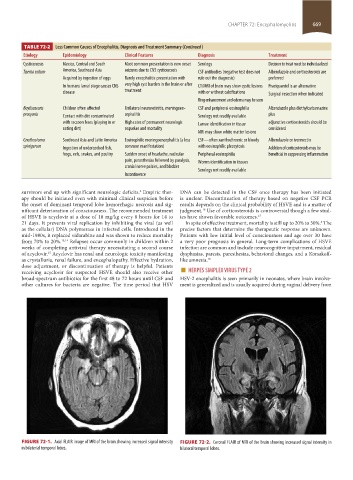
                    FIGURE 72-1.  Axial FLAIR image of MRI of the brain showing increased signal intensity   FIGURE 72-2.  Coronal FLAIR of MRI of the brain showing increased signal intensity in
                    in bilaterial temporal lobes.                         bilateral temporal lobes.


            section05_c61-73.indd   669                                                                                1/23/2015   12:48:44 PM

