


Page 939 - Hall et al (2015) Principles of Critical Care-McGraw-Hill
P. 939
670     PART 5: Infectious Disorders


                                                                       cause shingles (zoster) and postherpetic neuralgia. VZV is the only
                                                                       human virus known to replicate in arteries. VZV involves both small
                                                                       and large vessels and the term, VZV vasculopathy rather than encepha-
                                                                       litis best suits this syndrome.  The incidences of neurologic complica-
                                                                                            27
                                                                       tions with primary varicella are 1 to 3 per 10,000 cases.  Among them
                                                                                                                28
                                                                       cerebellar ataxia and encephalitis are common, while other entities
                                                                       such as aseptic meningitis, transverse myelitis, Guillain-Barré or Reye
                                                                       syndromes have been reported.  Cerebellar ataxia is seen in children
                                                                                              29
                                                                       and occurs with a frequency of 1 per 1000 cases of chickenpox. It is
                                                                       characterized by ataxia, nystagmus, headache, nausea, vomiting, and
                                                                       nuchal rigidity. This illness is usually self-limited, lasting 2 to 4 weeks,
                                                                       and most children have a complete recovery. The mortality rate is only
                                                                       0.5%. A more severe form of encephalitis occurs mostly in adults and
                                                                       infants, with an incidence of one to two episodes per 10,000 cases of
                                                                       VZV. It most often begins approximately 1 week after the varicella rash
                                                                       and is manifested by altered sensorium, seizures, and focal neurologic
                                                                       signs and has a mortality rate of 5% to 10%.  Neurologic complications
                                                                                                       29
                                                                       from zoster can occur acutely for weeks to months after the rash.
                                                                       Other than the common postherpetic neuralgia, encephalitis, myelitis,
                                                                       cranial nerve palsies (Bell palsy and Ramsay Hunt syndrome), and
                                                                       ophthalmic zoster are associated with VZV.  Zoster encephalitis usu-
                                                                                                       30
                                                                       ally manifests as delayed contralateral hemiparesis/stroke due to large
                                                                       vessel vasculopathy. This is most commonly observed in the elderly and
                                                                       can occur weeks to months after an episode of herpes zoster, typically
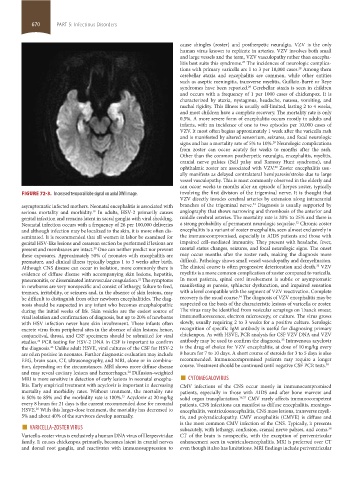
                 FIGURE 72-3.  Increased temporal lobe signal on axial DWI image.  involving the first division of the trigeminal nerve. It is thought that
                                                                       VZV directly invades cerebral arteries by extension along intracranial
                                                                                                31
                 asymptomatic infected mothers. Neonatal encephalitis is associated with   branches of the trigeminal nerve.  Diagnosis is usually supported by
                 serious mortality and morbidity.  In adults, HSV-2 primarily causes   angiography that shows narrowing and thrombosis of the anterior and
                                         19
                 genital infection and remains latent in sacral ganglia with viral shedding.   middle cerebral arteries. The mortality rate is 20% to 25% and there is
                                                                                                               32
                 Neonatal infection occurs with a frequency of 26 per 100,000 deliveries   a strong probability of permanent neurologic sequelae.  Chronic zoster
                 and although infection may be localized to the skin, it is more often dis-  encephalitis is a variant of zoster encephalitis, seen almost exclusively in
                 seminated. It is recommended that all women in labor be examined for   the immunocompromised, especially in AIDS patients and those with
                 genital HSV-like lesions and cesarean section be performed if lesions are   impaired cell–mediated immunity. They present with headache, fever,
                 present and membranes are intact.  One can neither predict nor prevent   mental status changes, seizures, and focal neurologic signs. The onset
                                          20
                 these exposures. Approximately 50% of neonates with encephalitis are   may  occur  months  after  the  zoster  rash,  making  the  diagnosis  more
                 premature, and clinical illness typically begins 1 to 3 weeks after birth.   difficult. Pathology shows small vessel vasculopathy and demyelination.
                                                                                                                      33
                 Although CNS disease can occur in isolation, more commonly there is   The clinical course is often progressive deterioration and death.  VZV
                 evidence of diffuse disease with accompanying skin lesions, hepatitis,   myelitis is a more common complication of zoster compared to varicella.
                 pneumonitis, or disseminated intravascular coagulation.  The symptoms   In most patients, spinal cord involvement is subtle or asymptomatic
                                                         21
                 in newborns are very nonspecific and consist of lethargy, failure to feed,   manifesting as paresis, sphincter dysfunction, and impaired sensation
                 tremors, irritability, or seizures and, in the absence of skin lesions, may   with a level compatible with the segment of VZV reactivation. Complete
                                                                                           34
                 be difficult to distinguish from other newborn encephalitides. The diag-  recovery is the usual course.  The diagnosis of VZV encephalitis may be
                 nosis should be suspected in any infant who becomes encephalopathic   suspected on the basis of the characteristic lesions of varicella or zoster.
                 during the initial weeks of life. Skin vesicles are the easiest source of   The virus may be identified from vesicular scrapings on Tzanck smear,
                 viral isolation and confirmation of diagnosis, but up to 20% of newborns   immunofluorescence, electron microscopy, or culture. The virus grows
                 with HSV infection never have skin involvement. These infants often   slowly, usually requiring 2 to 3 weeks for a positive culture. Serologic
                 excrete virus from peripheral sites in the absence of skin lesions; hence,   recognition of specific IgM antibody is useful for diagnosing primary
                 conjunctival, throat, and CSF specimens should be submitted for viral   chickenpox. As with HSVE, PCR analysis for CSF VZV DNA and VZV
                                                                                                          35
                 studies.  PCR testing for HSV-2 DNA in CSF is important to confirm   antibody may be used to confirm the diagnosis.  Intravenous acyclovir
                       22
                 the diagnosis.  Unlike adult HSVE, viral cultures of the CSF for HSV-2   is the drug of choice for VZV encephalitis, at dose of 10 mg/kg every
                           23
                 are often positive in neonates. Further diagnostic evaluation may include   8 hours for 7 to 10 days. A short course of steroids for 3 to 5 days is also
                 EEG, brain scan, CT, ultrasonography, and MRI, alone or in combina-  recommended.  Immunocompromised  patients  may  require  a  longer
                 tion, depending on the circumstances. MRI shows more diffuse disease   course. Treatment should be continued until negative CSF PCR tests. 30
                 MRI is more sensitive in detection of early lesions in neonatal encepha-  ■  CYTOMEGALOVIRUS
                 and may reveal cavitary lesions and hemorrhages.  Diffusion-weighted
                                                     24
                 litis. Early empirical treatment with acyclovir is important in decreasing   CMV infections of the CNS occur mostly in immunocompromised
                 mortality and morbidity rates. Without treatment, the mortality rate   patients, especially in those with AIDS and after bone marrow and
                 is 50% to 85% and the morbidity rate is 100%.  Acyclovir at 20 mg/kg   solid organ transplantation. 36,37  CMV rarely affects immunocompetent
                                                   25
                 every 8 hours for 21 days is the current recommended dose for neonatal   patients. CNS infections can manifest as diffuse encephalitis, meningo-
                 HSVE.  With this larger-dose treatment, the mortality has decreased to   encephalitis, ventriculoencephalitis, CNS mass lesions, transverse myeli-
                      26
                 5% and about 40% of the survivors develop normally.   tis, and polyradiculopathy. CMV encephalitis (CMVE) is diffuse and
                     ■  VARICELLA-ZOSTER VIRUS                         is the most common CMV infection of the CNS. Typically, it presents
                                                                       subacutely, with lethargy, confusion, cranial nerve palsies, and coma.
                                                                                                                          38
                 Varicella-zoster virus is exclusively a human DNA virus of Herpesviridae   CT of the brain is nonspecific, with the exception of periventricular
                 family. It causes chickenpox primarily, becomes latent in cranial nerves   enhancement seen in ventriculoencephalitis. MRI is preferred over CT
                 and dorsal root ganglia, and reactivates with immunosuppression to   even though it also has limitations. MRI findings include periventricular


            section05_c61-73.indd   670                                                                                1/23/2015   12:48:45 PM

