


Page 936 - Hall et al (2015) Principles of Critical Care-McGraw-Hill
P. 936
CHAPTER 72: Encephalomyelitis  667


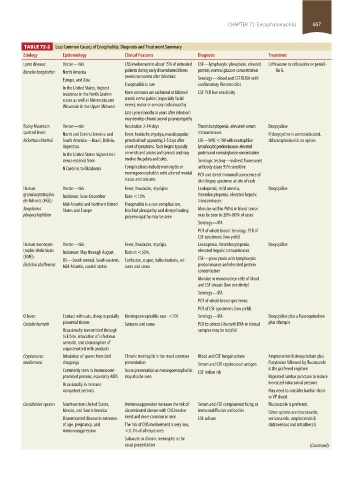
                      TABLE 72-2    Less Common Causes of Encephalitis, Diagnosis and Treatment Summary
                    Etiology      Epidemiology         Clinical Features        Diagnosis               Treatment
                    Lyme disease:  Vector—tick         CNS involvement in about 15% of untreated   CSF—lymphocytic pleocytosis, elevated   Ceftriaxone or cefotaxime or penicil-
                    Borrelia burgdorferi  North America  patients during early disseminated illness   protein, normal glucose concentration  lin G
                                                       (weeks to months after infection)
                                  Europe, and Asia                              Serology—blood and CSF ELISA with
                                                       Encephalitis is rare     confirmatory Western blot
                                  In the United States, highest
                                  incidence in the North Eastern   More common are unilateral or bilateral   CSF PCR low sensitivity
                                  states as well as Minnesota and   cranial nerve palsies (especially facial
                                  Wisconsin in the Upper Midwest  nerve), motor or sensory  radiculopathy
                                                       Late Lyme (months to years after infection)
                                                       may develop chronic axonal polyneuropathy
                    Rocky Mountain   Vector—tick       Incubation 2-14 days     Thrombocytopenia, elevated serum   Doxycycline
                    spotted fever:  North and Central America and   Fever, headache, myalgia, maculopapular,   transaminases  If doxycycline is contraindicated,
                    Rickettsia rickettsii  South America—Brazil, Bolivia,     petechial rash appearing 3-5 days after   CSF—WBC <100 with neutrophil or      chloramphenicol is an option
                                  Argentina            onset of  symptoms. Rash begins typically   lymphocytic predominance, elevated
                                  In the United States highest inci-  on wrists and ankles and spreads and may   protein and normal glucose concentration
                                  dence extends from   involve the palms and soles.  Serologic testing—indirect fluorescent
                                  N Carolina to Oklahoma  Complications include meningitis or   antibody assay 95% sensitive
                                                       meningoencephalitis with altered mental   PCR and direct immunofluorescence of
                                                       status and seizures      skin biopsy specimen at site of rash
                    Human         Vector—tick          Fever, headache, myalgias  Leukopenia, mild anemia,   Doxycycline
                    granulocytotrophic   Incidence: June-December  Rash <10%      thrombocytopenia, elevated hepatic
                    ehrlichiosis (HGE):                                         transaminases
                                  Mid-Atlantic and Northern United   Encephalitis is a rare complication,
                    Anaplasma     States and Europe    brachial plexopathy and demyelinating   Morulae within PMNs in blood smear
                    phagocytophilum                    polyneuropathy may be seen  may be seen in 20%-80% of cases
                                                                                Serology—IFA
                                                                                PCR of whole blood. Serology, PCR of
                                                                                CSF specimens (low yield)
                    Human monocyto-  Vector—tick       Fever, headache, myalgia.  Leukopenia, thrombocytopenia,   Doxycycline
                    trophic ehrlichiosis   Incidence: May through August  Rash in <50%.  elevated hepatic transaminases
                    (HME):                                                      CSF—pleocytosis with lymphocytic
                                  US—South central, South eastern,  Confusion, stupor, hallucinations, sei-
                    Ehrlichia chaffeensis  Mid-Atlantic, coastal states  zures and coma  predominance and elevated protein
                                                                                concentration
                                                                                Morulae in mononuclear cells of blood
                                                                                and CSF smears (low sensitivity)
                                                                                Serology—IFA
                                                                                PCR of whole blood specimens
                                                                                PCR of CSF specimens (low yield)
                    Q fever:      Contact with cats, sheep especially  Meningoencephalitis rare- <1%  Serology—IFA  Doxycycline plus a fluoroquinolone
                    Coxiella burnetii  placental tissues  Seizures and coma     PCR to detect C burnetii DNA in clinical   plus rifampin
                                  Occasionally transmitted through              samples may be helpful
                                  tick bite, inhalation of infectious
                                  aerosols, and consumption of
                                  unpasteurized milk products
                    Cryptococcus   Inhalation of spores from bird   Chronic meningitis is the most common   Blood and CSF fungal culture  Amphotericin B deoxycholate plus
                     neoformans   droppings            presentation             Serum and CSF cryptococcal antigen  flucytosine followed by fluconazole
                                  Commonly seen in immunocom-  Acute presentation as meningoencephalitis   CSF Indian ink  is the preferred regimen
                                  promised persons, especially AIDS  may also be seen                   Repeated lumbar puncture to reduce
                                  Occasionally in immune                                                increased intracranial pressure
                                  competent persons                                                     May need to consider lumbar drain
                                                                                                        or VP shunt
                    Coccidioides species  Southwestern United States,   Immunosuppression increases the risk of   Serum and CSF complement fixing or   Fluconazole is preferred.
                                  Mexico, and South America  disseminated disease with CNS involve-  immunodiffusion antibodies  Other options are itraconazole,
                                  Disseminated disease in extremes   ment and more common in men  CSF culture  voriconazole, amphotericin B
                                  of age, pregnancy, and    The risk of CNS involvement is very low,    (intravenous and intrathecal)
                                  immunosuppression    <0.1% of all exposures
                                                       Subacute or chronic meningitis is the
                                                       usual  presentation                                            (Continued)


            section05_c61-73.indd   667                                                                                1/23/2015   12:48:43 PM

