


Page 935 - Hall et al (2015) Principles of Critical Care-McGraw-Hill
P. 935
666     PART 5: Infectious Disorders

                                                                           ■
                   TABLE 72-1    Common Causes of Encephalitis            HERPES SIMPLEX VIRUS ENCEPHALITIS
                  Viral                       Papovaviridae            Herpes  simplex  virus type  1  (HSV-1)  encephalitis is  the  most  com-
                  Herpes viridae              JC virus—progressive multifocal   mon recognizable cause of sporadic fatal encephalitis worldwide. Early
                    Herpes simplex virus (HSV-1, HSV-2)    leukoencephalopathy  recognition is of utmost importance due to its significant mortality and
                                                                               1,2
                    Varicella-zoster virus (VZV)  Prion disease        morbidity.  Treatment with acyclovir should be initiated early even with
                    Cytomegalovirus (CMV)     Creutzfeldt-Jakob disease (CJD)  minimal clinical suspicion.
                    Epstein-Barr virus (EBV)  Variant Creutzfeldt-Jakob disease   Epidemiology and Pathogenesis:  Herpes simplex virus encephalitis
                    Human herpes virus 6 (HHV-6)  (vCJD)               (HSVE) is the most common cause of fatal nonepidemic encephalitis.
                    Herpes B virus          Bacteria                   It is estimated to affect at least 1 in 500,000 individuals per year.
                                                                                                                          1
                  Flaviviridae                Bartonella species (henselae    HSVE occurs in all age groups, with a bimodal peak distribution
                    West Nile virus           and  bacilliformis)      in patients younger than 20 years and older than 50 years of age. It
                    Japanese encephalitis virus  Listeria monocytogenes  occurs equally in both sexes and has no racial predilection. This is
                    St Louis encephalitis virus  Mycoplasma pneumoniae  seldom a disease of the immunocompromised. Indeed, it is hard to
                    Powassan virus          Mycobacteria               predict who is at risk for HSVE. 3
                    Murray Valley encephalitis virus  Mycobacterium tuberculosis  HSV infection of the central nervous system arises from either
                    Tick-borne encephalitis virus  Rickettsia and ehrlichioses  primary infection or reactivation. Primary infection, which is most
                  Picornaviridae              Rickettsia rickettsii (Rocky Mountain   common in children, occurs due to direct CNS invasion via the olfac-
                    Polio virus                 spotted fever)         tory tract following HSV infection of the oropharynx. Alternatively,
                    Nonpolio enteroviruses    Anaplasma phagocytophilum (human   latent infection most common in adults >50 years occurs due to viral
                    Echoviruses               granulocytotrophic ehrlichiosis)  reactivation in the trigeminal ganglia and reaches the CNS along a
                    Coxsackieviruses          Ehrlichia chaffeensis (human   neurotropic route. HSVE is the most common clinical presentation
                    Numbered enteroviruses      monocytotrophic ehrlichiosis)  of HSV and has a characteristic temporal lobe predilection. In most
                  Bunyaviridae                Coxiella burnetii (Q fever)  cases, necrosis of the temporal lobes is seen with associated clinical
                    California encephalitis group  Spirochetes         deficits. Much of the pathogenesis of HSVE seems to be immune
                    La Crosse virus           Borrelia burgdorferi (Lyme disease)  mediated. 4,5
                    Jamestown Canyon virus    Treponema pallidum (syphilis)
                  Togaviridae               Fungi                      Clinical Features and Diagnosis:  There are no typical clinical features of
                    Eastern equine encephalitis virus  Coccidioides species  HSVE. The clinical syndrome is often characterized by acute onset of
                    Western equine encephalitis virus  Cryptococcus neoformans  fever, headache, seizures, focal neurologic deficits, and altered mental
                    Venezuelan equine encephalitis virus  Histoplasma capsulatum  status. There may be an influenza-like prodrome. CSF examination typi-
                    Rubella virus           Protozoa                   cally shows lymphocytic predominance, elevated protein, and normal
                  Rhabdoviridae               Toxoplasma gondii        glucose levels. Red blood cells are present in 75% to 80% of samples,
                                                                                                                  6
                    Rabies virus              Acanthamoeba species     indicating the hemorrhagic nature of this encephalitis.  Unilateral
                  Orthomyxoviridae            Balamuthiamandrillaris   temporal lobe abnormalities on brain imaging are characteristic for
                                                                                                                          3
                    Influenza virus           Naegleria fowleri        HSVE. CT scans have only 50% sensitivity early in the course of illness,
                  Paramyxoviridae             Plasmodium falciparum (malaria)  but can be performed to exclude raised intracranial pressure prior to
                    Measles virus             Trypanosoma bruceigambiense (West   lumbar puncture. Abnormalities include localized edema, low-density
                    Mumps virus               African trypanosomiasis)  lesions, mass effect, contrast enhancement, and hemorrhage. On the
                    Nipah virus               Trypanosoma bruceirhodesiense (East   other hand, MRI is the most sensitive and specific neurodiagnostic test
                    Hendra virus              African trypanosomiasis)  for  HSVE  and  has  excellent  delineation  of  the  temporobasal  lobe  of
                  Retroviridae              Helminths                  the brain (Figs. 72-1 and 72-2). Diffusion-weighted MRI is especially
                                                                                                                7,8
                    Human immune deficiency virus  Baylisascaris procyonis  preferred early in the course of the disease (Fig. 72-3).  MRI shows
                    Human T-cell lymphotropic virus  Gnathostoma species  abnormal signal earliest in FLAIR sequences and diffusion-restricted
                  Adenoviridae                Taenia solium (cysticercosis)  images of the medial temporal lobes and insulas. Brain perfusion SPECT
                    Adenovirus              Postinfectious             scan shows increased tracer accumulation in the affected temporal lobe
                                                                                      9
                  Poxviridae                  Acute disseminated encephalomyelitis  with high specificity.  Focal EEG findings occur in 80% to 90% of cases
                    Vaccinia virus                                     of HSVE, but are nonspecific. The EEG typically shows focal spiked and
                                                                       slow wave (theta and delta slowing) patterns localized to the area of the
                                                                       brain involved. Paroxysmal lateralized epileptiform discharges are also
                 continues to deteriorate. The care of these patients is mostly sup-  seen but are nonspecific. PCR analysis to detect HSV DNA in CSF is the
                 portive and recovery can occur after long and even extreme changes   gold standard for establishing the diagnosis of HSVE, especially in
                 in mental function.                                   the early phase of the disease. It has a sensitivity of 98% and a specific-
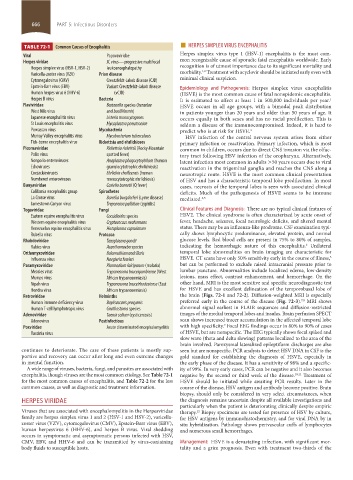
                   A wide range of viruses, bacteria, fungi, and parasites are associated with   ity of 99%. In very early cases, PCR can be negative and it also becomes
                 encephalitis, though viruses are the most common etiology. See Table 72-1   negative by the second or third week of the disease. 10,11  Treatment of
                 for the most common causes of encephalitis, and Table 72-2 for the less   HSVE should be initiated while awaiting PCR results. Later in the
                 common causes, as well as diagnostic and treatment information.  course of the disease, HSV antigen and antibody become positive. Brain
                                                                       biopsy, should only be considered in very select circumstances, when
                 HERPES VIRIDAE                                        the diagnosis remains uncertain despite all available investigations and
                                                                       particularly when the patient is deteriorating clinically despite empiric
                 Viruses that are associated with encephalomyelitis in the Herpesviridae   therapy.  Biopsy specimens are tested for presence of HSV by culture,
                                                                             12
                 family are herpes simplex virus 1 and 2 (HSV-1 and HSV-2), varicella-  for HSV antigens by immunohistochemistry, and for viral DNA by in
                 zoster virus (VZV), cytomegalovirus (CMV), Epstein-Barr virus (EBV),   situ hybridization. Pathology shows perivascular cuffs of lymphocytes
                 human herpesvirus 6 (HHV-6), and herpes B virus. Viral shedding   and numerous small hemorrhages.
                 occurs in symptomatic and asymptomatic persons infected with HSV,
                 CMV, EBV, and HHV-6 and can be transmitted by virus-containing   Management:  HSVE is a devastating infection, with significant mor-
                 body fluids to susceptible hosts.                     tality and a grim prognosis. Even with treatment two-thirds of the


            section05_c61-73.indd   666                                                                                1/23/2015   12:48:43 PM

