


Page 937 - Hall et al (2015) Principles of Critical Care-McGraw-Hill
P. 937
668     PART 5: Infectious Disorders


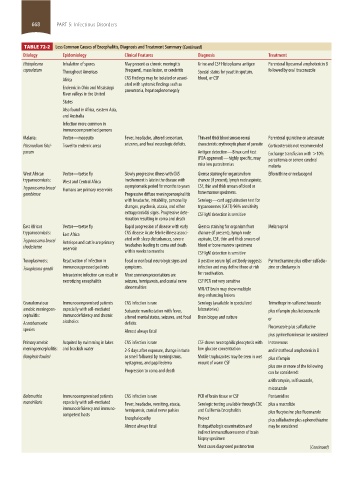
                   TABLE 72-2    Less Common Causes of Encephalitis, Diagnosis and Treatment Summary (Continued)
                  Etiology     Epidemiology         Clinical Features        Diagnosis               Treatment
                  Histoplasma    Inhalation of spores  May present as chronic meningitis    Urine and CSF Histoplasma antigen  Parenteral liposomal amphotericin B
                  capsulatum   Throughout Americas  (frequent), mass lesion, or cerebritis  Special stains for yeast in sputum,   followed by oral itraconazole
                               Africa               CNS findings may be isolated or associ-  blood, or CSF
                                                    ated with systemic findings such as
                               Endemic in Ohio and Mississippi   pneumonia, hepatosplenomegaly
                               River valleys in the United
                               States
                               Also found in Africa, eastern Asia,
                               and Australia
                               Infection more common in
                               immunocompromised persons
                  Malaria:     Vector—mosquito      Fever, headache, altered sensorium,    Thin and thick blood smears reveal   Parenteral quinidine or artesunate
                  Plasmodium falci-  Travel to endemic areas  seizures, and focal neurologic deficits.    characteristic erythrocytic phase of parasite  Corticosteroids not recommended
                  parum                                                      Antigen detection—Binax card test   Exchange transfusion with >10%
                                                                             (FDA approved)—highly specific, may   parasitemia or severe cerebral
                                                                             miss low parasitemias   malaria
                  West African    Vector—tsetse fly  Slowly progressive illness with CNS   Giemsa staining for organism from    Eflornithine or  melarsoprol
                  trypanosomiasis:  West and Central Africa  involvement is late in the disease with   chancre (if present), lymph node aspirate,
                  Trypanosoma brucei   Humans are primary reservoirs  asymptomatic period for months to years  CSF, thin and thick smears of blood or
                  gambiense                         Progressive diffuse meningoencephalitis   bone marrow specimens.
                                                    with headache, irritability, personality   Serology—card agglutination test for
                                                    changes, psychosis, ataxia, and other   trypanosomes (CATT) 96% sensitivity
                                                    extrapyramidal signs. Progressive dete-  CSF IgM detection is sensitive
                                                    rioration resulting in coma and death
                  East African    Vector—tsetse fly  Rapid progression of disease with early   Giemsa staining for organism from   Melarsoprol
                  trypanosomiasis:  East Africa     CNS disease Acute febrile illness associ-  chancre (if present), lymph node
                  Trypanosoma brucei   Antelope and cattle are primary   ated with sleep disturbances, severe   aspirate, CSF, thin and thick smears of
                  rhodesiense  reservoir            headaches leading to coma and death   blood or bone marrow specimens
                                                    within weeks to months   CSF IgM detection is sensitive
                  Toxoplasmosis:  Reactivation of infection in    Focal or nonfocal neurologic signs and   A positive serum IgG antibody suggests   Pyrimethamine plus either sulfadia-
                  Toxoplasma gondii  immunosuppressed patients  symptoms.    infection and may define those at risk   zine or clindamycin
                               Intrauterine infection can result in   More common presentations are    for reactivation.
                               necrotizing encephalitis  seizures, hemiparesis, and cranial nerve   CSF PCR not very sensitive
                                                    abnormalities            MRI/CT brain may show multiple
                                                                             ring-enhancing lesions
                  Granulomatous   Immunocompromised patients   CNS infection is rare  Serology (available in specialized    Trimethoprim-sulfamethoxazole
                  amebic meningoen-  especially with cell-mediated   Subacute manifestation with fever,   laboratories)  plus rifampin plus ketoconazole
                  cephalitis:  immunodeficiency and chronic   altered mental status, seizures, and focal   Brain biopsy and culture  or
                  Acanthamoeba   alcoholics         deficits
                  species                           Almost always fatal                              Fluconazole plus sulfadiazine
                                                                                                     plus pyrimethaminecan be considered
                  Primary amebic   Acquired by swimming in lakes   CNS infection is rare  CSF shows neutrophilic pleocytosis with  Intravenous
                  meningoencephalitis: and brackish water  2-5 days after exposure, change in taste   low glucose concentration  and intrathecal amphotericin B
                  Naegleria fowleri                 or smell followed by meningismus,    Motile trophozoites may be seen in wet   plus rifampin
                                                    nystagmus, and papilledema  mount of warm CSF    plus one or more of the following
                                                    Progression to coma and death                    can be considered:
                                                                                                     azithromycin, sulfisoxazole,
                                                                                                     miconazole
                  Balamuthia    Immunocompromised patients    CNS infection is rare  PCR of brain tissue or CSF  Pentamidine
                  mandrillaris  especially with cell-mediated    Fever, headache, vomiting, ataxia,    Serologic testing available through CDC   plus a macrolide
                               immunodeficiency and immuno-  hemiparesis, cranial nerve palsies  and California Encephalitis
                               competent hosts                                                       plus flucytosine plus fluconazole
                                                    Encephalopathy           Project                 plus sulfadiazine plus a phenothiazine
                                                    Almost always fatal      Histopathologic examination and   may be considered
                                                                             indirect immunofluorescence of brain
                                                                             biopsy specimen
                                                                             Most cases diagnosed postmortem        (Continued)


            section05_c61-73.indd   668                                                                                1/23/2015   12:48:43 PM

