


Page 946 - Hall et al (2015) Principles of Critical Care-McGraw-Hill
P. 946
CHAPTER 73: Life-Threatening Infections of the Head, Neck, and Upper Respiratory Tract  677


                                                                          physicians unfamiliar with these entities may underestimate their extent
                       •  The development of marked asymmetry in the course of a   and severity. In this chapter, the key clinical manifestations of several
                        submandibular space infection should be viewed with great con-  life-threatening infections of the head, neck, and upper respiratory tract
                      cern, since it may be indicative of extension to the lateral pharyn-  are highlighted, and the critically important anatomic relationships that
                      geal space.                                         underlie their diagnosis and management are emphasized.
                        •  In immunocompromised patients, the classical manifestations of
                      infection, such as edema and fluctuance at the local site and fea-  GENERAL ANATOMIC CONSIDERATIONS
                      tures of systemic toxicity, may be absent.          Life-threatening infections of the head, neck, and upper respiratory tract
                        •  β-lactam-β-lactamase inhibitor or penicillin in combination with   most commonly originate from suppurative complications of dental,
                      metronidazole is the antibiotic regimen of choice for odontogenic   oropharyngeal, or otorhinolaryngeal infections. From these sites, infec-
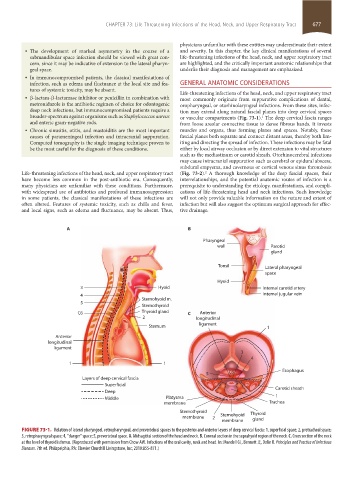
                      deep neck infections, but immunocompromised patients require a   tion may extend along natural fascial planes into deep cervical spaces
                      broader-spectrum against organisms such as Staphylococcus aureus   or vascular compartments (Fig. 73-1).  The deep cervical fascia ranges
                                                                                                     1
                      and enteric gram-negative rods.                     from loose areolar connective tissue to dense fibrous bands. It invests
                        •  Chronic sinusitis, otitis, and mastoiditis are the most important   muscles and organs, thus forming planes and spaces. Notably, these
                      causes of parameningeal infection and intracranial suppuration.   fascial planes both separate and connect distant areas, thereby both lim-
                      Computed tomography is the single imaging technique proven to   iting and directing the spread of infection. These infections may be fatal
                      be the most useful for the diagnosis of these conditions.  either by local airway occlusion or by direct extension to vital structures
                                                                          such as the mediastinum or carotid sheath. Otorhinocerebral infections
                                                                          may cause intracranial suppuration such as cerebral or epidural abscess,
                                                                          subdural empyema, and cavernous or cortical venous sinus thrombosis
                    Life-threatening infections of the head, neck, and upper respiratory tract   (Fig. 73-2).  A thorough knowledge of the deep fascial spaces, their
                                                                                  2
                    have  become  less  common  in  the  post-antibiotic  era.  Consequently,   interrelationships, and the potential anatomic routes of infection is a
                    many physicians are unfamiliar with these conditions. Furthermore,   prerequisite to understanding the etiology, manifestations, and compli-
                    with widespread use of antibiotics and profound immunosuppression   cations of life-threatening head and neck infections. Such knowledge
                    in some patients, the classical manifestations of these infections are   will not only provide valuable information on the nature and extent of
                    often altered. Features of systemic toxicity, such as chills and fever,   infection but will also suggest the optimum surgical approach for effec-
                    and local  signs, such as  edema  and fluctuance, may  be absent. Thus,   tive drainage.


                                   A                                        B
                                                                                 Pharyngeal
                                                                                      wall               Parotid
                                                                                                         gland
                                                                                       Tonsil          Lateral pharyngeal
                                                                                                       space
                                                                                      Hyoid
                                        3                         Hyoid                               Internal carotid artery
                                        4                    Sternohyoid m.                           Internal jugular vein
                                        5
                                                             Sternothyroid
                                       C6                    Thyroid gland  C   Anterior
                                                             2                 longitudinal
                                                               Sternum          ligament               1

                               Anterior
                             longitudinal
                               ligament
                                                                                              3
                                                                                                  4
                                    1                               1

                                                                                  5       C6                Esophagus
                                        Layers of deep cervical fascia
                                                Superficial                                               Carotid sheath
                                                Deep
                                                Middle               Platysma                             1
                                                                    membrane                            Trachea
                                                                         Sternothyroid            Thyroid
                                                                          membrane   2  Sternohyoid
                                                                                        membrane  gland
                    FIGURE 73-1.  Relation of lateral pharyngeal, retropharyngeal, and prevertebral spaces to the posterior and anterior layers of deep cervical fascia: 1, superficial space; 2, pretracheal space;
                    3, retropharyngeal space; 4, “danger” space; 5, prevertebral space. A. Midsagittal section of the head and neck. B. Coronal section in the suprahyoid region of the neck. C. Cross section of the neck
                    at the level of thyroid isthmus. (Reproduced with permission from Chow AW. Infections of the oral cavity, neck and head. In: Mandell GL, Bennett JE, Dolin R. Principles and Practice of Infectious
                    Diseases. 7th ed. Philapelphia, PA: Elsevier Churchill Livingstone, Inc; 2010:855-871.)


            section05_c61-73.indd   677                                                                                1/23/2015   12:48:52 PM

