


Page 947 - Hall et al (2015) Principles of Critical Care-McGraw-Hill
P. 947
678     PART 5: Infectious Disorders


                                                         Dura   Pia

                                                                       Brain abscess

                                        Osteomyelitis

                                         Diploic veins               Epidural abscess
                                                                     Subdural empyema
                                         Frontal sinus
                                                                        Arachnoid meningitis
                                      Ethmoid air cells                       Cavernous sinus
                                                                              thrombosis


                                                                       Sphenoid sinus
                                       Maxillary sinus                            Pituitary  Optic N.
                                                                                              Cavernous
                                                                       Int. Carotid A.        sinus
                                                                                                III
                                                                             V 1
                                                                            V 2                 IV
                                                                            V 3                 VI
                                                                               Sphenoid  Intersphenoid
                                                                                sinuses    septum
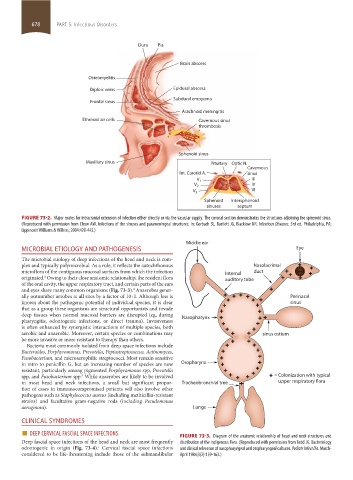
                 FIGURE 73-2.  Major routes for intracranial extension of infection either directly or via the vascular supply. The coronal section demonstrates the structures adjoining the sphenoid sinus.
                 (Reproduced with  permission from Chow AW. Infections of the sinuses and parameningeal structures. In: Gorbach SL, Bartlett JG, Blacklow NR. Infectious Diseases. 3rd ed. Philadelphia, PA:
                 Lippincott Williams & Wilkins; 2004:428-443.)

                                                                         Middle ear
                 MICROBIAL ETIOLOGY AND PATHOGENESIS                                                           Eye
                 The microbial etiology of deep infections of the head and neck is com-
                 plex and typically polymicrobial. As a rule, it reflects the autochthonous     Nasolacrimal
                 microflora of the contiguous mucosal surfaces from which the infection   Internal  duct
                 originated.  Owing to their close anatomic relationship, the resident flora   auditory tube
                         3
                 of the oral cavity, the upper respiratory tract, and certain parts of the ears
                 and eyes share many common organisms (Fig. 73-3).  Anaerobes gener-
                                                       4
                 ally outnumber aerobes at all sites by a factor of 10 : 1. Although less is                 Perinasal
                 known about the pathogenic potential of individual species, it is clear                     sinus
                 that as a group these organisms are structural opportunists and invade
                 deep tissues when normal mucosal barriers are disrupted (eg, during   Nasopharynx
                 pharyngitis, odontogenic infections, or direct trauma). Invasiveness
                 is often enhanced by synergistic interactions of multiple species, both
                 aerobic and anaerobic. Moreover, certain species or combinations may              sinus ostium
                 be more invasive or more resistant to therapy than others.
                   Bacteria most commonly isolated from deep space infections include
                 Bacteroides, Porphyromonas, Prevotella, Peptostreptococcus, Actinomyces,
                 Fusobacterium, and microaerophilic streptococci. Most remain sensitive
                 in vitro to penicillin G, but an increasing number of species are now   Oropharynx
                 resistant, particularly among pigmented Porphyromonas spp, Prevotella
                 spp, and Fusobacterium spp.  While anaerobes are likely to be involved                  = Colonization with typical
                                      5
                 in most head and neck infections, a small but significant propor-  Tracheobronchial tree          upper respiratory flora
                 tion of cases in immunocompromised patients will also involve other
                 pathogens such as Staphylococcus aureus (including methicillin-resistant
                 strains) and facultative gram-negative rods (including  Pseudomonas
                 aeruginosa).                                               Lungs

                 CLINICAL SYNDROMES
                     ■  DEEP CERVICAL FASCIAL SPACE INFECTIONS


                 Deep fascial space infections of the head and neck are most frequently   FIGURE 73-3.  Diagram of the anatomic relationship of head and neck structures and
                                                                       distribution of the indigenous flora. (Reproduced with permission from Todd JK. Bacteriology
                 odontogenic in origin (Fig. 73-4).  Cervical fascial space infections    and clinical relevance of nasopharyngeal and oropharyngeal cultures. Pediatr Infect Dis. March-
                                           1
                 considered to be life-threatening include those of the submandibular   April 1984;3(2):159-163.)


            section05_c61-73.indd   678                                                                                1/23/2015   12:48:56 PM

