


Page 949 - Hall et al (2015) Principles of Critical Care-McGraw-Hill
P. 949
680     PART 5: Infectious Disorders


                             A                                               B                   Cr. Nv. X, XI, XII
                               Int. jugular v.
                               Int. carotid a.           C2
                              Ext. carotid a.  P             5    Digastric                          Prevertebral f.
                                                             4    Stylopharyngeus  P           5
                               Internal                      3    Stylohyoid                    4    Alar f.
                               pterygoid m.         T             Styloglossus                 3     Middle layer
                                                                                                     deep cervical f.
                                Masseter m.       M                                          T       Sympathetic
                                 Superior                                                            ganglion
                                 constrictor m.                             Post.
                                                                             c.
                                   Buccinator m.                            Ant.
                                                                             c.
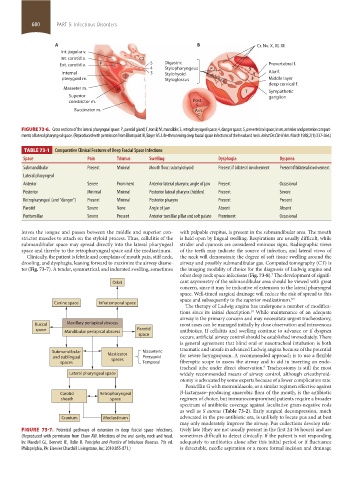
                 FIGURE 73-6.  Cross sections of the lateral pharyngeal space: P, parotid gland; T, tonsil; M, mandible; 3, retropharyngeal space; 4, danger space; 5, prevertebral space; Inset, anterior and posterior compart-
                 ments of lateral pharyngeal space. (Reproduced with permission from Blomquist IK, Bayer AS. Life-threatening deep fascial space infections of the head and neck. Infect Dis Clin N Am. March 1988;2(1):237-264.)

                   TABLE 73-1    Comparative Clinical Features of Deep Fascial Space Infections
                  Space                 Pain      Trismus    Swelling               Dysphagia            Dyspnea
                  Submandibular         Present   Minimal    Mouth floor; submylohyoid  Present if bilateral involvement  Present if bilateral involvement
                  Lateral pharyngeal
                  Anterior              Severe    Prominent  Anterior lateral pharynx; angle of jaw  Present  Occasional
                  Posterior             Minimal   Minimal    Posterior lateral pharynx (hidden)  Present  Severe
                  Retropharyngeal (and “danger”)  Present  Minimal  Posterior pharynx  Present           Present
                  Parotid               Severe    None       Angle of jaw           Absent               Absent
                  Peritonsillar         Severe    Present    Anterior tonsillar pillar and soft palate  Prominent  Occasional

                 leaves the tongue and passes between the middle and superior con-  with palpable crepitus, is present in the submandibular area. The mouth
                 strictor muscles to attach on the styloid process. Thus, cellulitis of the   is held open by lingual swelling. Respirations are usually difficult, while
                 submandibular space may spread directly into the lateral pharyngeal   stridor and cyanosis are considered ominous signs. Radiographic views
                 space and thereby to the retropharyngeal space and the mediastinum.  of the teeth may indicate the source of infection, and lateral views of
                   Clinically, the patient is febrile and complains of mouth pain, stiff neck,   the neck will demonstrate the degree of soft tissue swelling around the
                 drooling, and dysphagia, leaning forward to maximize the airway diame-  airway and possibly submandibular gas. Computed tomography (CT) is
                 ter (Fig. 73-7). A tender, symmetrical, and indurated swelling, sometimes   the imaging modality of choice for the diagnosis of Ludwig angina and
                                                                       other deep neck space infections (Fig. 73-8).  The development of signifi-
                                                                                                      7
                                                Orbit                  cant asymmetry of the submandibular area should be viewed with great
                                                                       concern, since it may be indicative of extension to the lateral pharyngeal
                                                                       space. Well-timed surgical drainage will reduce the risk of spread to this
                                                                       space and subsequently to the superior mediastinum. 8,9
                            Canine space    Infratemporal space
                                                                         The therapy of Ludwig angina has undergone a number of modifica-
                                                                       tions since its initial description.  While maintenance of an adequate
                                                                                               10
                                                                       airway is the primary concern and may necessitate urgent tracheostomy,
                      Buccal     Maxillary periapical abscess          most cases can be managed initially by close observation and intravenous
                      space     Mandibular periapical abscess  Parotid  antibiotics. If cellulitis and swelling continue to advance or if dyspnea
                                                         space
                                                                       occurs, artificial airway control should be established immediately. There
                                                                       is general agreement that blind oral or nasotracheal intubation is both
                                                                       traumatic and unsafe in advanced Ludwig angina because of the potential
                            Submandibular      Masticator  Masseteric
                            and sublingual      spaces    Pterygoid    for severe laryngospasm. A recommended approach is to use a flexible
                              spaces                      Temporal     fiberoptic scope to assess the airway and to aid in inserting an endo-
                                                                       tracheal tube under direct observation.  Tracheostomy is still the most
                                                                                                    9
                                 Lateral pharyngeal space              widely recommended means of airway control, although cricothyroid-
                                                                       otomy is advocated by some experts because of a lower complication rate.
                                                                         Penicillin G with metronidazole, or a similar regimen effective against
                              Carotid       Retropharyngeal            β-lactamase–producing anaerobic flora of the mouth, is the antibiotic
                               sheath          space                   regimen of choice, but immunocompromised patients require a broader
                                                                       spectrum of antibiotic coverage against facultative gram-negative rods
                                                                       as well as S aureus (Table 73-2). Early surgical decompression, much
                               Cranium       Mediastinum               advocated in the pre-antibiotic era, is unlikely to locate pus and at best
                                                                       may only moderately improve the airway. Pus collections develop rela-
                 FIGURE 73-7.  Potential pathways of extension in deep fascial space infections.   tively late (they are not usually present in the first 24-36 hours) and are
                 (Reproduced with permission from Chow AW. Infections of the oral cavity, neck and head.   sometimes difficult to detect clinically. If the patient is not responding
                 In: Mandell GL, Bennett JE, Dolin R.  Principles and Practice of Infectious Diseases. 7th ed.   adequately to antibiotics alone after this initial period or if fluctuance
                 Philapelphia, PA: Elsevier Churchill Livingstone, Inc; 2010:855-871.)  is detectable, needle aspiration or a more formal incision and drainage


            section05_c61-73.indd   680                                                                                1/23/2015   12:49:07 PM

