


Page 948 - Hall et al (2015) Principles of Critical Care-McGraw-Hill
P. 948
CHAPTER 73: Life-Threatening Infections of the Head, Neck, and Upper Respiratory Tract  679


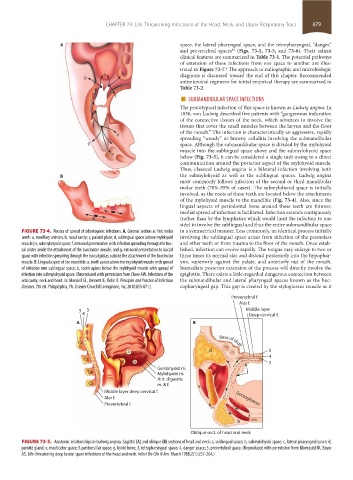
                                 A                                        space, the lateral pharyngeal space, and the retropharyngeal, “danger,”
                                                                          and  prevertebral  spaces   (Figs. 73-1, 73-5,  and 73-6).  Their  salient
                                                                                           36
                                                                          clinical features are summarized in Table 73-1. The potential pathways
                                                                          of extension of these infections from one space to another are illus-
                                                                          trated in Figure 73-7.  The approach to radiographic and microbiologic
                                                                                         6
                                                a     b                   diagnosis is discussed toward the end of this chapter. Recommended
                                         g
                                                                          antimicrobial regimens for initial empirical therapy are summarized in
                                                                          Table 73-2.
                                                   c                          ■  SUBMANDIBULAR SPACE INFECTIONS
                                            f                             The prototypical infection of this space is known as Ludwig angina. In
                                                                          1836, von Ludwig described five patients with “gangrenous induration
                                                                          of the connective tissues of the neck, which advances to involve the
                                                                          tissues that cover the small muscles between the larynx and the floor
                                                                          of the mouth.” The infection is characteristically an aggressive, rapidly
                                                    d
                                                                          spreading “woody” or brawny cellulitis involving the submandibular
                                          g                               space. Although the submandibular space is divided by the mylohyoid
                                                                          muscle into the sublingual space above and the submylohyoid space
                                                  e
                                                                          below (Fig. 73-5), it can be considered a single unit owing to a direct
                                                                          communication around the posterior aspect of the mylohyoid muscle.
                                                                          Thus, classical Ludwig angina is a bilateral infection involving both
                                 B                                        the submylohyoid as well as the sublingual spaces. Ludwig angina
                                                                          most commonly follows infection of the second or third mandibular
                                                                          molar teeth (70%-85% of cases). The submylohyoid space is initially
                                                                          involved, as the roots of these teeth are located below the attachments
                                                                          of the mylohyoid muscle to the mandible (Fig. 73-4). Also, since the
                                                                          lingual aspects of periodontal bone around these teeth are thinner,
                                                  a
                                                                          medial spread of infection is facilitated. Infection extends contiguously
                                            b                             (rather than by the lymphatics which would limit the infection to one
                                                                          side) to involve the sublingual and thus the entire submandibular space
                    FIGURE 73-4.  Routes of spread of odontogenic infections. A. Coronal section at first molar   in a symmetrical manner. Less commonly, an identical process initially
                    teeth: a, maxillary antrum; b, nasal cavity; c, palatal plate; d, sublingual space (above mylohyoid   involving the sublingual space arises from infection of the premolars
                    muscle); e, submylohyoid space; f, intraoral presentation with infection spreading through the buc-  and other teeth or from trauma to the floor of the mouth. Once estab-
                    cal plates inside the attachment of the buccinator muscle; and g, extraoral presentation to buccal   lished, infection can evolve rapidly. The tongue may enlarge to two or
                    space with infection spreading through the buccal plates outside the attachment of the buccinator   three times its normal size and distend posteriorly into the hypophar-
                    muscle. B. Lingual aspect of the mandible: a, tooth apices above the mylohyoid muscle with spread   ynx, superiorly against the palate, and anteriorly out of the mouth.
                    of infection into sublingual space; b, tooth apices below the mylohyoid muscle with spread of   Immediate posterior extension of the process will directly involve the
                    infection into submylohyoid space. (Reproduced with permission from Chow AW. Infections of the   epiglottis. There exists a little-regarded dangerous connection between
                    oral cavity, neck and head. In: Mandell GL, Bennett JE, Dolin R. Principles and Practice of Infectious   the submandibular and lateral pharyngeal spaces known as the buc-
                    Diseases. 7th ed. Philapelphia, PA: Elsevier Churchill Livingstone, Inc; 2010:855-871.)  copharyngeal gap. This gap is created by the styloglossus muscle as it
                                                                                           Prevertebral f.
                                                                                              Alar f.
                                       5  3                                                     Middle layer
                                        4                                                          Deep cervical f.
                                      A                                       B


                                       C2                                              Base of skull
                                                        a                          d                    5
                                                                                                        4
                                         C3           g   b                                             3
                                                                  Geniohyoid m.
                                          C4                      Mylohyoid m.                  f
                                                                  Ant. digastric
                                          C5                      m. & f.       e
                                                Middle layer deep cervical f.
                                                Alar f.                                 c    Genioglossus
                                                Prevertebral f.
                                                                                                 a
                                                                                             b
                                                                             Oblique sect. of head and neck
                    FIGURE 73-5.  Anatomic relationships in Ludwig angina. Sagittal (A) and oblique (B) sections of head and neck: a, sublingual space; b, submylohyoid space; c, lateral pharyngeal space; d,
                    parotid gland; e, masticator space; f, peritonsillar space; g, hyoid bone; 3, retropharyngeal space; 4, danger space; 5, prevertebral space. (Reproduced with permission from Blomquist IK, Bayer
                    AS. Life-threatening deep fascial space infections of the head and neck. Infect Dis Clin N Am. March 1988;2(1):237-264.)


            section05_c61-73.indd   679                                                                                1/23/2015   12:49:04 PM

