


Page 962 - Hall et al (2015) Principles of Critical Care-McGraw-Hill
P. 962
CHAPTER 74: Soft Tissue Infections  693


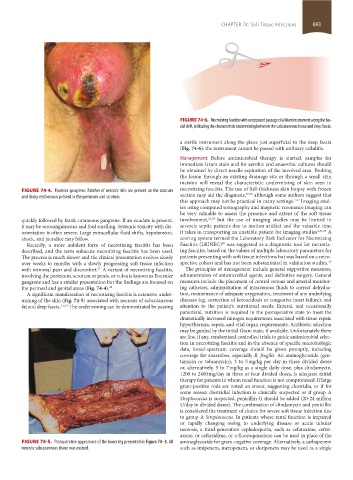
                                                                          FIGURE 74-6.  Necrotizing fasciitis with unopposed passage of a blunt instrument along the fas-
                                                                          cial cleft, indicating the characteristic undermining between the subcutaneous tissue and deep fascia.

                                                                          a sterile instrument along the plane just superficial to the deep fascia
                                                                          (Fig. 74-6); the instrument cannot be passed with ordinary cellulitis.
                                                                          Management:  Before  antimicrobial  therapy is  started,  samples  for
                                                                          immediate Gram stain and for aerobic and anaerobic cultures should
                                                                          be obtained by direct needle aspiration of the involved area. Probing
                                                                          the lesion through an existing drainage site or through a small skin
                                                                          incision will reveal the characteristic undermining of skin seen in
                    FIGURE 74-4.  Fournier gangrene. Patches of necrotic skin are present on the scrotum   necrotizing fasciitis. The use of full-thickness skin biopsy with frozen
                                                                                                35,36
                    and dusky erythema is present in the perineum and scrotum.  section may aid the diagnosis,   although some authors suggest that
                                                                          this approach may not be practical in many settings. 1,37  Imaging stud-
                                                                          ies using computed tomography and magnetic resonance imaging can
                                                                          be very valuable to assess the presence and extent of the soft tissue
                    quickly followed by frank cutaneous gangrene. If an exudate is present,   involvement, 23,24  but the  use of imaging studies  may  be limited in
                    it may be serosanguineous and foul smelling. Systemic toxicity with dis-  severely septic patients due to motion artifact and the valuable time
                    orientation is often severe. Large extracellular fluid shifts, hypotension,   it takes in transporting an unstable patient for imaging studies 1,31,37  A
                    shock, and jaundice may follow.                       scoring system termed the Laboratory Risk Indicator for Necrotizing
                                                                                        38
                     Recently, a more indolent form of necrotizing fasciitis has been   Fasciitis (LRINEC)  was suggested as a diagnostic tool for necrotiz-
                    described, and the term subacute necrotizing fasciitis has been used.   ing fasciitis, based on the values of multiple laboratory parameters for
                    The process is much slower and the clinical presentation evolves slowly   patients presenting with soft tissue infections but was based on a retro-
                    over weeks to months with a slowly progressing soft tissue infection   spective cohort and has not been substantiated in validation studies. 37
                    with minimal pain and discomfort.  A variant of necrotizing fasciitis,   The principles of management include general supportive measures,
                                              31
                    involving the perineum, scrotum or penis, or vulva is known as Fournier   administration of antimicrobial agents, and definitive surgery. General
                    gangrene and has a similar presentation but the findings are focused on   measures include the placement of central venous and arterial monitor-
                    the perineal and genital areas (Fig. 74-4). 34        ing catheters, administration of intravenous fluids to correct dehydra-
                     A significant manifestation of necrotizing fasciitis is extensive under-  tion, maintenance of adequate oxygenation, treatment of any underlying
                    mining of the skin (Fig. 74-5) associated with necrosis of subcutaneous   diseases (eg, correction of ketoacidosis or congestive heart failure), and
                    fat and deep fascia. 1,5,31  The undermining can be demonstrated by passing   attention to the patient’s  nutritional  needs.  Enteral,  and  occasionally
                                                                          parenteral, nutrition is required in the postoperative state to meet the
                                                                          dramatically increased nitrogen requirements associated with tissue repair,
                                                                          hyperthermia, sepsis, and vital organ requirements. Antibiotic selection
                                                                          may be guided by the initial Gram stain, if available. Unfortunately there
                                                                          are few, if any, randomized controlled trials to guide antimicrobial selec-
                                                                          tion in necrotizing fasciitis and in the absence of specific microbiologic
                                                                          data,  broad-spectrum  coverage  should  be  given  promptly,  including
                                                                          coverage for anaerobes, especially B. fragilis. An aminoglycoside (gen-
                                                                          tamicin or tobramycin), 3 to 5 mg/kg per day in three divided doses
                                                                          or, alternatively, 5 to 7 mg/kg as a single daily dose, plus clindamycin,
                                                                          1200 to 2400 mg/day in three or four divided doses, is adequate initial
                                                                          therapy for patients in whom renal function is not compromised. If large
                                                                          gram-positive rods are noted on smear, suggesting clostridia, or if for
                                                                          some reason clostridial infection is clinically suspected or if group A
                                                                          Streptococcus is suspected, penicillin G should be added (20-24 million
                                                                          U/day in divided doses). The combination of clindamycin and penicillin
                                                                          is considered the treatment of choice for severe soft tissue infection due
                                                                          to group A Streptococcus. In patients whose renal function is impaired
                                                                          or rapidly changing owing to underlying disease or acute tubular
                                                                          necrosis,  a third-generation cephalosporin, such  as cefotaxime, ceftri-
                                                                          axone, or ceftazidime, or a fluoroquinolone can be used in place of the
                    FIGURE 74-5.  Postoperative appearance of the lower leg presented in Figure 74–3. All     aminoglycoside for gram-negative coverage. Alternatively, a carbapenem
                    necrotic subcutaneous tissue was excised.             such as imipenem, meropenem, or doripenem may be used as a single


            section05_c74-81.indd   693                                                                                1/23/2015   12:37:25 PM

